

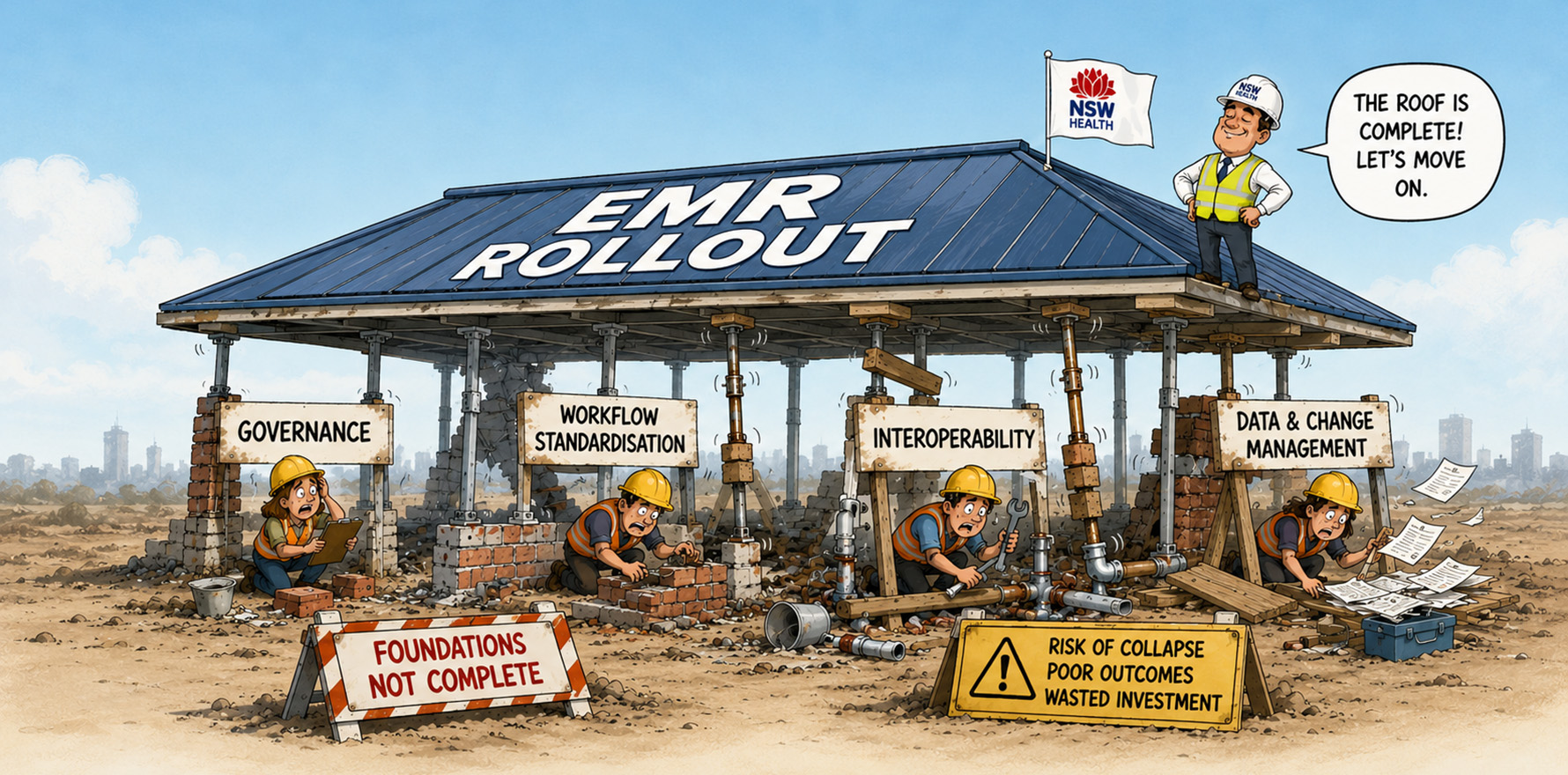
Doing things in the right order is important to long-term success. NSW has gone about it barse-ackwards.
Hunter New England LHD has just gone live with the Epic single digital patient record in a process senior managers have lauded as generational, and the frontline workers have called badly planned and poorly managed.
Australia has normalised structural gaps in healthcare; we treat overlooked governance, workflow inconsistency, missing integration layers, and violating dependency order as routine background noise rather than as the design failures they are.
That normalisation is the real risk.
NSW won’t “fail to implement an EMR”; it will succeed in delivering the most expensive possible version of getting the sequence wrong.
A $2 billion system doesn’t fall over because of the technology. It falls over because the foundational work – like standardising clinical workflows, building integration infrastructure, and establishing effective governance across hospital districts – was not done in the order required for it to hold.
And architecture, unlike politics, does not forgive you for rearranging the steps once the build has already begun.
To be clear, eHealth NSW isn’t wrong about the destination; a single, jurisdiction‑wide EMR makes commercial and operational sense.
And context matters: US EMRs are architected and commercially optimised for 500 to 1000-bed hospitals operating under a single governance structure. Most Australian public hospitals sit under 200 beds, with regional and rural sites far smaller.
For decades, we’ve been paying for platforms designed for institutions three to five times our size. Therefore, stretching a single instance across an entire jurisdiction, rather than paying for an-instance-per-site, is a logical correction.
But NSW isn’t the first to come up this idea. It is, however, arguably the largest single-EMR statewide rollout globally. Parts of the US, UK and the Nordic health systems have gone down this path; just very, very differently.
Other programs deploying a single system across a landscape understood that they needed to get four layers right, and in a specific order, before a vendor was ever engaged.
The EMR is the final of the four; it is the layer clinicians interact with, the one that receives the funding and the headlines.
Before the EMR, there is an integration backbone capable of routing clinical messages reliably between the EMR and every other system, medical device, pathology network, and general practice in the estate.
Before the integrations backbone, there needs to be workflow standardisation: a slow, clinician-led governance process. Negotiating every locally‑defined nuance of clinical practice; what a sepsis escalation pathway will look like across 15 local health districts with 15 different ways of doing things.
There are deterioration and escalation pathways (which differ by local thresholds and escalation authority), medication safety workflows (with site‑specific titration rules and monitoring practices), ED triage and acute care pathways (where the national framework exists but real‑world application varies by culture, staffing and streaming models), diagnostic ordering and result‑follow‑up responsibilities (which shift between wards, specialties and LHDs), and more.
And enabling all of it, is governance. The structure that gives those 15 LHDs genuine co-ownership of decisions that shape how care is delivered.
These four layers have different design principles, different timelines, and different owners. When they run in sequence, each one forms the stable foundation for the subsequent phase.
When they all run at the same time, the program collapses under the weight of unresolved variation, conflicting decision rights, and technical debt (or stress) that gets pushed directly on to clinicians.
The NSW Audit Office confirmed that the 2021 business case for the SDPR excluded the cost of integrating the new system with legacy platforms remaining in use; which is to say, the business case excluded the cost of the second layer listed above.
- Epic was contracted in October 2023;
- The Rhapsody integration engine; the connective tissue routing every clinical message between Epic and every remaining system in the estate; was contracted in July 2025, 21 months later;
- The RLDatix Galen data migration and archive solution, responsible for historical records, arrived in November 2025, two years after the primary contract;
- The Hyland clinical document management system, covering functionality Epic is known to not handle natively, was contracted in January 2026.
None of these represent unusual vendors or unknown requirements; they are standard components of any EMR program – considerations that should have been in the original business case.
Their absence is not an accounting oversight. It is confirmation that the requirements of a program of this scale were not fully understood when the core architectural decision was locked in.
Also in today’s edition:
- Duckett review recommends sacking Cohealth board
- Exclusive: ‘I can’t keep doing this. I need help’: Cohealth GP
- Butler’s own NDIS advisory body urges reform bill rejection
- Government leans in to regulating ‘excessive’ specialist fees
- Stoush over PHI rebate changes in estimates
- Wake up Jeff: Australia is going way too slow on medical data and AI
- DoHDA to spend $18m on review of controversial assessment algorithm
- Inspector-General says aged care reform risks are being ‘magnified’
To understand what sufficient preparation actually looks like, the Nordic jurisdictions provide the most instructive reference; a concrete operational precedent.
Between 2002 and 2007, the Finnish government built national health information infrastructure from the ground up.
There was new legislation for ePrescription, patient access, and archiving; the Kanta services; prescription centre, patient data repository, a citizen portal constructed on HL7 v3 CDA R2 standards, and mandated across the entire public system; and a health information exchange that gave every hospital and primary care clinic a common data backbone.
All done before an EMR vendor was ever involved in a single configuration decision.
By 2015, Finland had achieved 100% EMR coverage across all public primary and secondary care.
The contract with Epic didn’t come until 2016, providing an EMR solution finally sitting atop an interoperability layer that had been in place at a national scale for nearly a decade.
That is 14 years of foundational work, before a single line of Epic configuration was written.
Denmark took a shorter but structurally equivalent path, but also invested years in policy-driven clinical workflow standardisation and governance reform before they went live across 12 hospitals and 2.6 million people.
That is what adequate preparation looks like. And at a fraction of the NSW footprint.
NSW managed roughly six years from concept to first major go-live, focused largely on vendor evaluation and procurement.
The distinction that matters is not how long each jurisdiction took, but what they produced – legislation, a national data exchange, universal coverage, and a governance and interoperability foundation robust enough to support a single instance EMR without collapsing under its own complexity.
The Nordics asked what the dependencies were.
NSW asked which vendor to select.
The fruits of this labour were confirmed at the Hunter New England LHD go-live on Wednesday 27 May.
The EMR had been configured on top of inconsistent and unresolved processes, which then gets amplified into operational confusion, clinician burden, and downstream data quality issues.
Frontline workers reported on record that admission processes were unclear at go-live, that responsibilities between nursing and clerical staff was unresolved, and that emergency department workflows did not align with what the system required.
These are not edge cases; they are the daily operations of a hospital. They were absent because the governance work of agreeing them had not been completed before the system was configured.
The stop-work meetings, demands for independent workplace health and safety reviews, a staff member hospitalised with stress, frontline workers at HNELHD operating until 1:15am before a 7am return – this is what architectural debt looks like when it is carried by people.
The issues with sequencing and consideration of dependencies are transferred to the humans responsible for closing it in real time, at the expense of their own wellbeing and at the cost of the clinical readiness that go-live required.
The implications go beyond go-live.
A unified database is not the same as a single source of truth, and the distinction matters for everything the SDPR is meant to deliver in its second decade.
The clinical intelligence the SDPR implicitly promises; deterioration prediction, pathway optimisation, AI-assisted care at population scale – depends on having a dataset that is not only stored in one place, but means the same thing everywhere.
If the underlying workflows and configurations differ, the data will encode those differences. AI models trained on that data will learn the artefacts of inconsistent configuration.
That is not a technology problem that we can easily solve when the AI layer arrives; it is a sequencing problem that must be solved now.
Related



Once all LHDs are live on divergent encodings, the cost of going back and harmonising that data is incomparable to the cost of getting the sequence right before each district is configured.
NSW effectively committed to a vendor-led rollout without fully understanding or sequencing the dependencies, meaning current failures are predictable outcomes of design and governance decisions rather than technical shortcomings.
Fourteen LHD go‑lives remain, and each one is an opportunity to correct the sequence the program did not begin with.
Continuing without correcting this sequence will only compound costs, operational strain, and future limits on things like analytics and AI. It determines whether NSW ends up with a system that works or one that simply costs a lot.
The next phase requires people who understand the architecture well enough to stop compounding the debt, and who understand that the workforce cannot continue carrying the consequences of mis sequenced decisions made far above their heads.
Alina Alecu is a former clinician and health system consultant, working domestically and internationally. She is building Altheae, an AI-native platform for longitudinal care across distributed health systems.