

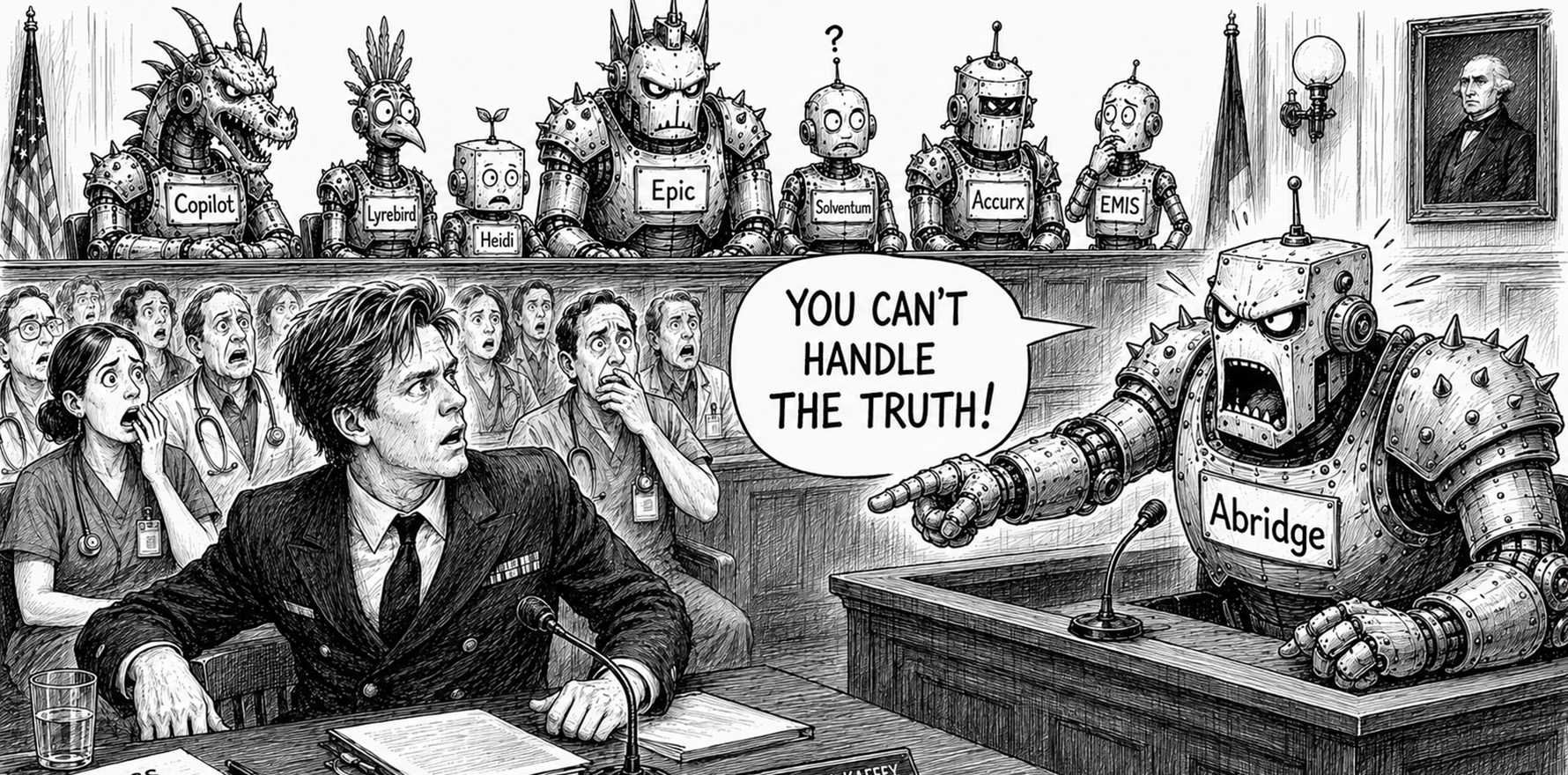
A massively competitive AI scribe market pitting large EMR incumbents and enterprise AI vendors against disruptive fast growing challengers in a race for the future of a clinicians daily workflow seems to have an early casualty: evidence and truth.
Early last week Heidi announced that NHS England Midlands had named them as the sole supplier on a new regional procurement framework for AI-powered ambient voice technology (AVT) in a press release titled “NHS launches largest ever AI clinical document procurement covering 70,000 Midland clinicians”.
It was quite a big deal in England’s consumer press. BBC Midlands TV even reported it as major breakthrough for the NHS in reducing its’ doctors workload (six minutes per consultation) and patient communication backlog (from six months to 14 days).
The detail of the deal in actual press release is sparse, but it does say that:
- It is the largest procurement of its kind in NHS history;
- Heidi was selected as the “sole supplier through a competitive process”;
- The deal framework covers 15 acute and community NHS Trusts, encompassing 1239 GP practices;
- In a “real world” pilot, it cut a six-month rheumatology backlog to 14 days and “reduced emergency care documentation by 80%”.
Anyone reading the release could be forgiven for quickly making some assumptions about the importance and value of this deal, and then about the market position and success of Heidi.
And likely most of those assumptions would be wrong.
Only one of the above three points of detail – results from the pilot – is an accurate representation of what has happened. But even the reporting of the pilot results is misleading in various ways because the pilot, while conducted by an NHS Trust, wasn’t rigorous or subject to any peer review.
Before we go on here, it’s important to note that we are picking this release from Heidi purely as one example of the sort of AI healthcare vendor PR and comms voodoo we are starting to witness.
Heidi is neither the biggest nor the worst practitioner of this new style of medical software marketing comms positioning.
Indeed, as big as we see Heidi in Australia, on a recent Becker report listing the share of top global AI healthcare plays, Heidi only makes it into the bundle of “other” 7% at the end of in the top 10 list.
Abridge, founded about the same time as Heidi in the US, is reported to have about 30% of the entire global AI scribe market and is valued at US$5.3 billion, coming in second after the Microsoft DAX at 33% (born of a big incumbent) and after that the list goes Ambience Healthcare 13%, Suki 10%, Freed 4%, Nabla 4% and “other” 7%.
Heidi’s current valuation is US$465 million.
The new style of marketing and communications that we are now seeing is not what clinicians and healthcare provider institution management are used to in this sector.
It’s new and it’s disturbing. But not surprising given the valuations of the new companies in play, and the fact that all these companies are looking to take big bites out of a global US$37 billion plus incumbent EMR market.
Healthcare remained stubbornly resistant to the sort of rapid and large technological advances we saw in other markets through the expansion of cloud platforms and technology after the early 2000s because of its complexity, government funding, oversight and regulation, very high risk and safety profile, and, the culture of doctors – an artifact of the asymmetric knowledge gap between a doctor and a patient in medicine that has underpinned healthcare for centuries.
AI, in particular, has now broken down most of these resisting forces in healthcare and the step change is seismic because not only is the sector experiencing all the AI razzamatazz that other sectors are experiencing today, it’s catching up on its conservative siloed and non-interoperable past.
A lot of this change so far feels far more good than bad.
AI scribes have already radically altered the patient and doctor patient experience for the better, and they haven’t really even got going yet. Upstream agentic AI in healthcare organisations promises to be even more game changing, both for the patient and the provider.
But good nearly always comes with some bad.
Until now, the healthcare sector as a market has been among the most evidence and peer review-based markets in the world. Even medical software platform providers tended to follow this creed.
Not so much now.
To support the funding and valuations of the key challenger start-ups leading this transformation has come an apparent need for a lot more buzz and hype.
A company’s valuation isn’t set by what it can prove today, it’s set by what enough credible people are willing to say it might become.
So, we are being pitched a lot more on the “vibe”, “using our imagination” and “the possible future” as concepts we have to be taking into consideration in investment and purchasing.
Heidi’s Midlands contract announcement is an example of what can go on in the wider AI healthcare community these days.
It’s not the worst example by far, just a recent one.
Although it’s still a relative minnow in the global AI scribe wars, Heidi has still managed to put a reasonably large target on its back by announcing itself as a global play that intends to be the “all in one clinician workflow stack” and “own the clinicians workflow.”
Without a way into the EMR incumbent market Heidi’s core strategy is to flood the clinician zone with the utility of its product fast and early until so many doctors depend on a single workspace (the Heidi workspace) for their notes, live clinical reasoning and automated admin and payments so that the friction of switching is too high and the love so great that groups of doctors can influence procurement in larger healthcare institutions to force EMR integration.
It’s a good strategy given what Heidi has to work with and against – incumbent EMRs and a lot better funded scribe plays out of the US and Europe.
But it’s apparently not enough to avoid the temptation to “boost” in the manner they have with their Midlands announcement.
“Boosting” has become an integral component of the larger AI funding and investment ecosystem. “Boosters” are the parts of the ecosystem that pump up the hype around a company in order to establish a believable and high growth trajectory, in order to maintain and improve valuation.
Just like the LLM frontier AI plays – ChatGPT and Claude – Heidi has an expensive growth runway (in relative terms at least) it has to feed if it is going to make it to its next round of funding and fight against much better funded global compettitors.
The Midlands announcement is a reasonable example of “boosting”.
It’s about supporting an image of success, not informing the market with “evidence” of its product’s actual success and prowess, with a view to maintaining and improving the perception of future value.
Which is why clinicians and healthcare provider organisations need to reset their bullshit meters quite a bit from what they might have been even a year ago.
Also in today’s edition:
- Fresh anonymous accounts paint troubling picture inside SDPRIA
- Government narrows NDIS budget-cut powers after Senate backlash
- Honeysuckle’s sting: insurers and hospitals clash over ACCC application
- TGA, medtechs defend device approval system after 60 Minutes story
- ‘We’re too important to fail’: community health sector
- Qld Health’s IVF guidance doesn’t define lesbians as family, limits donor access
- DoHDA held private meetings with tobacco giants over new health warning rules
Look for rigour and evidence
You don’t have to dive particularly deep past the language and framing of the Heidi Midlands announcement to gain a more accurate picture of what the Midlands deal actually means.
A couple of things stand out at the start.
Heidi says it was “selected as the sole supplier through a competitive process”.
Technically it was: Heidi won a formal tender with an NHS trust to be tested as a pilot and was subsequently approved for procurement following what we are told was a successful pilot.
But Heidi was the only scribe that was in the pilot and we don’t even know if any other groups competed against it to win that tender.
All the communications on this aspect of the procurement win read like Dudley Group NHS Foundation Trust ran a panel of scribes to come out with the best one, which of course they didn’t.
Did the Dudley Trust run a good procurement process on behalf of the Midlands here?
Not really no.
We aren’t told much about the tender process, including if any other groups tendered and why Heidi was selected against any other group and the pilot only tested one scribe and then in a very limited and non-transparent manner.
You can’t find any published independent pilot design methodology or predefined sample or outcome measures set before the tool was deployed, there is no peer review of the trial and although it’s an NHS Trust doing the pilot, it is not an NHS England-commissioned evaluation team.
That’s not Health Services Daily getting picky. It’s how some other NHS scribe pilot trials have actually been run in other regions.
Why such a bad process?
It’s likely a direct result of the pressure that all the NHS trusts are under to get some productivity going within their doctor communities and to prioritise ambient scribe technology where they can.
We asked Heidi directly whether the procurement was genuinely competitive, and a spokesperson told us that “Heidi was selected as sole supplier through a competitive procurement”.
“The framework is the assured route for the 15 trusts and all ICBs in the region that opted in – any clinician within those organisations can be onboarded to Heidi through it and use the platform in their practice.”
Another blurring of meaning though omission in the Midlands announcement is that it comes across a little like Heidi has won a contract to supply 70,000 doctors and 1239 GP practices.
It hasn’t.
It has won the approval of a local set of Trusts for any doctor or practice in the Trust to choose Heidi, and not have to go through a whole lot of bureaucratic hoops to get approval for any other scribe.
It’s a big advantage for Heidi in the Trusts who have approved it, sure, but on day one, Heidi has no revenue and has to convince practices and doctors one by one to adopt them and pay their license.
Another potentially important piece of detail left out: only five of the 15 Trusts in Midlands have actually formally agreed to roll out this deal so far. It’s unclear what the other 10 Trusts are going to do and why all the Trusts included in the announcement aren’t going ahead straight away.
Heidi told us this:
“All 15 trusts and all Midlands ICBs opted into the framework when it was set up. Five trusts, including The Dudley Group NHS Foundation Trust, Sandwell and West Birmingham NHS Trust, The Royal Wolverhampton NHS Trust and Walsall Healthcare NHS – progressed to deployment in May. The remaining trusts have the framework available to them and will be implemented in phases.”
Okay, looks promising based on what Heidi is telling us for those other 10 Trusts.
Why didn’t the other 10 Trusts fold in with the first five, though? No one really knows at this point of time, but if you believe Heidi’s statement there are no further questions to be asked about the remaining 10 Trusts.
Without those 10 Trusts actually committed yet, the 70,000 clinicians and 1236 GP practices claim isn’t technically correct.
As things stand so far, it’s really only one-third of the 70,000 doctors claimed to be in the procurement who are in play, or 23,100, and even those aren’t actually committed contractually in any way to Heidi. They can choose another scribe if they really want, they just have to go through the compliance and regulatory checking protocol work to do that.
This makes the Midlands deal essentially an “opt-in” arrangement that Heidi now has to work on to get practices onboarded and paying for a license.
That might have been useful to explain.
Lastly, there is a vital point in the Midlands deal that has so far not been mentioned anywhere publicly that we can see.
Heidi does not deeply integrate to the patient record with any of the major patient management systems – the underlying EMRs – in the scope of the procurement.
It’s probably the most important thing that should have been alerted for anyone interested in how Heidi works with underlying EMRs, which it can, if an EMR is prepared to grant it access.
Asked directly whether Heidi would have deep integration to the patient record on the EMRs in scope of the contract, the company’s response was that it “has strong integrations with several of the most used EMRs across the Midlands”.
The company doesn’t name which system(s) it might integrate with but more importantly it fails to specify if that means native write-back to the underlying EMRs of the kind that a major competitor to Heidi in the UK – Accurx – has built for EMIS and SystemONE.
Native EMR integration is Heidi’s biggest strategic problem globally. It’s the biggest problem for every new AI scribe and clinician workflow layer play. They probably should have mentioned what was happening in this aspect of the contract because it’s what everyone is interested in better understanding.
Related



In terms of assessing deal success and mechanics in the UK it is worthwhile comparing the 23,100 potential doctors in the Heidi Midlands procurement as it stands today with the Lyrebird South West London contract for hospital doctors at four NHS Trusts – St George’s University Hospitals, Epsom and St Helier University Hospitals, Croydon Health Services, and Kingston and Richmond NHS Foundation Trust.
This contract was for up to 20,000 clinicians over four years, staged deliberately with 10,000 onboarded in year one, scaling to 20,000 by year four. That’s a committed number of doctor seats in the procurement at the start, not a ceiling figure from which doctors can “opt in”.
Croydon Health Services has been awarded a separate UK£379,743, five-month contract specifically to support the Lyrebird deployment. The money component of the overall deal with Lyrebird is not public but the licenses are real so someone can at least do a back of an envelope calculation on it.
Notably, all four trusts share Oracle Cerner Millennium as their electronic patient record and Lyrebird is reportedly natively integrated into it including real-time patient demographic and medication syncing, direct write-back of clinical notes and care plans through Cerner’s MPage framework, and, notably, automated clinical coding and referral-to-treatment automation layered on top of the scribe itself.
The coding and RTT automation piece is described as a UK first. It technically means a clinician at one of these four trusts isn’t copy-pasting anything. The note, the coding, and the referral tracking should all happen inside the record they’re already working in if we can trust the reporting.
Detail like this would be pretty important for a group like NSW Health who is assessing Lyrebird and Heidi to potentially be part of a panel of scribes for 6000 clinicians across the state’s 15 LHD network.
Heidi claims to have created direct integration with “Epic using SMART on FHIR to generate documentation and write it back to the patient record… launched from the patient chart as an embedded panel… structured to align with Epic templates,” although it is yet to score a contract with a US hospital where such integration can be tested like it will likely be in the London hospital Lyrebird deal.
On spec the Lyrebird deal is the better deal if you’re thinking about valuation, but you wouldn’t think that from the press release and LinkedIn coverage of Midlands announcement..
But this is game being played: it’s about what investors think you’re worth into the future not what you’re actually worth on paper today.
Find the real story – there’s a lot of fluff
To date, Heidi has generally been reported as an above average scribe experience.
Heidi reports that it has significant market share in the UK and Australia of AI scribes but it has never reported its actual user numbers, free or otherwise, so it’s not that easy to establish just how big it is relative to other products in any country. Neither has its local competitor Lyrebird.
In Australia the most reliable scribe use survey to date (HealthEd) reports that one in five GPs use a scribe regularly, and of that 46% use Heidi. If we include registered GPs, registrars and non-VR GPs, that amounts to only 3680 regular heavy users.
Heidi announced a recent deal in Canada with one of the top three EMRs for physicians in that country which reports a share of 26% and 25,000 user doctors, but this is not Heidi users, it’s the potential Heidi has if all the doctors on that EMR end up choosing Heidi over time.
Heidi’s US numbers are so far a lot less impressive: only two hospital pilot deals with a potential for about 1200 seats, but like always, that depends on how many doctors join the pilots.
Heidi does report consult numbers which can give you a very rough gauge of likely users and that number comes in at between 20,000 and 25,000 daily regular users doing at least 20 consults per day. This calculation can’t determine how many of these users are paid or not.
Heidi’s underlying UK numbers look like they are between 3000 and 7000 clinicians doing serious, regular, daily-driver usage.
That is quite a long way from some of the claims Heidi has been making on social media like it is “used by one in two GPs across the UK” or “60% plus of NHS GPs”.
There are roughly 36,000-40,000 practising GPs in England, so “one in two” would mean 18,000-20,000 plus GPs, which is closer to what their global figure probably is.
The consult math here could be flaky but short of Heidi telling us the actual numbers there isn’t much to support the usage claims being made in the media at the moment.
Some things to watch out for
The reality of the global AI scribe market is that there still aren’t many rigorous side by side pilots that are going to give you a good indication of comparative performance metrics, including the important stuff like integration capability, and you can’t believe any of the numbers they say they are doing in terms of actual regular daily users.
Side-by-side performance might soon be on the table in NSW if NSW Health’s 6000 clinician scribe panel tender ends up being awarded to a good spread of the main AI scribes on offer in market.
You’d hope that NSW would at the least put Australia’s two key AI scribe plays, Heidi and Lyrebird on that panel. Both have integration capability to either Oracle Cerner, or Epic, which presumably NSW Health will force Epic to do with any scribe that makes its panel.
If they do pick Heidi and Lyrebird for the panel, these two local challengers will likely have an opportunity to be piloted alongside Epic’s in house solution, probably Microsoft’s DAX Co-Pilot (already being used reportedly inside NSW Health) and maybe something like Abridge, a major US enterprise play.
Some other basic tells on communications puffery you can look out for include:
- When an announcement emphasises how many doctors work within a jurisdiction that a scribe has won a contract, rather than the day one estimate of how many licensed scribe seats the jurisdiction is paying for. Often at the moment scribes are simply winning the right to play in a jurisdiction, not actual licensed users.
- If a scribe has won a contract right to participate in a health jurisdiction or institution, check if it’s an exclusive right. It rarely is, which means other scribes might already be in play in that jurisdiction or could still have a better chance of ultimately being the major scribe supplier for that region or institution.
- Check deep EMR integration capability in as much detail as you can. It’s an AI scribe’s major existential strategic threat. Only in the US can an EMR vendor be forced to provide deeper access to the longitudinal patient record, and even then the incumbent vendor can make it difficult and very expensive for the challenger AI scribe to access its patient data. In the US the big incumbents in both the hospital and GP markets are building their own internal AI functionality with a view to bundling and locking challengers out of major procurements.
- In any direct EMR deal that is announced with an AI scribe, check if it is exclusive or not, what the integration level is, and what the price comparisons are once that deal is in place. In Canada, Heidi has a deal with a 26% share GP and specialist clinician EMR provider, which they could technically claim is exclusive because they are the only AI scribe natively built inside the EMR. But that EMR does not stop other scribes integrating via APIs at the same level as Heidi, so while Heidi’s native integration is likely better, it’s not actually exclusive.
Controlling the narrative vs evidence
When transformation is in play with the future of a US$37 billion market at stake, it’s not that hard to see why the traditional standards of medical software marketing are currently on shifting ground.
In a PR and comms world played out significantly on social media these days, flooding the zone with your preferred narrative becomes an important strategic play for growth companies looking at their next investment round.
But it’s never been norm in healthcare.
And while it is a form of “faking it until you make it”, it is not something healthcare tech companies will ever embrace from a technical or governance standpoint ever. So there’s a clash between commercial priorities and technical ones.
Some questions for these vendors not withstanding:
- Is this really a strategy that doctors and healthcare institution specifiers are going to be okay with in the long run?
- Will your clients forgive a little “boosting” here and there as a part of the game required to get the money to innovate at the speed being promised?
Heidi’s UK Midland press release has a fair bit of “vibe not evidence” about it.
It feels like all the fast-growing AI plays in healthcare using this sort of tactic will have to pay some price down the track for the trade off they are making.
If it gets too prolific surely doctors and institutional procurement committees are going to quietly start to re-read every future AI scribe vendor announcement with one eyebrow raised.
That’s a much more expensive brand problem to repair in hindsight than it is to avoid.