


If governments really want to support younger Australians, they should pay heed to some very old advice: an ounce of prevention is worth a pound of cure.
While governments have long acknowledged the value of prevention in the care sector, it’s rarely reflected systematically in their budgets.
We all know that it’s better to act early to avoid bigger problems later. Yet when it comes to care funding, governments are still, more often than not, choosing expensive cures over timely intervention.
At the Productivity Commission, we have argued that Australia needs to break this cycle.
In our recent report on improving productivity in the care sector, we highlighted the need for reforms that support greater investment in prevention and early intervention.
This need is becoming increasingly urgent. Spending on health and social care is rising as a share of the economy and now accounts for five of the top seven pressures facing the Commonwealth budget.
Today’s young people are also on course to carry a greater burden of chronic disease, developing illness earlier and living with more complex needs over their lives. Not only might younger generations end up with lower material living standards than their parents, they may also be in worse health.
If governments continue to focus overwhelmingly on urgent pressures without doing more to reduce demand upstream, the system will become more expensive and more strained. That is bad for productivity, bad for the budget and bad for Australians.
The good news is that Australia already has many examples of early interventions that improve lives and reduce long-term costs.
The SunSmart program, for example, has been shown to have prevented thousands of skin cancers, with an evaluation showing a return of $8.70 per dollar invested.
The recent federal budget included funding for several worthwhile, evidence-based programs, including Birthing on Country, a model of care that recognises the strengths of Aboriginal and Torres Strait Islander culture, community and kinship in supporting mothers and in the health and development of children. Compared to standard care, this model delivered a 5% reduction in preterm births and generated savings of $4800 per mother baby pair, demonstrating the value of culturally appropriate programs.
Also in today’s edition:
- Exclusive: Damning report finds Cohealth failed on multiple fronts
- Senators call out government denial over IAT human oversight
- Pocock challenges DoHDA over timing of aged care wait times report release
- Why medicine resists healthcare reform: 80 years of policy, power and progress
- Simple compliance is not enough
- Hospitals told to tighten oversight as clinician scopes expand
The challenge is embedding such worthy investments in a coordinated approach across sectors and jurisdictions, so governments consistently invest earlier rather than later.
At present, our institutions work against this kind of long-term thinking.
While it’s often one agency or level of government that needs to put up the money for these investments, they only enjoy part of the benefit.
Stable housing can reduce hospital admissions and contact with the justice system. Early childhood interventions can improve educational attainment, employment and health outcomes across a lifetime. Family support services can reduce future child protection involvement.
Victoria’s recent budget shows what a more deliberate model to capture these cross-agency gains looks like in practice.
The state’s Early Intervention Investment Framework programs, some now in their sixth year, are expected to generate more than $1 billion in financial and economic benefits over the next decade, including $395 million in avoided costs from reduced demand for government services.
Related

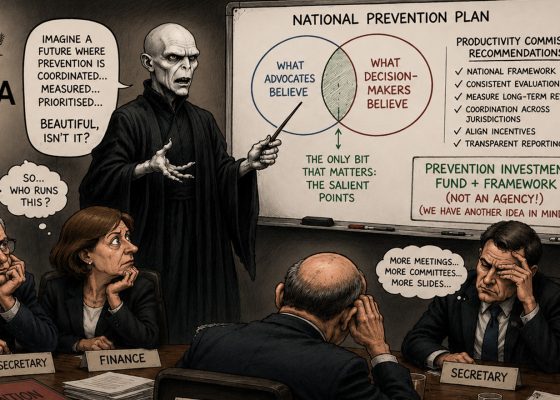

To embed investment in prevention and early intervention across portfolios and jurisdictions, we proposed a National Prevention and Early Intervention Framework.
The building blocks of the framework were designed to help governments coordinate investments, assess evidence consistently, and share both risks and rewards across jurisdictions.
This would make it easier to back programs that improve outcomes and reduce future demand for services, investments that might otherwise fall through the cracks between agencies and jurisdictions, or be frustrated by short-term funding cycles and fragmented responsibilities.
It would also give practical effect to the Australian government’s Measuring What Matters Framework by linking spending more directly to long-term outcomes.
The recent federal budget contained some promising signs of progress. The next step is to move beyond isolated initiatives toward a genuinely integrated approach that recognises prevention not as an add-on, but as central to Australia’s future productivity, wellbeing and fiscal sustainability.
Dr Alison Roberts and Dr Angela Jackson are the Productivity Commissioners who led the Inquiry into Delivering Quality Care More Efficiently.
Dr Roberts will be a panelist at next month’s Wild Health Leaders Conference and Workshop in Canberra – The Great Prevention Pivot. You can get a 25% discount using this code: Extra25. Tickets and program are at www.wildhealth.net.au