


Beneath the sweetness of what should have been a tame department specified review of this vital program, the Sparked crew doesn’t seem too happy with how the government is co-ordinating our interoperability plans and narrative.
Of all the programs being funded by the federal government to make its “sharing by default” agenda come to be, its most successful by far to date is Sparked, the CSIRO-led effort to create a set of national FHIR standards so that vendors and providers can move patient records between each other and patients more seamlessly.
It’s first base in a much grander set of interoperability plans that the Department of Health, Disability and Ageing, and the Australian Digital Health Agency have on the drawing board, because if you can’t standardise on technology-sharing protocols, you can’t get anywhere.
In a manner Sparked surprised everyone because in the past our key technology vendors and standards people have broken apart miserably when trying to co-ordinate on standards and the future of data sharing.
With an effervescent, glass-overflowing positivity, Kate Ebrill somehow herded a whole host of our smartest and most critical technical, clinical, and vendor experts—and kept them energised, productive, and actually getting things done.
Sparked is probably the only program really so far in all the government “sharing by default” initiatives that is actually kicking goals for stuff being built and near ready to use moving forward.
So it was almost surprising to see that DoHDA had forked out quite a bit of cash for digital health consultancy Voronoi to review the progress of the program – after all, it’s the one thing everyone agrees is going fast and doing great in all the stuff on the drawing board.
Another feature of a department-funded, department-specified review of one of its own programs is that it is rarely published so quickly and in full unless things are going exceptionally well.
Everything at Sparked is going great but….
You don’t have to read too far into the report to get a strong sense that the upbeat crew at Sparked isn’t all that happy with how the government is co-ordinating other initiatives that should dovetail into the Sparked work, the speed of progress in these other initiatives, and the general narrative that is starting to unfold around the Sparked program in the context of “sharing by default”.
The key Sparked people were on a (probably well-earned) break when we called to ask about certain recommendations in the report, and how they felt about them.
Or, being such a positive bunch, they may have wanted to avoid commenting on and adding any spice to some of the material buried in the report hinting at their frustration.
Take it as read that a lot of the report is devoted to saying just what a great job Sparked has been doing, both in getting stuff actually done – a good chunk of FHIR implementation guides, e-requesting tools for pathology and imaging, a ton of community building – and in bringing together previous antagonists to try and move everything forward from a community perspective.
But everyone knew all this already.
The Voronoi report is quite specific in pointing out the following on behalf of the fine folk at Sparked:
- “There needs to be a programmatic view of standards requirements and roadmap of strategic projects to create market certainty to support change… a national FHIR Standards Roadmap would assist a range of stakeholders to be confident in committing to invest in change.”
- “Vendors need confidence that investing for interoperability will grow business. Health provider organisations need a marketplace of trusted and standards-based interoperable solutions to buy from.”
- “There needs to be a better story to engage health service executive and managers, a broader set of clinicians, and consumers alike.”
- There needs to be a clear “policy statement” from the government “on how standards will be used and managed”, and, that statement needs to clearly state if FHIR standards are going to be mandated or not, what the incentives will be for stakeholders, with or without a mandate, and, when any of this is actually going to happen.” (You can read how Voronoi actually worded this point HERE)
[Our emphasis].
Think about it.
Most of the above are direct quotes from the recommendations section of the report. The report is based on Voronoi interviewing key people from the Sparked program.
It’s probably important to emphasise here that these are the words (and technically the recommendations) of Voronoi, not the leaders of Sparked.
But how did they draw these quite stark and problematic conclusions?
Might it be that government isn’t seeing past the bubbly, happy clappy optimists over at Sparked, to the hard-assed scientists and technicians that most of them are when not doing their PR.
I’ve always felt that the nerds you need to understand and talk to the most are the ones that don’t say much in the corner of that big project meeting.
If you take the above recommendations and put them into the context of the government’s “sharing by default” agenda so far, the recommendations shouldn’t be entirely surprising.
Related



The ADHA came out a few weeks back with one of its colourful pie chart-filled announcements to tell us that they were 70% through their National Healthcare Interoperability program meant to finish in 2028.
“The great news is that 70% of the actions have now been completed and we are continuing to drive forward work on the remaining outcomes, with 2.5 years of the plan still left to run,” ADHA chief digital health officer Peter O’Halloran told us proudly on LinkedIn.
But is it?
Technically, yes. See all the pie charts on the latest progress report here. Average all the green in those pie charts out and yep, it equals 70%.
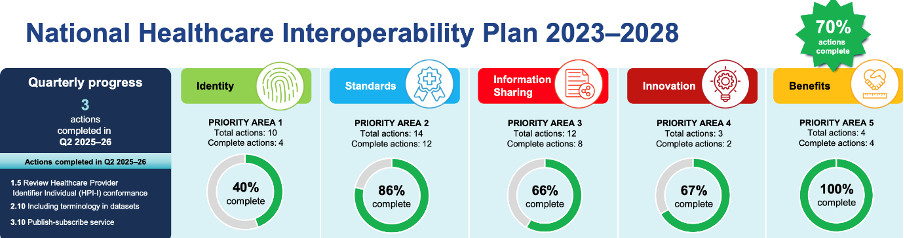
But practically, not even close.
Practically, you could say the following:
- The priorities to complete aren’t weighted properly e.g., identity and information sharing are huge components nowhere near completion and in the case of information sharing, not really started at all from an infrastructure point of view;
- A lot of progress has come from legislation which DoDHA is behind, not the ADHA but even then we don’t have anything on mandating standards, identifiers, or incentives yet (it’s all still promised as “coming”);
- The Provider Connect Australia initiative is precisely nowhere and going nowhere at speed at present. It’s stuck for reasons which should already be obvious to the Agency. Among other things, ChatGPT Health et al have so far not been contemplated at all in this and other key connectivity projects, which is a gaping hole in strategy now. AI will kill internet-based directories, and soon;
- The two major interoperability builds by the ADHA which are meant to underpin all the plumbing for sharing by default – the atomisation of the My Health Record with FHIR and open API connectivity, and the national Health Information Exchange, which would follow that MHR work, are not even started – the tender for the MHR part has been won but that’s not starting it. These are massively complex technical projects which AI is almost certainly going to disrupt in the short term, but we haven’t yet stopped to contemplate how.
Add all this up and some other stuff and you’d have to say that whoever said in the Sparked review that the government is moving too slowly, doesn’t have a cohesive plan, policy statement or the right industry and consumer narrative yet, is on the money.
When we rang the department and the CSIRO to ask for a comment and give them a heads up on what we were proposing to write here (we didn’t give them enough time for today unfortunately), both seemed surprised at our angle and take on the report.
It felt like we shouldn’t be creating any disharmony because everyone is harmonious and it’s going well at the moment.
A lot has been harmonious and a lot has been going well.
The plan put together by the Agency and DoDHA has been comprehensive and well thought out, Sparked has performed miracles of collaboration and laid some great foundations for standardisation of data-sharing technology, and there is a lot of goodwill, intent and energy in the sector.
But this report suggests that people in the middle of all these great initiatives are starting to get annoyed or nervous or both, at how slow everything is moving outside of the Sparked work.
Not our words, theirs – or at least those of the consultant that put together this review.
Now let’s add consumer and provider-side AI to all our grand “sharing by default” plans, both of which are essentially turbo charging how consumers and providers will do health in the short and long term.
And probably, the Sparked or the Voronoi people, or both, are making a very good point for us all.