

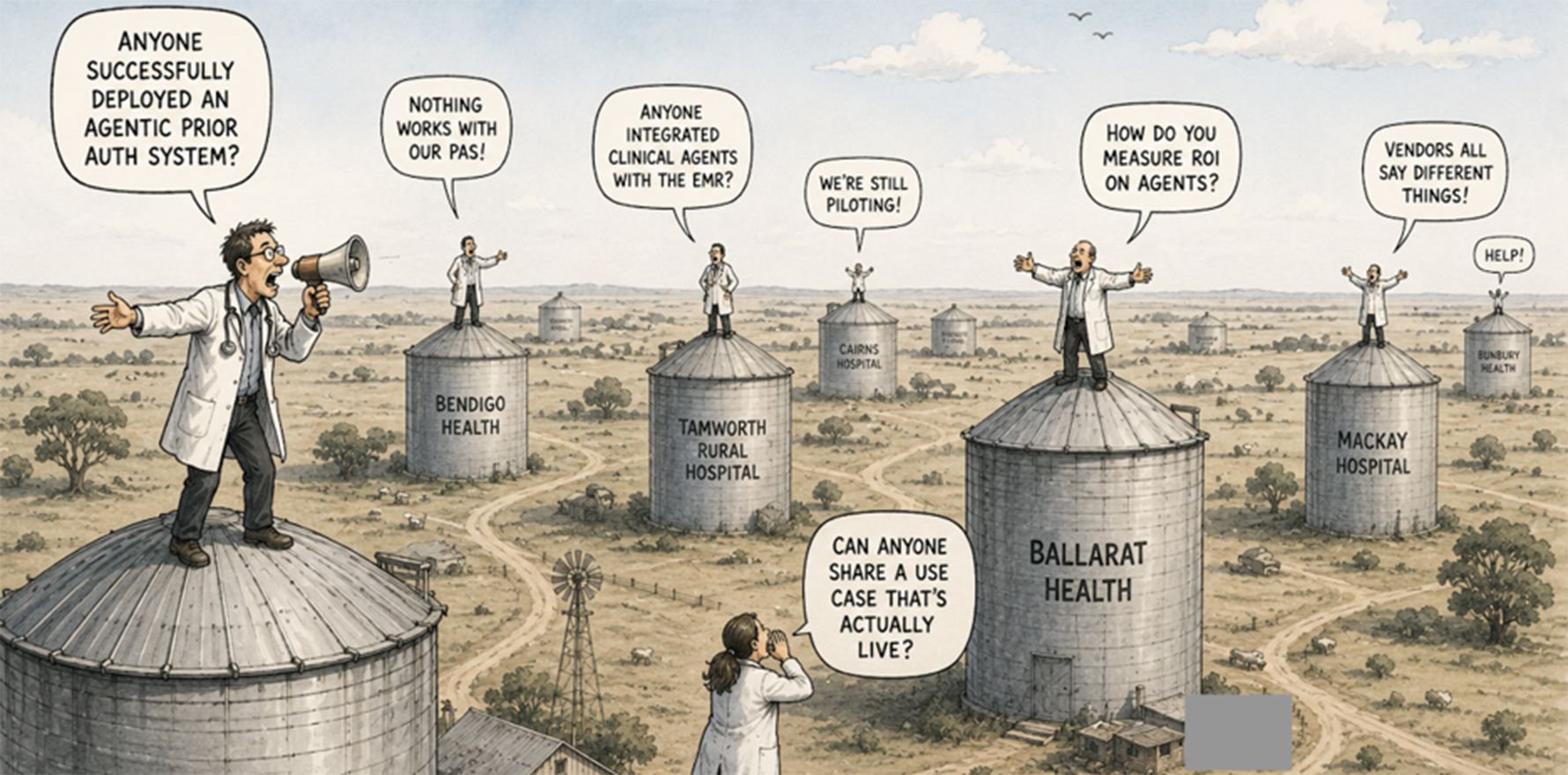
Unless someone starts centrally organising the deployment of agentic AI in hospitals across Australia starting now, we are going to end up hardwiring multiple siloed virtual care delivery models, a bit like we have now, but worse.
Australia’s hospitals are about to hit the greatest opportunity to pivot to true efficiency gains, improved patient experience and interoperability in their history: agentic AI.
The opportunity for transformation will be akin to the opportunity that scribes are handing to individual clinicians. But this time we aren’t talking about an individual clinician tool spread far and wide, we are looking at revolutionary new operating models for patient management.
Agentic AI systems can autonomously handle the operational work that currently ties up clinical and administrative staff – verifying patients, triaging referrals, scheduling and following up appointments, checking results and flagging deterioration – end-to-end and across a whole health region rather than one hospital at a time, freeing clinicians to spend their limited hours on the parts of care that actually need a clinician.
These systems are being deployed now overseas and are already moving from pilot to full deployment.
But the speed of this change is unnerving for hospital management and for policy makers.
Who owns the process of such a transformation?
More pointedly, who coordinates it across jurisdictions? Because the real superpower of agentic AI in a hospital system is coordination across multiple hospital systems, both for optimisation of patient servicing, but maybe more importantly, to make virtual hospital care actually work.
Australia is in a particularly parlous position here.
There is no question around where we should adopt agentic AI – the argument is already over based on overseas pilots and deployments.
Our major question and problem is: who is doing the organising?
Because as things stand today, the answer is no one.
It’s not that Australian policy makers and hospital managers are stupid. They see it.
But our state vs federal and state vs state operational paradigm means that organising for this optimisation opportunity is almost wickedly difficult.
With separate EMRs, separate procurement, separate tenders and separate political incentives, agentic AI, the entire value of which lies in operating at national or regional scale across a shared patient records and shared triage logic, could easily end up being rebuilt from scratch by every state and even every hospital within each state, multiplying cost and effort while guaranteeing none of the systems can actually talk to each other.
If we don’t get our act together this might end up as the biggest missed opportunity for real system care transformation in the history of Australian healthcare.
Our current fragmentation of virtual care is a bad starting point
Our structural problem is already playing out in the more basic technology of virtual care. It’s a preview of what will go wrong with agentic AI if nothing changes.
Every state and territory in Australia is currently building its own version of hospital-in-the-home, its own virtual emergency department, and, increasingly, its own virtual outpatient service, largely without reference to what the state next door is doing, and in some cases without much reference to what’s happening in the hospital down the road.
Victoria is one early example.
The state runs the genuinely well-regarded Victorian Virtual Emergency Department which now includes hospital-in-the-home (HITH) as one of several onward referral pathways, alongside things like residential in-reach teams and palliative care services, the same way it refers into GP follow-up or urgent care clinics.
Separately, the Royal Melbourne Hospital and Austin Health won a Victorian government tender to build out a “Virtual Hospital Pilot” (also called the virtual specialist hospital). It began initially targeting heart failure and post-cardiac patients and treating 250-plus patients. The pilot was due to complete evaluation in June.
It is explicitly framed by government as building on VVED’s success and funding, but as a distinct program with distinct leadership.
A New South Wales example: Sydney’s RPA Virtual Hospital runs one model, while at least two other local health districts run separate virtual-care operations of their own, in some cases with reports of nurses being sent out to patients’ homes with devices that not everyone on the ground has been trained to use, all driven by a state mandate to adopt hospital-in-the-home before the operational model was fully worked out underneath it.
Queensland Health’s own HITH guideline states that services exist across 15 of the state’s 16 Hospital and Health Services, plus a separate “Mater at Home” service run by Mater Health (a different governance entity entirely, being a Catholic not-for-profit hospital network operating alongside the public HHS system), plus additional “ACCESS services”.
Queensland Health’s HITH guidelines appear to actually mandate variation, stating that “a variety of models of care can be implemented by the HHS to meet local needs and should be reflected in the HHS admission policy and procedures”.
None of this is because anyone is doing a bad job. It’s what happens when every hospital and every state treats virtual care as an extension of the physical footprint of hospital services, rather than as a genuinely different kind of service: one whose entire value proposition is that it doesn’t need to be tied to a location at all.
The three different things we keep calling a ‘virtual hospital’
The term “virtual hospital” isn’t a good one. It is currently used in Australia to describe at least three distinct patient care models: hospital-in-the-home (an extension of acute inpatient care into the home), virtual emergency departments (urgent triage), and virtual outpatient or elective care.
These models have little in common operationally, yet they’re discussed and sometimes funded as if they’re one thing.
Getting a shared national vocabulary for these three categories might be a small, low-cost fix with an outsized payoff, because right now jurisdictions can’t even benchmark against each other properly when they’re not sure they’re measuring the same category of service.
The NHS model is important, albeit we can’t replicate it
The UK has taken an approach Australian health executives should be keeping an eye on.
The key thing the UK has done is to make an organisational choice that plays to the fidelity and natural advantage of agentic AI, especially in the case of the delivery of virtual care, in all three ways described above.
NHS Online, announced as a genuinely new provider of planned care, will not operate from any physical hospital site at all.
Instead, when a GP refers a patient for specialist care, the patient will have the option of being triaged through the NHS app and matched to a consultant anywhere in England, rather than only the specialist attached to their local trust.
Diagnostics and procedures still happen locally at hospitals or community diagnostic hubs, but the clinical relationship and the follow-up are decoupled entirely from geography.
Nearly two-thirds of NHS consultants have already indicated they’re willing to volunteer time on the service alongside their existing trust roles, and the service is predicted to deliver the equivalent of up to 8.5 million additional virtual appointments and assessments in its first three years.
If it works it’s about a four-fold capacity increase for the average NHS trust.
This isn’t a hypothetical.
Trusts that have already applied similar thinking at a smaller scale are producing striking results. Moorfields Eye Hospital consolidated referral triage across multiple providers into a single shared access point and cut referral processing time from 11 hours to two, while safely downgrading more than half of “urgent” referrals to routine care once properly assessed.
University Hospital Southampton’s gastroenterology team introduced virtual follow-ups for low-risk inflammatory bowel disease patients and cut waiting times by 62%, with more than 80% of patients now managed virtually and a 66% reduction in follow-up visits.
Barking, Havering and Redbridge University Hospitals NHS Trust now triages 99% of referrals virtually within 48 hours.
The organising principle behind all of this is that the NHS made a conscious decision about where virtual care creates value and built a new institution: a legally separate entity, sitting across every trust rather than inside any one of them.
The NHS is already at a huge advantage here with the trust structure and the fact that most trusts sit on the same IT platform.
In some ways you can see why Australia is so far often letting each hospital decide for itself.
So far in Australia each hospital is solving the easiest, most locally visible 20% of the problem – extending its own ED or its own inpatient ward into the home – while nobody is capturing the much larger economic opportunity that only exists at a shared, national or state scale: outpatient and elective care, where the patient doesn’t need to be touched, and where a cardiologist in Sydney could reasonably see a patient in a remote Indigenous community in Western Australia if the technical and clinical governance underpinning existed to allow it.
Agentic AI as the enabler is not actually the point
In the NHS Online model, and in the thinking of technologists building this infrastructure in Australia, AI agents are the mechanism that makes the triage, matching, documentation and scheduling load of a decoupled, at-scale virtual service manageable without an army of new administrative staff.
It’s the difference between a human manually checking whether a patient’s results are back and ready for the next step, and a system doing that continuously and automatically, freeing clinicians to spend their limited hours on the parts of care that actually require a clinician.
Amazon’s commercial rollout of this idea gives a concrete, already-operating example of scale, and it’s the reference point worth considering by Australian hospital executives rather than dismissing as an offshore curiosity in a land of general dysfunctional systems and people (the US).
UC San Diego Health, which handles 3.2 million patient interactions a year, deployed Amazon’s purpose-built agentic AI healthcare product to handle patient verification and appointment-related calls – historically around half of all inbound patient call volume – and is now redirecting 630 hours of staff time every week away from manual verification and toward direct patient assistance, while cutting call abandonment rates by 30% overall and as much as 60% in some departments.
The system integrates directly with the hospital’s existing electronic health record via standard interfaces, rather than requiring a separate database or a new interface for clinicians to learn, and every AI-generated note, insight or code is traceable back to the specific call transcript or chart entry that produced it.
Related



Who is best placed to look at this idea for Australia and maybe coordinate?
The Australian Digital Health Agency is, on paper, the body best positioned to start this as a national conversation. Not to coordinate the centralised running of virtual care hospital models, but to do the kind of discovery and modelling work that would tell governments where a coordinated virtual-care and agentic-AI strategy would deliver the greatest economic and clinical return.
It could then maybe broker the kind of state-Commonwealth conversation this would require, plausibly through National Cabinet’s health arrangements, given no single jurisdiction can mandate this alone.
Right now, that discovery work isn’t visibly happening, and the criticism increasingly heard in the sector is that the Agency’s attention remains overwhelmingly consumed by the maturation of the My Health Record system.
No one is saying we shouldn’t be optimising this valuable but so far latent resource.
But the arrival of agentic AI as a genuinely new category of national hospital infrastructure is a conversation we should all be having now.
The Agency isn’t operating in a vacuum here: a 24-recommendation national AI roadmap for healthcare does exist, but as is the speed of AI, it’s already outdated.
It’s not that hard to look around and see opportunity to move on agentic AI in a manner that the whole country can eventually use.
The NSW SDPR, though controversial, is an ideal single-EMR-by-region play that feels ideal to examine what a centralised strategy around agentic could achieve.
And there is already good work being done in the area.
NSW’s Digital Front Door initiative and Healthdirect are already building agentic capability of their own. A single agentic front door for NSW talking eventually to a single digital patient record, via a single EMR.
Queensland is a plausible fast follower.
Tasmania and WA don’t have EMRs yet, but both are mulling high-cost enterprise implementations. It might be worth coming to the middle with a group like NSW and see what they think.
The state best placed to act is probably NSW given existing digital-front-door infrastructure that already works irrespective of where in the state a patient is located.
But the prize on the table, a genuinely national approach to deciding where virtual care and agentic AI should sit, who delivers it, and how it’s shared rather than duplicated 50 times over, is squarely the kind of nation-building digital health infrastructure question the Agency was created to lead.
The NHS didn’t wait for perfect data or full consensus before deciding virtual outpatient care needed a dedicated national entity behind it.
Australia’s hospitals, meanwhile, are still mostly building their own delivery trucks, one at a time, when the entire point of virtual care is that it never needed a truck in the first place.
The topic of this article is the central theme of a one-day hospital summit in Melbourne on 29 October. If you want to come you can get 20% off the early bird price using the promo code NEWMODELS20 HERE.