

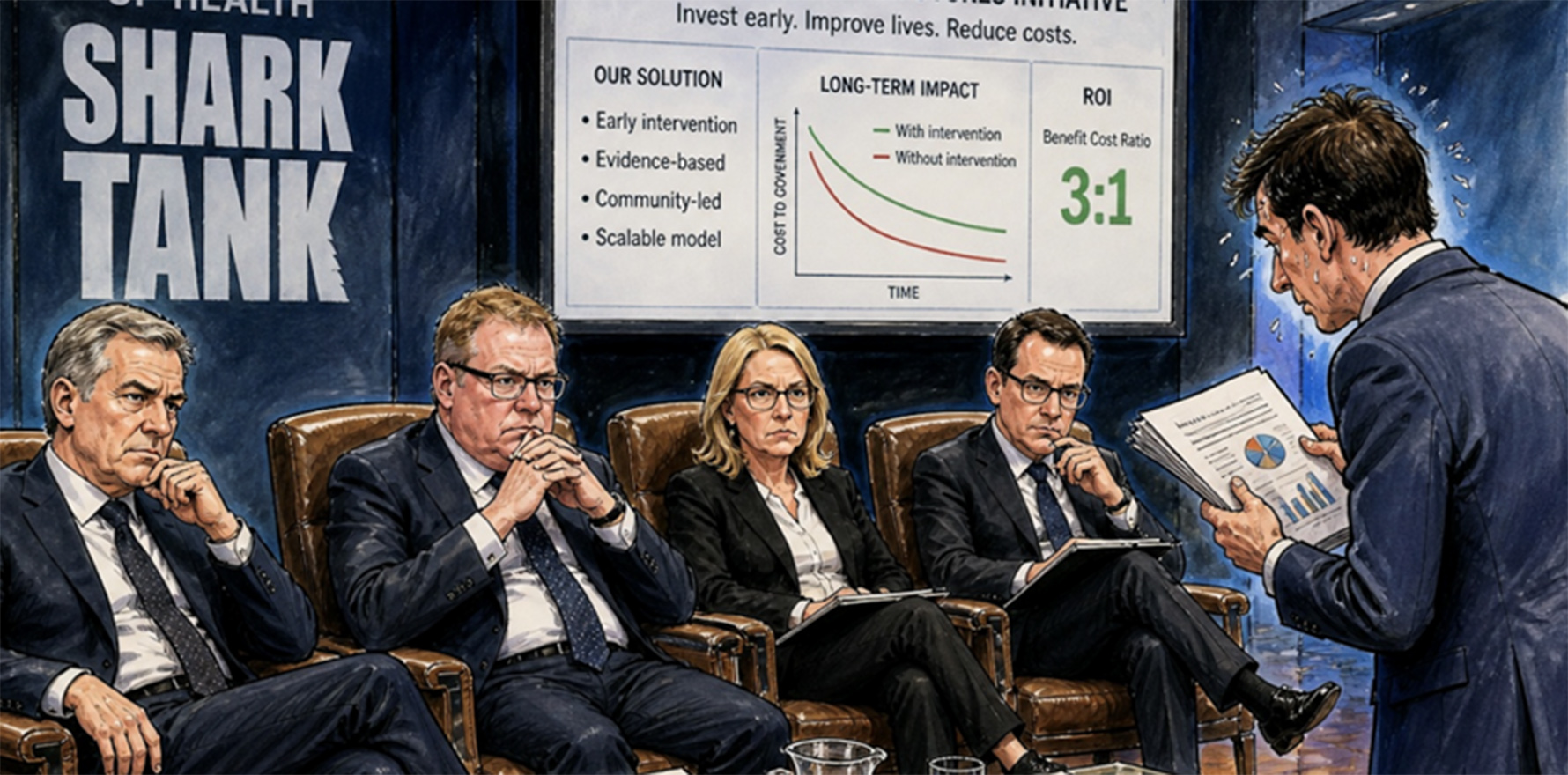
Everyone in health thinks their prevention idea is self-evident. The secretary of health sees hundreds of those ideas every budget cycle, and most go nowhere. Here’s why.
Prevention advocates pitching to government need to stop trying to prove the value of early intervention and instead show what they are willing to give up to fund it, the secretary of the Department of Health, Disability and Ageing has warned.
Speaking at the Public Health Association of Australia conference this morning, Blair Comley delivered a blunt reality check on how prevention proposals are assessed inside government, saying central agencies were already convinced of the case for early intervention.
“I have never had any trouble convincing them that early intervention works,” he said.
“What I have trouble convincing them of is why I’m not doing the prioritisation.”
Mr Comley said the typical cycle saw health agencies bring forward proposals with strong benefit-cost ratios, only for their pitch to stall when asked to identify off-setting savings.
“A line agency … says, ‘I’ve got this fantastic program … we should do it. So give us some more money for it,’” he told conference delegates.
“The central agency turns around and says ‘I believe your argument … I’d just like you to do that, but offset within your portfolio something else’.”
That, he said, was where proposals tended to fall over.
“The line agency then says that would really annoy some stakeholders … and lo and behold, the program is never invested in,” he said.
The result is a cycle that repeats “multiple times”, with prevention initiatives failing not because they lack evidence, but because they lack clear trade-offs.
Mr Comley also urged advocates to rethink how they presented their case, arguing that technical analysis alone rarely cut through.
“In this game, there is nothing that beats a killer fact,” he said.
Also in today’s edition:
- Shock resignation rocks aged care sector
- ‘Yawning gaps’ in psychosocial care: Butler
- Record Victorian health boost despite growing debt
- Prevention won’t cut health costs overall, conference hears
- Gold Coast HHS director loses IRC appeals
- Chemist Warehouse to enter UK market
- $15m win for research into early onset cancer
He pointed to early results from “birthing on country” programs – which have found a 63% reduction in children entering out-of-home care – as an example of the kind of simple, compelling statistic that could influence decision-making, even while acknowledging the need for stronger evaluation.
More broadly, he said proponents must focus on arguments that resonated with decision-makers, not just those that appealed within the sector.
“Think of a Venn diagram … what you find persuasive, and what the person you’re trying to convince will find persuasive,” he said.
“The middle intersection is the salient points.”
Mr Comley’s comments came as the DoHDA continues to embed prevention and early intervention as one of its four long-term strategic pillars, alongside equity, digital and technology, and systems integration.
But the secretary made clear that prevention was competing with a wide range of immediate pressures and policy priorities across the health system.
Those priorities – outlined in last year’s department briefing to the incoming government – were led by a push to strengthen Medicare, with a focus on improving access and affordability in primary care, including lifting bulk-billing rates and expanding urgent care clinics.
The second priority was delivering “cheaper and better medicines”, balancing PBS affordability with pressure to support faster access to innovative treatments in a changing global pricing environment.
Workforce remained the third major focus, particularly addressing shortages and maldistribution in rural and regional areas, alongside efforts to expand scope of practice.
Mental health was the fourth priority, which Comley described as “unfinished business”, with significant unmet demand and high out-of-pocket costs, alongside new investment in digital early intervention.
Related


The fifth priority was First Nations health, where the government remained off track on key Closing the Gap targets, including life expectancy, birth outcomes and suicide rates.
Set against that agenda, Comley said prevention advocates needed to be realistic about the environment they were operating in, and sharpen their arguments accordingly.
“I’m on the prevention early intervention bandwagon … but I have seen some of the real barriers,” he said.
“Part of it is making sure you put the sceptics hat on … and think about what’s the argument that’s convincing the people that you need to convince.”
For an edited transcript of Mr Comley’s speech, click here.
If as a system stakeholder you are interested in contributing ideas to this topic and getting an Australian Preventative Health Agency up and running, please come to Health Services Daily’s Canberra Health Leadership Workshop and Summit on Prevention on 16 and 17 June at the Hyatt in Canberra. The first five delegates to use this discount code will get a 50% discount on any ticket type: Extra50. If you’re reading this Jim, your ticket is on us. Program and tickets HERE.