


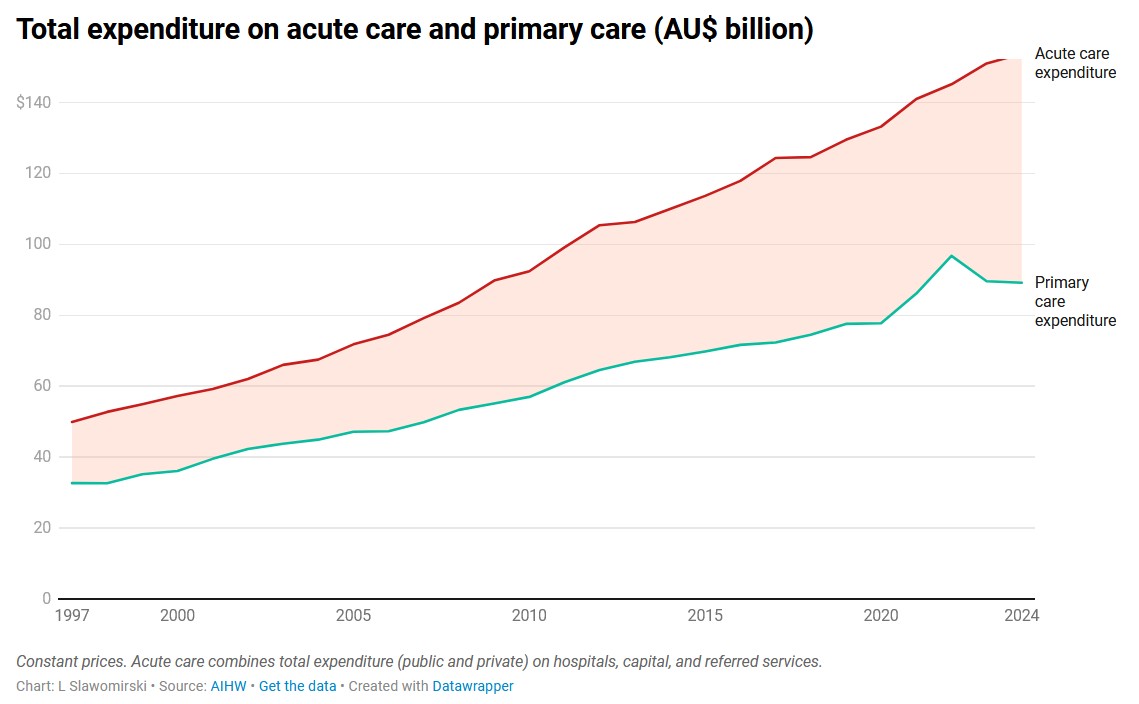
Australia’s health system is exhibiting some of the worst traits of its US counterpart. We spend heavily once people are sick. Spending on hospitals has grown faster than spending on primary care and prevention.
Australia’s health system is exhibiting some of the worst traits of its American counterpart.
We spend heavily once people are sick. Hospitals absorb 42% of Australia’s $270 billion annual health expenditure. Over the longer term, spending on hospitals has grown faster than spending on primary care and prevention.
So, how healthy are we having spent all that money?
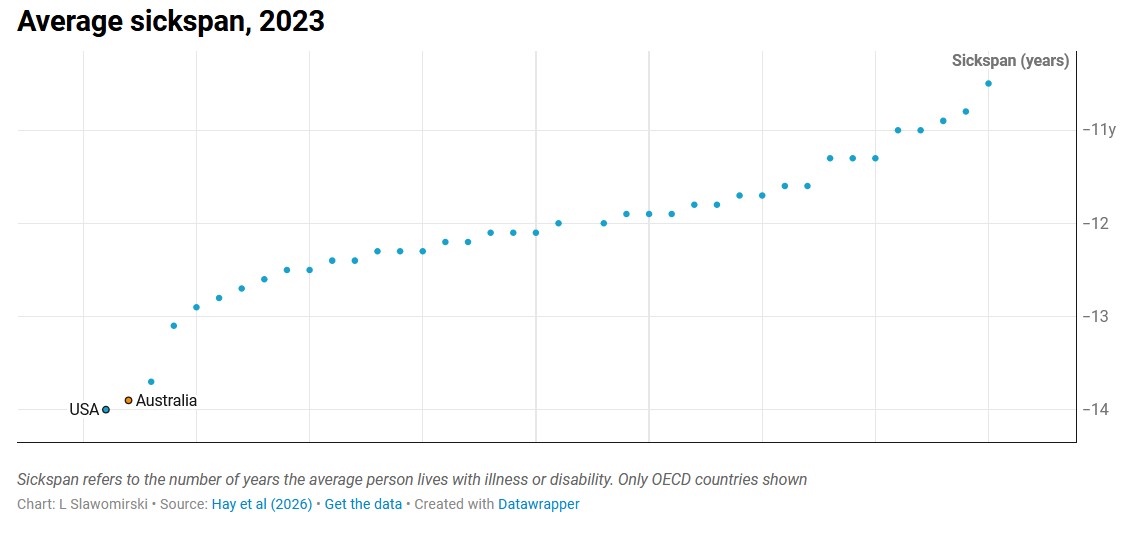
Not that healthy, according to two global studies that show Australians living an average of 12-14 years in ill health or disability. In the OECD, where many countries have a similar life expectancy to ours, only the US has a “sickspan” worse than ours.
Meanwhile, roughly one in 10 Australians delay or skip specialist care because of the cost. Among people with chronic conditions, about a third say they’re not confident that they could afford care if they became seriously ill. And wait times in public hospitals continue to lengthen.
Value for money
One part of our system – the Pharmaceutical Benefits Scheme (PBS) – works differently.
The PBS is built around two ideas that are increasingly unique in health care: access and value.
Its stated purpose is to provide “timely, reliable and affordable access to necessary medicines”. Before a new drug can be subsidised, the Pharmaceutical Benefits Advisory Committee looks at whether it works, whether it is safe and, crucially, whether it represents value for money compared with existing treatments.
Value is essential.
If a new drug does roughly the same thing as an old one, the PBS does not simply accept whatever price the manufacturer asks. The PBS compares the extra health benefit with the extra cost.
Its guidelines say it cannot recommend a medicine that is substantially more expensive than an alternative unless it also delivers a significant improvement in health. It negotiates an acceptable price with the manufacturer and then subsidises it so Australians pay less when they pick it up at their local pharmacy.
And the results are impressive.
Take Vyvanse, a common ADHD medicine. On the PBS, 30 capsules of the branded 30mg product have a total dispensed price of A$46.11. In the US, the current National Average Drug Acquisition Cost – based on pharmacy invoice prices – is about US$370 (A$530).
That’s around 11 times the Australian PBS price.
There’s a similar story with Ritalin. One hundred 10mg tablets have a PBS dispensed price of A$36.68. The corresponding US price is about US$113 – more than four times as much after currency conversion.
Ozempic is starker again. The Australian PBS dispensed price for a 4mg/3mL pen is A$134.60. The comparable US price is almost US$996 (A$1427), roughly 10 times as much, making the prescribed drug far less affordable for American patients.
These comparisons reflect previous Australia Institute research, which found that US patients pay up to 125 times more for common medications like Atorvastatin, a cholesterol drug.
That’s predominantly because the PBS explicitly links price to a drug’s medical benefit compared to existing alternatives. But also because it negotiates on behalf of all Australians, giving it far more leverage than a bunch of smaller funds would have.
Related



Asking the right questions
The point is that the PBS addresses a question much of the health system avoids. What health improvement are we actually buying for the money we spend on health care?
Low-value care is an obvious example. We spend substantial amounts on tests, procedures and treatments that deliver little or no benefit to patients – and can sometimes harm them.
One Australian study found that, among 27 procedures examined in NSW public hospitals, between 11% and 19% of episodes were low value. Another found that between 21% and 32% of admissions involving 21 selected procedures among privately insured patients were low value. These included knee arthroscopy for osteoarthritis, spinal fusion for uncomplicated back pain, and other procedures that continue to be performed despite mounting evidence that they generate no more benefit than a placebo.
Yet most of health care has nothing equivalent to the PBS routinely asking: does this work, how much better is it than what we already have, and is the improvement worth the additional cost?
Most of Australia’s health system still pays for activity: consultations, scans, procedures and hospital episodes. The question we should be asking is: what aspects of all this activity improves our health?
And we continue to spend heavily treating preventable illness while putting comparatively little into preventing it.
Why does value only apply to pharmaceuticals?
Before taxpayers spend billions on medicines, the PBS demands evidence that they improve health and that the improvement justifies the price. Governments are far less disciplined about the much larger sums spent elsewhere in healthcare.
Australia can choose to fund health care that improves health. Or we can fund expensive care with poor results. That’s how the US health system goes about it, and it’s not an example we would want to follow.
Luke Slawomirski is Senior Postdoctoral Research Fellow at The Australia Institute.
This article was originally published by The Point. Read the original here.