

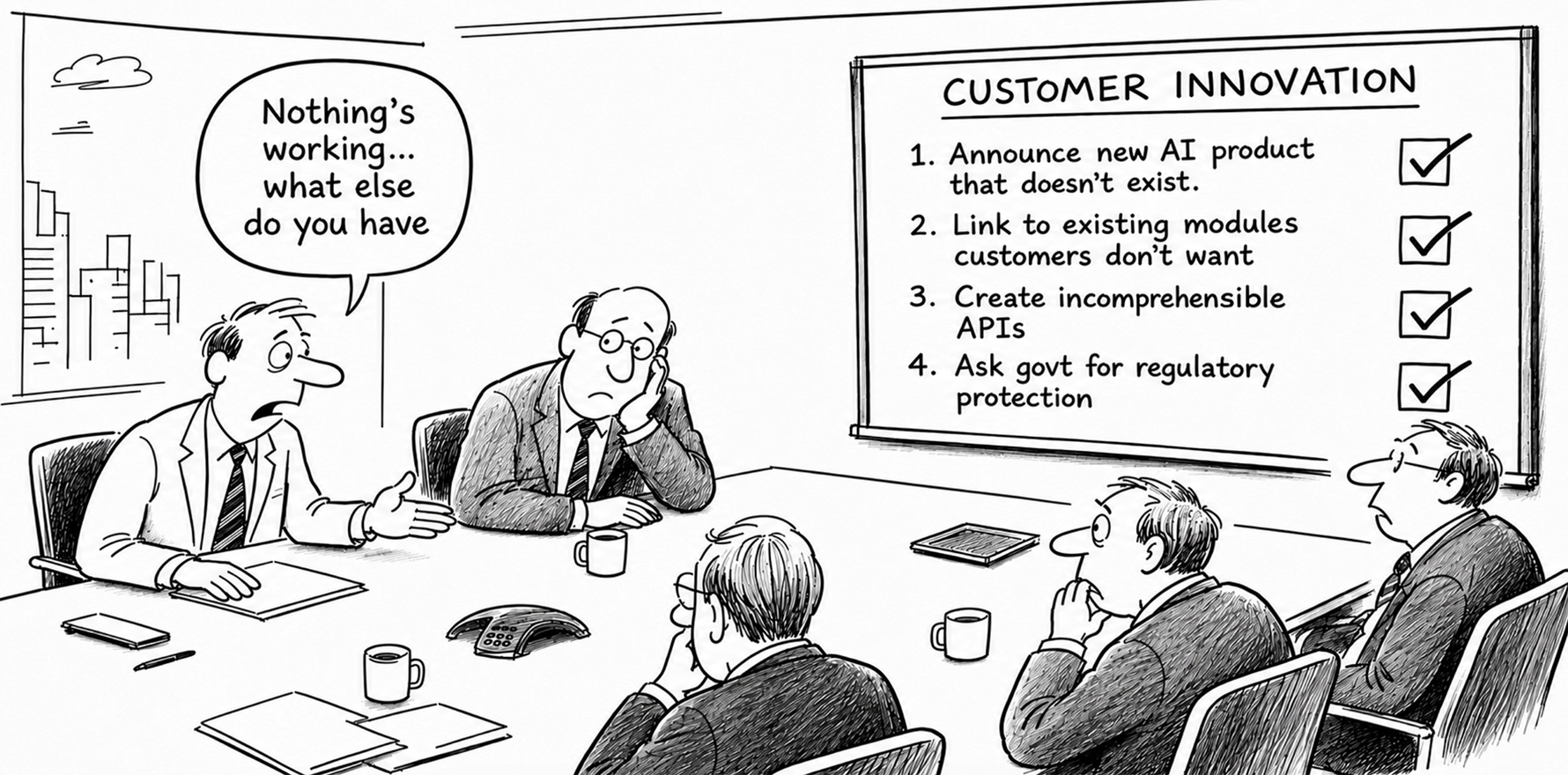
NSW Health’s $38.7 million scribe investment for 6000 clinicians looks innocent enough, but who the tender is awarded to and why could set a precedent that resets the power balance in every hospital's relationship with Epic and Oracle moving forward.
There is a decision NSW Health is about to make that looks, on paper, like fairly ordinary state government procurement: which AI scribe vendor gets the nod for a $38.7 million rollout to up to 6000 clinicians across the state’s public health system.
It isn’t ordinary.
Handled a certain way, this single contract could shift the balance of power between the world’s biggest hospital EMR vendors and every health system that has ever had to negotiate with them.
Epic’s long-time PR problem
Epic is not a bad company, and its electronic medical record isn’t bad software.
By most credible clinical and IT accounts it remains the best core enterprise EMR technology on the market, which is presumably why NSW Health picked it in 2023 to build its Single Digital Patient Record, the state’s largest ever technology program.
But ask any hospital clinician or administrator anywhere in the world running Epic whether they like it and the answer is usually somewhere between grudging and openly hostile.
That reputation isn’t really about Epic’s quality.
EMRs promised to give clinicians time back and instead loaded them with data entry, and that history, one of clinician burnout and a new job specification as a clerk, has never been entirely forgiven.
The trust and love doctors now extend to a scribe, checked before anything reaches the record, has never extended to the EMR sitting underneath it, which gets treated as unavoidable core patient data management infrastructure rather than something to like.
Hospitals buy Epic, again and again, because on the actual job of being a safe, compliant, and an at-scale clinical billing record, it usually wins.
This has been the source of Epic’s power. And over the last two decades the leverage of being the necessary base patient data platform for big hospitals, from which all data must flow, has meant ever-increasing leverage over its clients as interoperability demands more and more integration of other tasks.
When there are really only two credible options for something this critical – Epic and Oracle Health – the vendor has tended to hold the leverage in whatever relationship follows.
Modules, pricing, integration terms, and roadmaps: Epic or Oracle largely set them, because walking away is not a realistic option for a health system of any size.
None of this is Epic or Oracle behaving particularly badly. It’s simply what happens when a piece of essential infrastructure has very few credible alternatives.
The sometimes tough negotiating stance Epic can take, including on pricing, is a natural consequence of the imbalance of power in the vendor-client relationship.
It’s business.
The action has now moved above the EMR
What’s changed in the last two years is where the real contest for value in clinical productivity and patient data management is happening.
The blunt problem for Epic and other EMRs, but particularly the big hospital ones, is that there is a new layer of important patient data action, and it’s not inside the EMR, although the new layer will always need to reference that EMR.
It’s in the workflow layer sitting on top of it: ambient scribing first, and now clinical coding, evidence and decision support, and agentic tools that manage how a patient moves through the entire system.
Scribing has turned out to be the easy, visible front end of a much bigger shift, not the whole AI workflow story. But it’s the way in because scribes are great for productivity and the clinicians love them so there are no adoption issues. Once you have the clinician’s heart, a scribe can move upwards and outwards to new dimensions in workflow and data management.
The EMR now has a serious competitor for patient data capture and management.
Every serious hospital-tech player has noticed: Amazon is selling agentic patient-contact AI through Connect Health, Salesforce is pushing its own agentic layer into hospital call centres, and Epic and Oracle Health are both racing to build native versions of all of this directly into their own EMRs – for the obvious reason that keeping it in-house keeps the revenue in-house, and their client leverage intact.
This is the layer NSW Health’s tender sits, which is why the vendor chosen for those 6000 clinicians may matter a lot more than the dollar figure on the tender document.
Australia has already run a small-scale version of this fight.
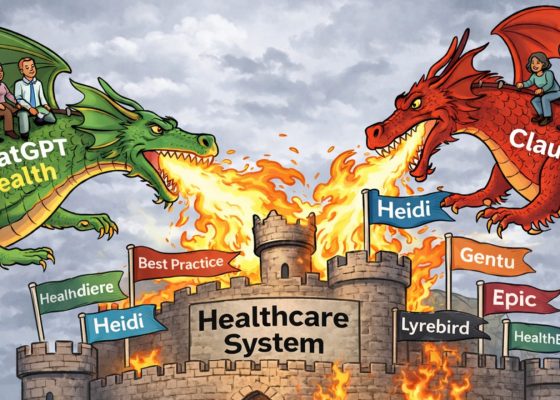
Best Practice, which controls around 80% of the country’s GP software market, picked one scribe, Lyrebird, as its deep-integration partner, giving it native record access that no other scribe bolted onto the same software gets.
This was a logical commercial move for both companies in this smaller more eclectic EMR market but the signal it sent, that whoever owns the record chooses who gets to build on top of it, doesn’t necessarily play out at scale.
The GP market isn’t the enterprise hospital market. Best Practice either had to build their own AI or choose a partner they could either eventually buy or, at the least, control.
NSW Health is in a different and more powerful position.
It’s in a position to split its key patient data and analytics provision of services into two major suppliers not one: the EMR layer and the AI workflow and admin layer.
The tender, and what sits behind it
Under any scribe contract NSW Health awards will sit the SDPR, the program consolidating nine electronic medical records, 10 patient administration systems and five pathology laboratory systems into a single Epic build across all 15 Local Health Districts, two Specialty Health Networks and every NSW Health Pathology laboratory.
If NSW Health can pull its SDPR transformation project off – they’ve had some big early troubles in Hunter New England, but who doesn’t have trouble rolling out Epic – it will be the largest implementation of any EMR platform in the southern hemisphere and one of the largest Epic deployments anywhere, spanning more than 220 hospitals and roughly eight million patients.
Also in today’s edition:
- Advocates question timing as Butler goes full steam ahead with NDIS plans
- Aged care assessments need experts not algorithms
- Supervised injecting room cuts ambo callouts by 71%
- Connecting data to close the policy gap
- We’re living longer, but more unhealthily: AIHW
- Trust, not technology, emerges as healthcare AI’s biggest challenge
- IHACPA flags rising aged care reform costs as it seeks feedback on 2027-28 pricing
How the leverage flips
Whoever wins the scribe contract would be in position to expand upwards and outwards with other key AI workflow layer services, such as a clinical knowledge layer and most importantly, all the admin at the interface of in and out-patient services.
Choosing an Australian scribe vendor – Heidi Health and Lyrebird are obvious candidates – has a few important advantages for NSW Health.
Australian clinicians are already enamoured of both brands – they both have already passed the all-important Aussie pub test – in particular probably Heidi, with its global expansion profile and Evidence and Comms modules.
Both vendors, but Heidi in particular (it seems to be raising more money now) would be able to raise more capital to meet any of the needs of the client, and the client would be backing local tech in a big profile way.
Because NSW Health would make Epic integrate deeply with whoever it chooses, the scribe vendor would have a global reference project that any AI scribe vendor would die for.
If the scribe vendor becomes the trusted workflow partner sitting across the EMR record, not just for notes but later for stuff like for coding, evidence and eventually the agentic tools managing patient flow, NSW Health will have effectively installed a second vendor relationship at the layer where most of the future value is being created, one it controls far more than it currently controls its relationship with Epic.
From that point on, its ongoing negotiating position with Epic changes: engagement can be kept meaningful without being as expensive, because Epic is no longer the only key party in the room holding something the health system needs.
What might such change in hospital IT procurement dynamics look like to other major health systems examining the options for an AI layer who have either Epic or Oracle as their enterprise EMR?
Why Heidi would be good for this deal
This is a deal Heidi needs more than Lyrebird.
Heidi is staking its future on a global play and to pull that off it needs a way into enterprise EMRs at scale. Oracle and Epic are never going to willingly let them in.
That makes Heidi look like it is strategically stuck in the middle right now: it has pulled back Comms support for small practices, restructured its pricing upward, and is chasing hospital enterprise budgets against a lot of other well funded AI scribe groups. But as it moves upstream into agentic AI and patient admin it is facing up to the likes of Amazonm, Salesforce and other large cloud players.
A reference win of this scale, executed well, may that problem in one move: it becomes the proof point Heidi can take to every other Epic and Oracle large hospital jurisdiction in the world. Which means Heidi has every commercial incentive to make this work brilliantly for NSW, not just adequately.
From NSW Health’s perspective it would be choosing a vendor that is Australian, innovative, not expensive, motivated to grow and learn at the enterprise level and which has access to the capital needed to do the job well.
The vendor’s future depends on the reference case rather than just the contract value. Both sides want the same outcome. That alignment is rare in hospital IT procurement.
It’s an unusual coming together of innovation and timing, a contract that could start the ball rolling on one of the most significant changes to hospital patient data platform dynamics in more than three decades.
Epic’s Microsoft Internet Explorer moment
As with Heidi this is a pivotal strategic moment in time not a contractual problem for Epic.
In February 2026 Epic released AI Charting, its own ambient scribe, part of a broader clinical AI suite it calls Art, built in partnership with Microsoft’s Azure models.
It is already livel: Wisconsin’s Group Health Cooperative and Louisiana’s FMOL Health were among the first sites, and Epic has said the tool will keep expanding beyond note-taking into orders and diagnoses.
It may not even need to win an open tender to compete for NSW’s business: while the eHealth NSW supplier panel process closed in December 2025, before AI Charting’s public release, Epic’s more natural path in may simply be to offer it as an upsell inside the SDPR contract NSW has already signed.
If I’m Epic, I’m throwing this module in for free, at least for long enough to make picking anyone else look like an unnecessary expense.
Such an Epic pitch would not be unreasonable from a commercial perspective. AI Charting sits natively inside the same Epic instance already running the SDPR, so there is no separate write-back integration to build, test or govern – arguably the lowest-integration-risk, lowest-cost option on the table (if Epic wants to make it that way), especially given NSW has already paid for the platform underneath it.
But taking that path might mean missing one of the major reasons to put the work out to tender – competitive tension and leverage.
If NSW Health hands the scribe contract to Epic on the promise of lower integration risk, and even price, NSW remains largely beholden to Epic for the layer that now matters most, and nothing about the underlying power dynamic changes: the leverage stays exactly where it has always sat.
From an ROI perspective moving forward for NSW, leverage should matter more, not less, from here, given the opportunity for operational efficiency and patient engagement at hand.
The scribe is the smallest and most visible slice of the medical AI opportunity opening up above the EMR – coding, evidence, and above all the agentic tools that will manage how patients and resources move through an entire hospital system will naturally follow.
That upstream productivity gain is about to be enormous, and a health system doesn’t necessarily want to hand the company that already holds the leverage in one part of its stack the keys to the next part too, especially if that company has less reason than a hungry innovative challenger to move quickly, or to keep its own pricing lean, once the keys are handed over.
The problem for Epic in this tender becomes this – bundling a module in for very low cost or even for free to starve outside competition of oxygen isn’t a new idea. It’s predatory marketing that may at some point of time be subject to regulatory scrutiny.
It’s the same play Microsoft ran with Internet Explorer in the 1990s, folding a browser into Windows at no extra charge until a court found Microsoft had used its operating system monopoly to strangle competition in separate, adjacent markets.
Would bundling and low pricing here be seen as an attempt to strangle the fast-evolving AI scribe vendor market?
The risk for Epic isn’t that its own AI Charting module is worse or more expensive than a third party’s. It might genuinely be better, and cheaper, if Epic takes the strategic threat seriously.
The risk is that hospital administrators, once they see what a state-mandated outside integration can do to their leverage, start preferring the outside vendor even when Epic’s native module is perfectly good.
Because picking the incumbent’s bundle quietly gives away the one thing every Epic customer currently lacks: negotiating power.
It’s the same logic that leads big enterprises to keep paying for independent platforms like Snowflake or Databricks rather than lean solely on their cloud provider’s own free native tools: the free option only looks cheap until the vendor holding the platform is the only one left to set next year’s price.
It’s a market-structure problem for Epic if NSW Health sees the opportunity and wants to act on it.
“The Epic way”, “One patient one record”, “One point of accountability” are all idioms people associate with Epic.
Each are about client capture and leverage when you break them down.
Why would a client ever trust Epic’s AI module pricing to stay as reasonable as it would if the client kept its options open by splitting vendors?
Epic and Oracle finally have an innovation in market problem. And big hospital buyers have a chance finally to reign in some of the power these groups have wielded over the past few decades.
If NSW pulls this off and it gets noticed, and surely a deal this size, at this level of government, would get noticed, every large hospital group in the world running Epic, or indeed Oracle, has a template it didn’t have before: pick a credible outside AI workflow partner, force the integration, and use the resulting relationship to keep the EMR vendor honest on price and terms from then on.
It wouldn’t need to work everywhere to matter. It would only need to work once, publicly, at NSW’s scale, for every hospital CIO’s next Epic renewal conversation to be a little different.
And Heidi would have a path to get escape velocity from where it is currently “stuck in the middle”.
Related


The bets other scribes have been trying
Given most scribe clients that are shut out of a deep EMR partnership don’t get a shot at leverage this size, some in Australia have been thinking through different workarounds to crack the problem.
One bet being considered is the idea of going around the EMR altogether via the My Health Record, using a patient’s authorisation to pull results and history straight from the national record rather than the doctors EMR.
Clever in theory, but My Health Record’s access isn’t close to real-time or reliable enough yet, coverage from labs, specialists and hospitals is far from universal, and even a perfect version would still miss the clinical context, the doctor’s own notes and reasoning, that only a longitudinal provider side EMR record carries.
This is a strategy no hospital would ever contemplate as there is way too much to miss, too much complexity to get wrong, and latency of data would always be an issue.
In the world of GP and specialist practices its hard to see any doctor thinking that not having near total control of their patient record would be the way to go.
That the idea is being considered at all suggests how much the scribes are realising that their situation is becoming precarious.
The second bet is to build an AI and cloud-enabled EMR outright, or something adjacent to it.
Heidi has been rumoured to be doing exactly this, and its 2026 moves, Heidi Evidence for clinical decision support and Heidi Comms for patient calls and bookings, look like early steps in that direction.
But a full EMR has to be rebuilt market by market, and it demands a level of trust-and-safety engineering scribes have never had to build, since doctors have already learned to forgive a scribe’s mistakes but rarely an EMR’s.
It’s not practical, even with lots of capital.
The third bet is to partner with an EMR vendor, as Lyrebird has managed to do with Best Practice.
Epic and Oracle aren’t going to do that willingly, and of those Australian SME EMRs left – the likes of MediRecords, ZedMed, MedicalDirector, Gentu – this bet seems to now have an obvious flaw.
Ambient scribing is table stakes now, so most EMR vendors would rather build the equivalent themselves and keep the revenue, and the record, in-house.
The bet that matters
All of these three bets underline the fundamental strategic issues for most scribe vendors these days: someone else owns the record, and owning the record is where the leverage has always lived.
But at scale, a healthcare system or health jurisdiction can choose now to split that leverage.
The NSW tender is different because of its sheer scale, large enough that it could hand a scribe vendor a seat at the EMR table that the scribe vendor could never have negotiated its way into alone.
Whether NSW Health sees it that way, whether Heidi or Lyrebird can execute well enough to be worth betting on, and whether Epic responds by competing on price and other terms, rather than digging in, are all open questions.
But the decision NSW Health is about to make is significantly more important to the global EMR market than the A$38.7 million attached to it.
Done one way, it’s a template for tipping the power balance back from the enterprise EMR towards the health system client – the hospital, its clinicians and its patients.
A template for taking leverage back from Epic and Oracle is something every large hospital system on the planet would want a look at.
It could systemically change the economics and the way we deliver medicine via hospital systems globally moving forward.
No pressure, NSW Health.