


If you’ve spent decades in the trenches building real expertise – here’s your chance to unlock your impact 10x with AI.
Healthcare: “AI could never replace clinicians – our job is too complex.” Also Healthcare: “AI lets us vibe code our own software. Who needs tech vendors?”
As always, reality is far more complicated.
Look, I know we’ve all done this:
- Asked AI to explain your test results: “so why do we need doctors?”;
- Asked AI to review a vendor contract: “so why do we need lawyers?”;
- Asked AI to edit an article: “so why do publications need editors?”
AI is so magical that when we look outward at domains we don’t deeply understand (because it’s not our day-to-day job), it’s easy to think “that industry is doomed, AI will completely replace them”.
It’s why technologists outside healthcare consistently underestimate how hard it is for AI to completely replace everything a clinician does. Heck, it’s been trying to replace radiologists for a decade and we still need radiologists more than ever!
It’s easy to imagine the least complicated use case and singular workflow – eg, triaging a low-risk medication refill – and think “wow AI can automate that one thing a doctor can do”, and then make the giant mental leap to “which means AI can then automate 1000 other things a doctor can do, and can orchestrate all of them, make value and clinical trade-off judgments and also earn the trust of patients and colleagues”
Actually that’s a LOT more complicated.
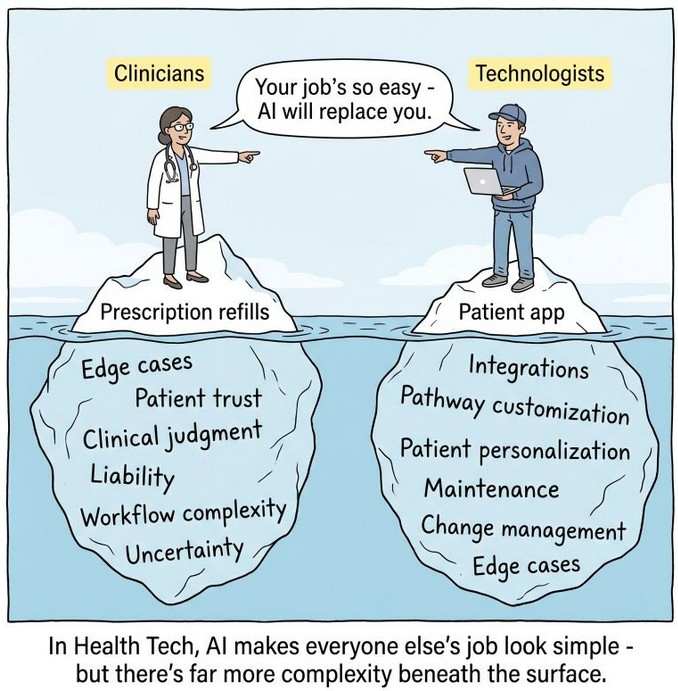
On the flipside, it’s easy for healthcare to look at AI and say “I can vibe code a working prototype in two hours, so just give me a week and I can totally replace X vendor!”
But similarly, it’s way more complicated to build and maintain enterprise healthcare grade software that handles so many complex workflows and business processes – not to mention AI coding might unlock more stuff to build and maintain – it never stops!
And let’s not forget all the change management, edge cases navigated, and more that a tech partner brought to the table even before the age of AI.
On the surface, it seems like you just need a few features and workflows to make digital health work. But once you get in the trenches, you run into “oh, but what about this edge case we never thought would happen” or “I know we asked for X, but it turns out we actually need Y”.
This is the stuff that drives IT bonkers, but it’s the stuff that tech partners who solve this specific problem live and breathe 24/7 and design for.
What this does mean is that in the age of AI, simply knowing the mechanics for building code, reviewing medical literature or writing legalese matters less and less – and subject matter expertise, judgment and taste matter way more.
Related



So, if you’ve spent decades in the trenches building real expertise – here’s your chance to unlock your impact 10x with AI.
But if you were just copying everyone else, not solving problems from first principles and doing something undifferentiated … you might be in for a rude awakening.
Dr Joshua Liu is a Canadian physician turned cofounder/CEO of SeamlessMD, a health tech company which enables CMIOs, CIOs and health systems to digitise patient care journeys with automated reminders, education and symptom monitoring – leading to lower length of stay, readmissions and costs.
This article was first published on Dr Liu’s LinkedIn feed. Read the original article here.