

This article is an edited and structured version of remarks delivered by Blair Comley at the Public Health Association of Australia Conference in Hobart. Some of the words have been paraphrased for focus and brevity.
I’ve spent a long time thinking about prevention and early intervention — in health, and before that in other areas of public policy.
In fact, I was thinking about it more than 25 years ago in social assistance, when the social investment model was becoming very topical. The idea was simple: you intervene early, when someone is relatively young, and you change the trajectory.
There were studies in New South Wales, for example, showing that if you had an Indigenous male incarcerated in their teenage years, they were likely to cost the state around $2 million by the age of 35 once you’d missed that intervention opportunity.
Now, it’s quite hard to work out the precise cost-benefit analysis in many of these cases. But it’s often not hard to think to yourself:
What would I have to believe about the effectiveness of a program to think this is worth investing in?
Usually, you don’t have to believe very much. And yet, I’ve been struck by a pattern I’ve now seen repeated for decades.
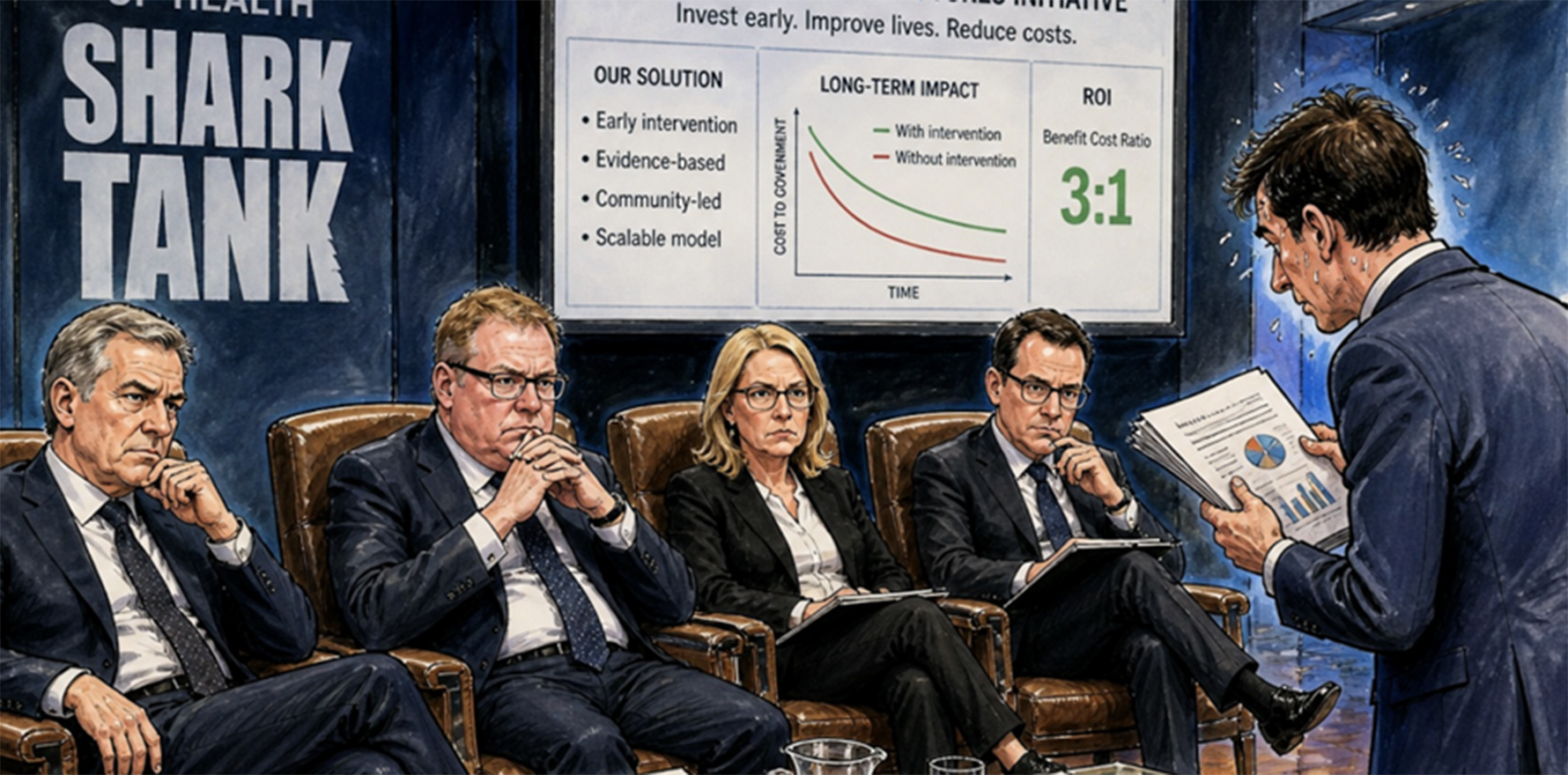
A line agency comes forward and says: “I’ve got a fantastic program. It has a benefit-cost ratio of three. This is a no-brainer. We should invest.”
The central agency responds: “I actually believe your argument… I don’t dispute that this has got a really high benefit-cost ratio.”
But then comes the catch: “So I’d just like you to do that and offset within your portfolio something else that’s clearly got a lower benefit-cost ratio.”
The line agency then says: “That would really annoy some stakeholders.”
And so nothing happens. Five years later, we have the same conversation again.
I’ve seen that game played multiple times.
So I’m actually quite convinced we don’t have much work to do convincing the centre of government that early intervention works.
What I have trouble convincing them of is something else entirely: Why I’m not doing the prioritisation myself.
The reality inside government
Since returning to the Commonwealth and spending nearly three years in the health department, I can say this clearly:
I have never had any trouble convincing Treasury, Finance or Prime Minister and Cabinet that early intervention works.
Where the conversation shifts is here:
Yes, intervention may improve outcomes. Yes, it may reduce lifetime cost for that individual. But we operate within a rationed system.
If one person doesn’t go into hospital… the next person off the queue in the ration system will go in.
So the question becomes: Where is the aggregate saving?
And the answer that comes back is: You need to prioritise within your existing envelope.
That is the conversation we have all the time.
Why your ‘self-evident’ idea isn’t landing
One of the things I’ve observed across public policy is that people who are passionate about an issue often believe the argument is self-evident.
That’s not unique to prevention. It happens everywhere.
But what I want to do is paint you a picture of what sits on my plate — and on the plate of my colleagues — and encourage you to think about how you make your case within that context.
Because the reality is, we are not looking at one proposal.
We might be looking at 100.
The priorities you need to align to
In the department, we’ve tried to create a long-term strategic framework — something that endures beyond governments.
At the highest level, our first priority is a pivot to prevention and early intervention. The second is equity. The third is digital and technology. The fourth is systems integration.
Every proposal we assess is considered against those lenses. We are constantly asking, does this proposal move the dial?
The complexity you’re pitching into
When you come forward with a prevention idea, you are not pitching into a simple system.
You are pitching into multiple systems — health, aged care, disability — and often across jurisdictions and portfolios.
Let me give you an example.
If you had dollars, what would you spend it on? I immediately said I would spend it on PE teachers.
That might sound odd coming from a health secretary. But there was research showing schools with trained PE teachers had demonstrably better outcomes years later.
Now imagine trying to implement that. Let’s take $5 billion out of health funding. Let’s give it to our education minister…
Except education funding sits with states. So now you need a Commonwealth-state agreement. You need to track outcomes over time.
You need to justify the upfront cost. That is the reality of cross-portfolio prevention.
Evidence matters, but not the way you think
There is nothing more important than evidence.
You need rigorous evaluation. You need to be as critical of your own data as anyone else will be.
But in this system, there is something else that matters just as much: The killer fact.
For me, an example is “birthing on country”.
There was a very early evaluation… a 63% lower chance of that child ending up in out-of-home care. Now, I’ll be honest: I don’t believe that fact… because I’ve never seen a social program… that moves the dial that much.
But that doesn’t mean it’s not powerful. Because it tells a story. It creates focus. And it gives decision-makers something to anchor on.
How we actually test ideas
Inside the department, we run what we call a Shark Tank.
Teams come forward. They get two minutes to pitch. Then they’re interrogated.
“You made three great points in that presentation — that’s not actually in your pitch.”
That’s the challenge. Not just having the argument — but communicating it.
The Venn diagram test
Years ago, I learned a simple framework. Take your argument and draw a Venn diagram.
In one circle, the arguments you find persuasive. In the other, the arguments your audience will find persuasive.
The middle intersection is salient points. That’s where your pitch needs to live.
Final advice
I am firmly on the prevention and early intervention bandwagon. I have been for a long time.
But I’ve also seen the barriers. So my advice is simple:
Put on the sceptic’s hat. Think about what will convince the people you need to convince — not the people who already agree with you.
Because in this system, it’s not enough for your idea to be right. It has to be:
- prioritised
- aligned
- evidenced
- communicated
- and deliverable
That’s how it gets funded.
If as a system stakeholder you are interested in contributing ideas to this topic and getting an Australian Preventative Health Agency up and running, please come to Health Services Daily’s Canberra Health Leadership Workshop and Summit on Prevention on 16 and 17 June at the Hyatt in Canberra. The first five delegates to use this discount code will get a 50% discount on any ticket type: Extra50. If you’re reading this Jim, your ticket is on us. Program and tickets HERE.