


New modelling warns the government’s new aged care system doesn’t have the money or preparation for the incoming wave.
There’s a wave of Baby Boomers about to turn 80 years old and hit the aged care system. But Professor Kathy Eagar fears the federal government is in no way prepared for them.
The former adviser to the aged care Royal Commission has presented new modelling that suggests there will be a shortfall of over 171,000 Support at Home places by June 2026 and that shortfall will only rise.
She has used ABS population projections (mid estimates) for people 65+ and 80+ and the government’s own budget papers.
“For the last decade, we’ve had around 20,000 people each year in Australia turning 80. And for the next 10 years, we will have between 60,000 and 80,000 people turning 80.
“So, we need substantial expansion of aged care to accommodate the very big balloon of population coming through.
“We’ve known for 80 years that this wave was coming through. This should not be a surprise to government. We’ve had 80 years to prepare, and yet government seems completely unprepared,” Professor Eagar told Health Services Daily.
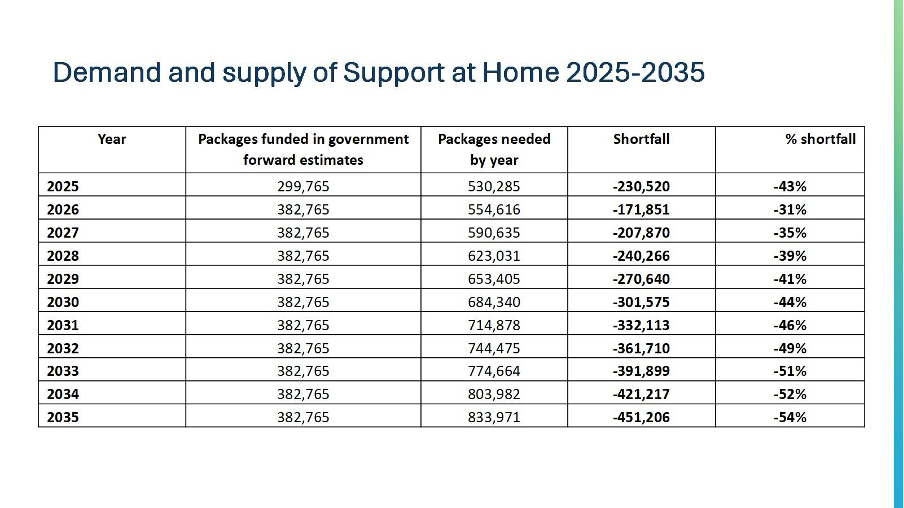
The federal minister for aged care Sam Rae has previously said that the government plans to release 300,000 new packages by 2035.
“[That] 300,000 over 10 years won’t be enough, anyway. We’ll still be at least 150,000 packages short,” said Professor Eagar.
“But in the Budget forward estimates, which is the official Budget papers, there is no growth in Support at Home in the next four years (because the forward estimates are only four years out). So there’s growth this year but there’s nothing in the budget for the next four years.
“I can only presume that when he says there’s going to be 300,000 packages, that they’re planning to put 300,000 out in the following five years, not in this current five years,” she said.
“I have no idea why.
Related



“The sensible thing to do to accommodate a population bubble like we’re about to have is to put out an increase in packages each year commensurate with the growth in population – rather than turn on the tap and then turn off the tap,” she said.
Her modelling predicts that by 2030, 44% of people who need a package won’t get one (over 300,000 people). That will increase to 54% in a decade, which is over 450,000 people.
“These percentages exclude Commonwealth Home Support Program and its current and future waiting lists, so they really are an underestimate,” she said.
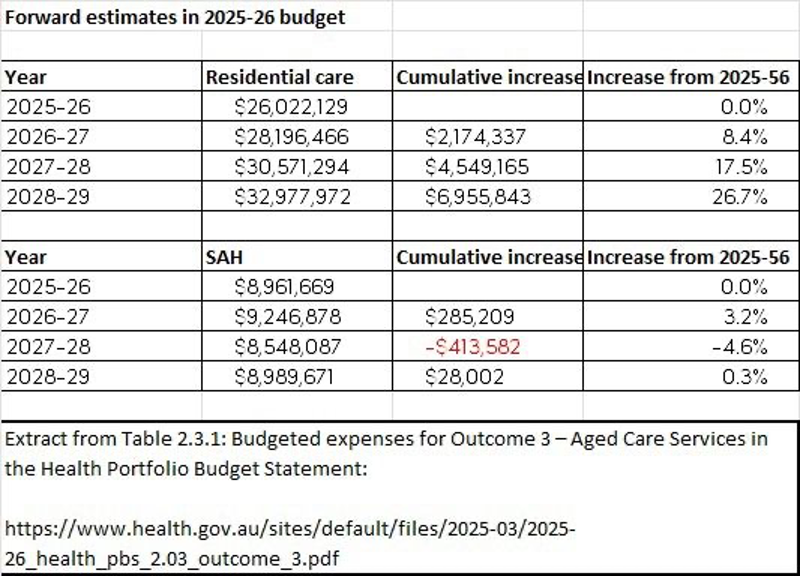
“As shown in the 2025-26 budget papers, the forward estimates from 2025 to 2029 are for a 26.7% funding increase for residential care but only a 0.3% increase in Support at Home funding,” she said.
To help pay for it, Professor Eagar said the government projects a $18.8 billion cut for aged care based on older people paying more.
“But that’s a false economy, because I don’t think that’s an achievable figure.”
Professor Eager said luckily there was that growth in residential aged care because it looks like people are going to need it.
“If people don’t get the support at home they need, they’re going to end up in emergency departments, hospital wards and nursing homes at substantially higher cost, so there’s no saving to the government,” Professor Eagar concluded.