


What we do need to do is have a fundamental rethink about revenue and the nation’s social welfare priorities. The big questions, not the petty quibbles between sectors.
On Monday, Dr Nick Coatsworth – often seen by many as a controversial figure in the Australian healthcare system – said something … well … controversial.
He was on a “big picture” panel at the Australian Financial Review’s annual healthcare summit in Sydney.
In a discussion about healthcare costs and most notably, bed block and stranded patients, Dr Coatsworth talked about the struggles he and his brother – also a medical practitioner – are having with their dementia-stricken mother, and trying to keep her out of hospital while waiting for an aged care place.
He then said the following:
“This is the reality of the situation. We talk about funding. We have to address the elephant in the room. You’ve got … the top five things that the Australian budget funds – health, aged care, defence, the NDIS and interest payments.
“One of those benefits 800,000 people and the rest of them – the [remaining] 26 million.
“When are we going to transfer some of that NDIS funding into people who pay taxes all their lives and are stuck now?”
Now, bear in mind the AFR summit is a room full of business folk, economists and policymakers. It’s all about the dollars.
Since Monday, Dr Coatsworth has been hammered on the socials.
“A person’s capacity to pay tax does not equal how much support they deserve,” said one commenter.
“Your comments on this video are just disgusting. I’m embarrassed on your behalf for implying the government should choose who’s more worthy, a disabled person or an older person,” said another.
“Disabled people pay taxes too, Jesus Christ. And we deserve care and support to live. Awful. Awful,” said a third.
“Somehow their right to taxpayer-funded care arrangements isn’t as great as those who have paid tax? That very notion and position is a very dangerous one – that people’s importance and rights should align to how much taxation they’ve paid. It’s appalling,” said a fourth.
Quite so.
I think I can safely say I have never agreed with anything Dr Coatsworth has said in his various roles. And I believe him to be 100% wrong in this case.
But not for the reasons you might think.
Dr Coatsworth, and, sadly, many of the brains thinking about health funding, are working from a narrow set of assumptions.
There is no question that Australia spends an insane amount of money on the NDIS – $46.2 billion in 2025-26 alone.
It is one of the biggest line items in the federal budget – bigger than defence and education in some forward estimates, depending on the year.
And it’s not just the absolute number that’s big. The annual growth rate peaked in the early 2020s at 23% a year. That’s dropped each year since 2021-22, down to the current 10-11%.
The Albanese government’s big plan, of course, is to get that growth rate down to about 8% per year by the end of this year.
The number of participants in the NDIS has grown as well, of course, from about 467,000 in June 2021, to about 800,000 today. That’s about 50% in four years.
The big question – at least according to Dr Coatsworth and other like-minded thinkers – is whether that spending is proportionate and reasonable compared with the amount spent on, say, aged care. Or research. Or funding GLP-1s on the PBS.
The mistake being made is thinking that if the NDIS is “overfunded” and aged care is “underfunded”, that the money should be more evenly spread between the two sectors – less to the NDIS and therefore, more to aged care.
That’s basically what Dr Coatsworth was saying on Monday. And to be fair, the underlying point isn’t unreasonable. Government budgets are finite, and trade-offs are real. Every dollar spent in one area is a dollar not spent somewhere else.
The assumption underlying this debate is that the pool is fixed. The alternative to that assumption is a bigger thought – a more altruistic approach. And yes, a more socialist approach, I guess. Sue me – Gough Whitlam was my hero.
Instead of thinking “this is all the money we’ve got, we need to figure out which bucket gets the most and therefore which bucket gets less” … why don’t we try to find some more money?
Why don’t we, for example … oh, I don’t know … increase and enforce corporate taxes? Tax the gas giants and miners more? Make the top 1% pay their fair share of those taxes that Dr Coatsworth was so concerned about?
I know, I know. I can hear you now.
“Cate, that’s not how politics works. Even left-wing governments have to pander to their corporate friends to keep the donations coming in, so they can get re-elected, earn their lifetime pensions and flight discounts.”
Greasing the wheels of government, am I right?
Related


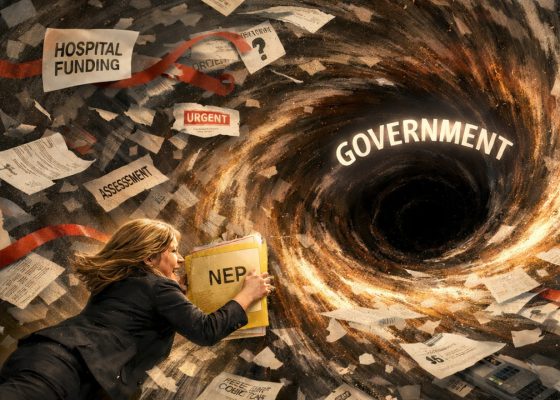
But this continual robbing Peter to pay Paul, clearly, does not work. We have to increase the size of the bucket, not pour one bucket into another.
What if what we’re paying for the NDIS is exactly what disabled Australians need us to be spending to give them appropriate levels of care and support? (It’s not, and I don’t mean it’s too much.)
What if we’re criminally underfunding aged care? (We are.)
The corporate tax rate in Australia is 30%. But many – MANY – companies are not paying anywhere near that much.
Big multinationals – Google and Microsoft are the classic examples — have been reported to pay effective tax rates in the low single digits on Australian-declared income – some outlets put it at between 1.9% and 4.8% – via declaring a large share of revenue offshore, profit shifting or only part of their revenue being treated as taxable in Australia.
Companies like Optus, Netflix, Apple, Domino’s Pizza, Virgin Australia and, in some years, CSL pay nothing in a given year, by reporting losses, using carry-forward losses, and claiming deductions or offsets.
According to some media reports over 1000 large companies paid no tax in 2022-23.
How about we fix that gross distortion before we start ripping money from disabled Australians, and under-supporting older Australians, and under-funding a research sector that returns four times what we spend on it?
NDIS growth, aged care underfunding, hospital pressure – these are actually symptoms of the same system failure, not sectors working against each other.