

The Albanese government’s attempt to have taxpayers stop paying so much for private health insurance sparked talk about premiums, pensioners and pressure on public hospitals. But, it also exposed a much bigger problem with Australian healthcare.
The fight over the private health insurance (PHI) age-based rebate sure has been noisy.
The Albanese government’s attempt to have taxpayers stop paying so much for private health insurance sparked all kinds of talk about premiums, pensioners and pressure on public hospitals.
But more importantly, it has also exposed a much bigger problem with Australian healthcare.
We have normalised a system where money buys faster access to treatment.
The Bill at the centre of the fight is fairly modest. It would remove the additional rebate available to people aged 65 and over – thus aligning the size of the rebate with other ager groups – and redirect around $3 billion over four years into aged care.
Whether this change is good policy is not really my point here. Listen, instead, to the arguments being made against it.
Faster access … for those who can afford it
We’ve repeatedly heard that private health insurance is valuable because it gives people faster access to elective surgery and greater “choice” over their hospital and doctor.
Follow that argument through, and you’ll find that what it’s actually saying is that Australians who can afford private insurance can buy themselves faster access to things like cataract surgery and hip replacements, while Australians who cannot afford it join a longer public queue.
Shouldn’t that trouble us even just a little?
Around 46% of Australians have private hospital cover. That means meaning 54% do not.
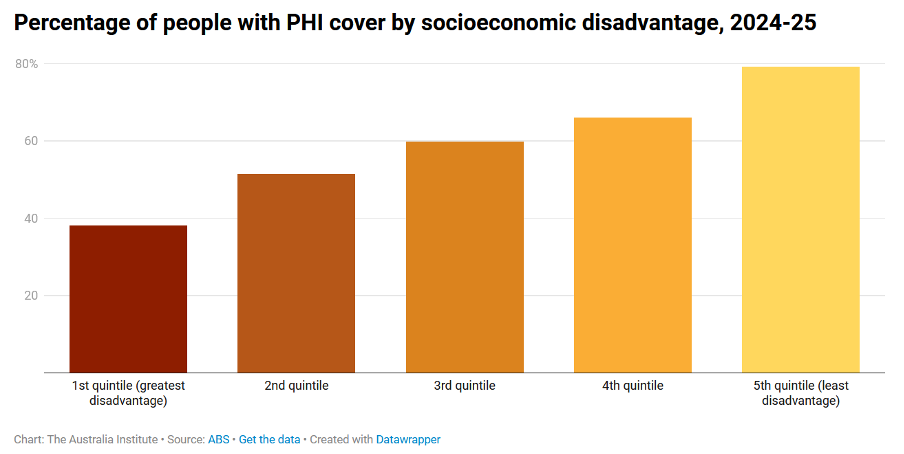
And private insurance is hardly distributed evenly. Among Australians aged 15 and over, almost 80% of people living in the wealthiest areas have some form of PHI, compared with just 38% in the most disadvantaged areas:
Hospital data tells us the same story.
Public hospital use is highest among most disadvantaged populations. Private hospital use is highest among the wealthiest:
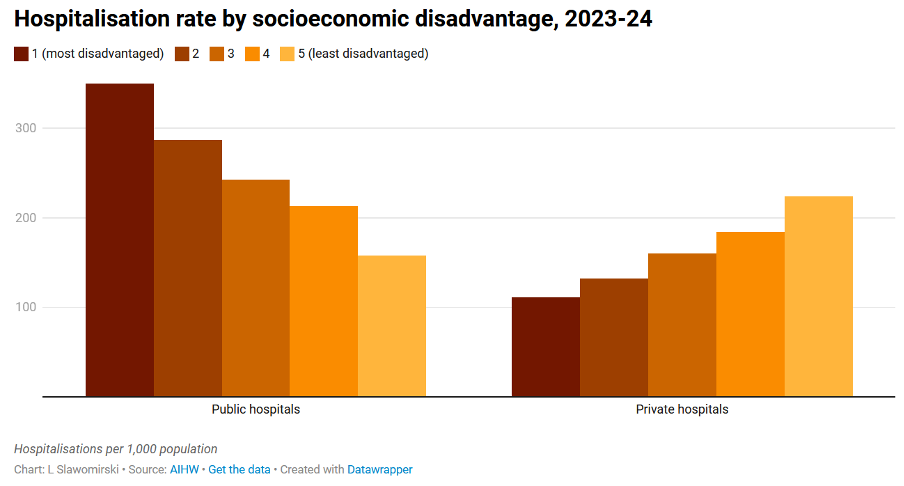
The difference is stark.
Our public system looks after people who are poorer and sicker. On top of that, public hospitals carry most of the emergency burden (private insurance doesn’t cover emergency care), while private hospitals overwhelmingly specialise in planned care. (In 2024-25, two-thirds of elective hospital admissions involving surgery occurred in private hospitals.)
This means that patients arriving at public hospitals are more likely to need urgent care, while those needing elective care must wait. The private system provides planned procedures to people with the means to insure themselves.
Competing for the same resources
First, the two systems do not have separate pools of doctors and nurses. They compete for the same surgeons, anaesthetists and other scarce health workers. A surgeon operating in a private hospital cannot simultaneously be operating on someone waiting in the public system.
Second, a significant number of private procedures don’t benefit the patient. Things like knee arthroscopy, spinal surgery, and cardiac stents for people with stable angina are no better than a placebo. This compounds the problem because it ties up scarce resources that could be put to better use in the public system.
One Australian study looked at how a particular heart examination (coronary angiography) varies from place to place. It found a large variation in how often this invasive diagnostic procedure is done around the country, but the change was only weakly related to rates of heart disease. The strongest correlation between how often these angiograms get carried out is not how sick people are, but the rate of private-hospital cardiac admissions.
In other words, more of these expensive tests get done where there is more money, or at least, more private health insurance.
More care isn’t always better care.
Related



Yet we subsidise this arrangement heavily. The Commonwealth spends around $8 billion a year directly subsidising private health insurance. That’s roughly a third of these private insurers’ annual revenue.
Think about how odd that is.
Taxpayers (including the majority without private hospital cover) subsidise a system whose most celebrated benefit is that those with insurance can get to the front of the queue for planned care.
Meanwhile, the people relying entirely on the public system are those with less money and greater health needs. Yet, despite the hand they have been dealt, public hospitals perform remarkably well where it matters most. They carry the overwhelming majority of emergency care and look after most Australians when they suffer serious acute illness. To see this, look at Australia’s rates of mortality following stroke and heart attack – among the best in the world.
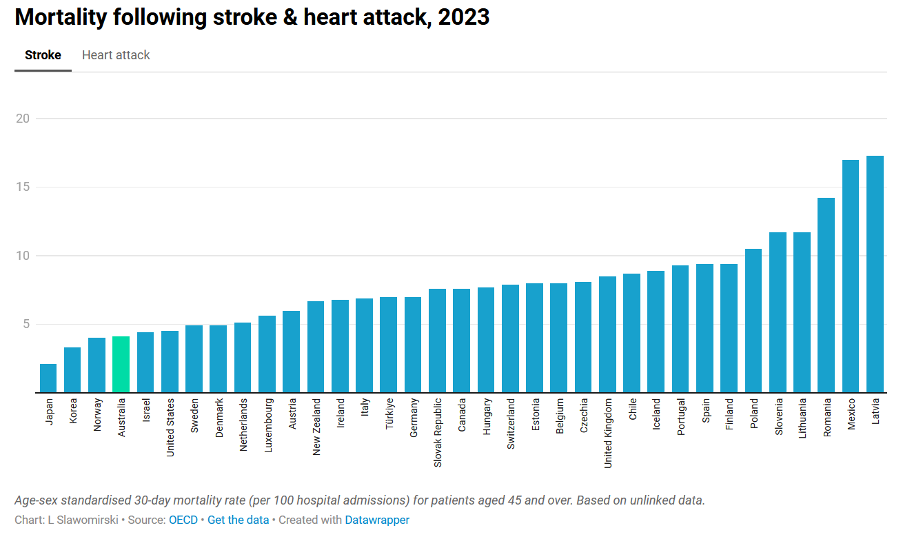
This is thanks to the public hospital system that treats the vast majority of stroke and heart attack victims.
Our two queues
There’s nothing inherently wrong with private provision of health care. But shouldn’t we question how the system allocates scarce healthcare resources and whether ability to pay should determine how quickly someone gets treatment?
Australia likes to think of itself as having universal health care. The principle behind Medicare is that access should reflect medical need rather than the size of your wallet.
Yet for a large amount of elective hospital care we have effectively built two queues.
One moves faster if you can afford the ticket, with the taxpayer subsidising that ticket.
Perhaps that deserves just a little more attention than tweaking at the edges of the PHI rebate?
Luke Slawomirski is Senior Postdoctoral Research Fellow at The Australia Institute.
This article was originally published by The Point. Read the original here.