

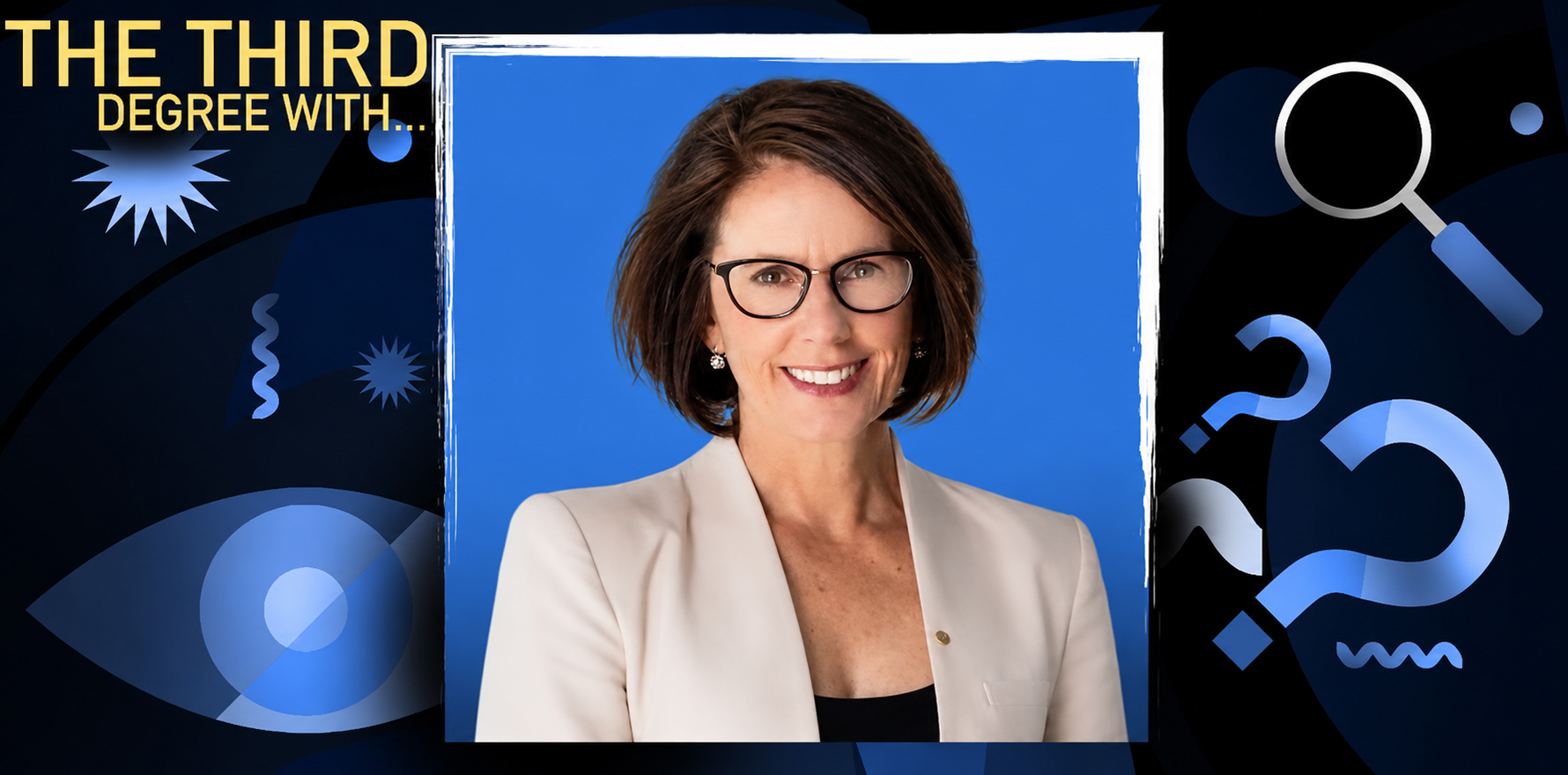
Decisions around AI need to be made with the same urgency we faced during the covid pandemic, but governments aren’t moving quickly enough, the CEO of the new Australian Council on AI Strategy says.
Australia is in a unique position to play a key role in influencing and leading debate around AI governance and safety, but only if we gain a seat at the table, says Anna-Maria Arabia OAM, CEO of the newly formed Australian Council on AI Strategy.
ACAIS is an independent, non-partisan Australian charitable body established to support AI governance and policy decisions.
Ms Arabia, a former neuroscientist with a career spanning the public service, politics and senior executive leadership, tells Health Services Daily that the speed of transformation in AI is like nothing she’s seen before and warns that raising AI literacy across key decision makers and the community is critical.
Could you talk about your background and how it led to this role?
I started my career as a neuroscientist and have engaged in a range of roles in public policy development, in advisory roles in politics and in science organisation leadership.
Most recently, I concluded a 10-year term at the Australian Academy of Science as their CEO. My experience is a deep understanding and involvement in science and technology from the perspective of a practitioner right through to R&D policy development, as well as having the political understanding of how decisions are made.
A lot of my work has been involved in science and tech diplomacy internationally, which is useful in better understanding the diplomatic efforts that are required for Australia to gain a seat at the table and have a leading role in international AI governance.
We haven’t gained that seat at the table, and when I think about some of the risks associated with AI – and I should say there are significant benefits as well – the absence of regulation in the United States, quite significant racing dynamics between the US and China, middle powers like Australia can hold levers to shape frontier AI technology and play a significant role in international AI governance.
We will only play that role if we are a significant part of the AI supply chain.
We [the Australian Council on AI Strategy] are of the view that Australia needs to host training compute in Australia.
We need to be involved in the training of frontier AI in Australia in order to have the levers and the opportunity to shape AI on Australia’s terms, and to be part of that international governance discussion or potentially lead that discussion.
Is that training occurring in Australia at the moment?
Not at all. The only countries that have training compute at scale are the countries that develop frontier AI. That’s primarily the US and China.
It’s important to distinguish inference and training compute to understand why it is important to train frontier AOI models in Australia.
There are a number of data centres in Australia. They’ve been here for many, many years, and an increasing number of them are being built here and around the world. Those are inference data centres, and they are running the processes and work that comes out of using products like Claude and ChatGPT that frontier labs produce. A query goes in, and some information is spat out.
A training data centre is quite different.
When frontier labs train their frontier AI models, they are doing so to improve their accuracy, efficiency, and speed and to make them more advanced. It doesn’t spit anything out. It effectively is designed to make that model more efficient and more advanced.
At the moment there is a race between the US and China around who can have the most advanced models, acknowledging that advanced models have dual-use capabilities. They have capabilities that carry risk.
The frontier labs in the United States – that’s Anthropic and OpenAI – only train their models in the United States but they want to expand the training of those models to at least one other country.
They have said that their country of choice is Australia. That is for a number of reasons. Australia is a democratic country. We’re one of the Five Eyes nations. We have a stable democracy and stable institutions. We have a track record in building renewable energy at scale. We have land. We are in favour of regulation, which they welcome.
Australia is seen as the country of choice for the expansion of frontier AI training.
If Australia were to gain training capability onshore, we would have levers we currently don’t have today, because when someone is operating in your jurisdiction on your soil, there are regulations and laws that can be enforced that can’t be from afar.
Some of the levers that would allow us to mitigate the risks associated with AI include requiring special data centre standards, we could ask for mandatory incident reporting so when an incident like the Medicare breach happens, we could demand that there be mandatory reporting of that.
We could ask for access to AI models before they are released, so that we can assess them and evaluate them. We could ask for our national security agencies to have special access to training models.
So we would gain a significant number of advantages if frontier AI labs were able to train their models in Australia, which are quite distinct from the advantages you gain by having an inference data centre, which don’t hold the same sort of bargaining power that a training data centre does.
The Australian Council on AI Strategy was established for a number of reasons. We recognise how fast this area is moving. We appreciate that literacy across the key decision makers in Australia – across our Parliament and our APS – is variable.
We feel it is critical that we raise that literacy because Australia has some very significant decisions to make across a large number of policy areas, and we need to be making the best-informed decisions.
We also acknowledge that frontier AI is not being developed in Australia. So, where we would normally have drawn on our Australian experts, we simply don’t have the depth and breadth of that expertise in frontier AI. We are unable to comprehensively examine it, assess it or forecast it.
Independent analysist, evaluators and forecasters in the United States hold an extraordinary amount of evidence and knowledge that we’re trying to bring into the Australian ecosystem, so that the decisions we make are informed by the best available knowledge.
How did the new Australian Council on AI Strategy evolve?
The Australian Council on AI Strategy was formed to bring the best available evidence anywhere in the world to Australian decision makers, so that we make informed decisions around the development of AI in Australia, and so that we can do so on Australia’s terms.
We’re an independent, non-partisan NGO that is not funded by AI companies or any of the stakeholders – the data centre providers, the energy proponents, energy companies or copyright stakeholders.
I say that very deliberately because we do bring a very independent lens to our work.
We are assisting decision makers in the national interest, as well as in the global public interest. So, Australia has a very important role in advancing global AI safety.
Related

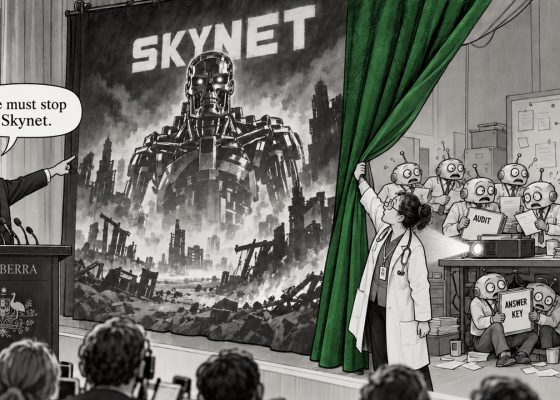

What we do in Australia in our national interest is important for us here, and we should absolutely focus on that, but Australia can also act to improve AI safety globally, and we are uniquely positioned to do that because we are a Five Eye country and we have a strong alliance with the United States.
We know that we need better regulation around AI. We know we need better risk mitigations around AI. We know that so far, the United States administration has been reluctant to put any guardrails around AI development, so there is a role for other countries to play, and Australia can play that leading role in global AI safety, especially if we have frontier training compute here.
What are the biggest challenges with AI at the moment in Australia, particularly around health?
I think there are some challenges and some opportunities. The opportunities in healthcare, of course, go to improved healthcare for patients, where AI can enhance decision making.
For example, a patient who may be diagnosed with cancer might be directed to a clinical trial that is better suited for them, because their particular diagnosis can be checked against data sets that are larger than were possible without the involvement of AI.
When I think about drug discovery, the development of vaccines – and therefore the positive benefits on healthcare – AI doesn’t just hold extraordinary promise but is already showing the benefits we can have as a community in healthcare.
They’re not to be underestimated, and they are by far some of the most exciting aspects of AI development in Australia and across the world.
However, in terms of challenges, I think it’s quite important that the community are aware of the extent to which AI is being applied to their healthcare and to their experience of the healthcare system, whether that’s in a hospital, at their GP, and how they might engage with healthcare through government services.
It is important for there to be awareness around that and for there to be ultimate human oversight of decisions where AI is involved. So far, there’s no reason to believe that’s not happening.
As models get more advanced, I think it will be important to reassure patients of that oversight. It is often said that the best solution is AI and humans working together, not humans alone and not AI alone, that often generates the best benefits for everyone.
Ensuring that AI is used, is verified, and that Australian data can be used to inform those decisions is important.
What led you to taking on this role?
I’m a trained neuroscientist, so I do have a bent towards this. I never thought my neuroscience training would be so relevant, but I have been involved in science and tech all of my life.
Once I concluded my term at the Australian Academy of Science, I was keen to lend my skills to areas that I felt were of great national and global interest.
And as I continued to look at emerging technologies – as I have over the course of my career – I couldn’t see past the implications of AI on our society. As someone with an understanding of neuroscience, as someone who has worked in policy development, in politics, and in science and tech locally and abroad, I felt I could make a contribution in the best possible development of AI in this country, for the benefit of Australians.
I felt that it was an area where I could bring my skill and expertise to something that I feel is extraordinarily significant for Australia and for the world.
I have never really seen anything like the transformation we are going through now. In all of my years in policy development, the pace of change is like nothing I’ve ever seen.
The complexity of the decision making, the unorthodox scenarios where you have private companies asking to be regulated, and governments that won’t regulate them. That’s not the Australian government, of course.
It’s a topsy-turvy world. And I feel that I can’t see past this AI moment. I can’t see what’s more consequential right now.
I feel like in time we will look back at this period and fully appreciate what any extraordinary transformation we’re living through.
It does have, for me personally, enormous parallels with covid in terms of the urgency required for national and international governments to move. I think the threat is as great, but that is not yet as present as covid was in the lives of Australians and others around the world.
When the Medicare incident happened, it was brought to people’s living rooms in a way that it hadn’t before.
We feel very proud about Medicare in Australia, and we love our Medicare system for good reason. So, when there is a disruption of it, we don’t like it. It was a benign disruption, but it was an early warning sign.
I think people are starting to appreciate the scale of the potential threat and what needs to be done.
I feel the decisions that need to be made by the Australian Government are as urgent as the decisions we made during the covid pandemic, and I am not convinced that governments are moving at the required speed.