


The DoHDA knew its advice to aged care assessors conflicted with the rules before Support at Home began. Most assessment organisations subsequently raised concerns and reported algorithm results that did not align with clients’ needs.
Federal aged care minister Sam Rae and health minister Mark Butler were warned days before the new Aged Care Act commenced that assessors had no legal discretion to override the algorithm determining older Australians’ ongoing home-care classifications.
Documents released under freedom of information laws show the Department of Health, Disability and Ageing knew its legal position contradicted its previous public statements, workforce guidance, draft assessment manual and the functionality built into its IT system.
An urgent brief sent to Mr Rae on 29 October 2025 and copied to Mr Butler said the Aged Care Rules provided “no legal discretion for assessors or assessment delegates to override the recommendation of the algorithm for a SaH classification”.
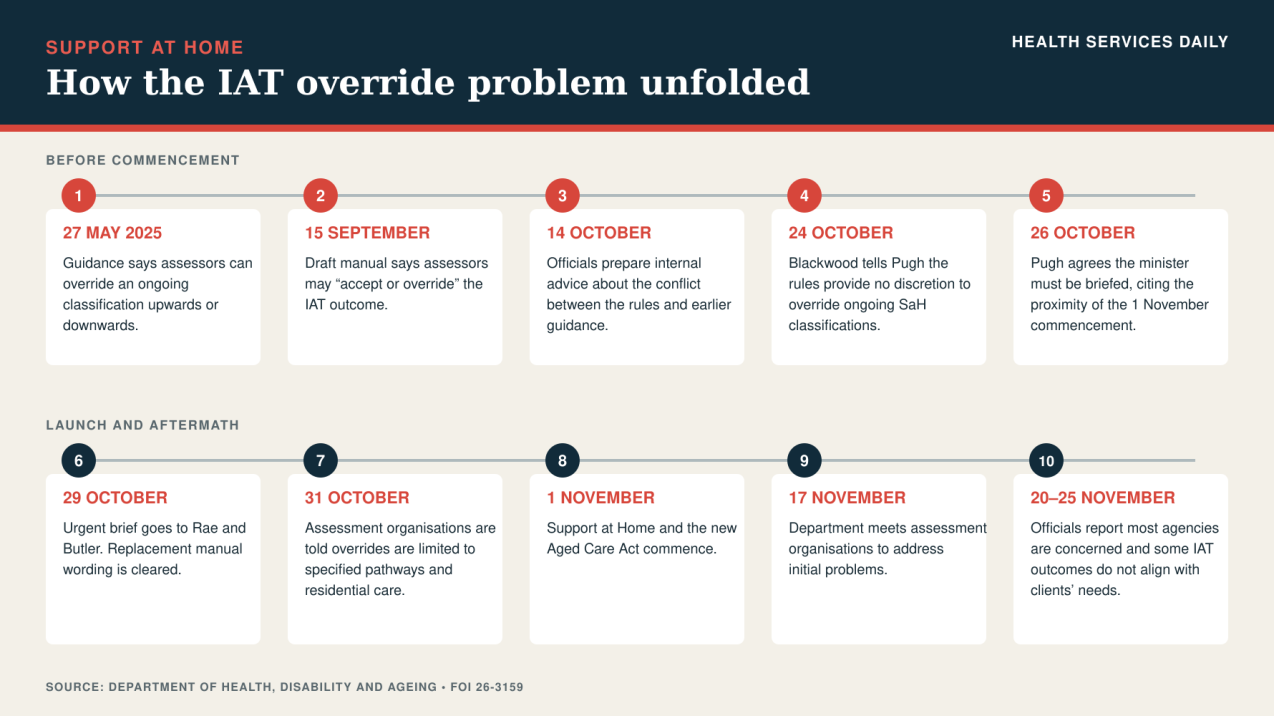
Support at Home and the new Aged Care Act commenced on 1 November.
By late November, the department was preparing to tell Mr Rae’s office that the “majority” of aged care needs assessment organisations, including state and territory governments, had raised concerns about the inability to override Integrated Assessment Tool classification results.
Assessment organisations had also reported cases in which assessors believed the algorithm had generated an outcome that did not align with the client’s needs.
Override had been a ‘settled position’
The IAT uses information recorded during an aged care assessment to produce an outcome recommending Commonwealth Home Support Program eligibility, one of eight ongoing Support at Home classifications, or ineligibility for government-funded aged care.
The October ministerial brief said the classification algorithm was developed through analysis of 22,000 participant assessments collected during the IAT live trial between April and August 2023.
But the department had consistently told assessors that their clinical judgement remained part of the classification decision.
In a 24 October email to then Access and Home Support division first assistant secretary Greg Pugh, Single Assessment System branch assistant secretary Rachel Blackwood wrote:
“It is clear that the inclusion of an override has been regarded by many staff, and SES, including my predecessor and the former B1 of Support at Home Branch, as a settled position.”
The assumption had been reflected in advice to assessment organisations and the design of the IT system, she said.
“We have consistently indicated that assessment delegates would have the discretion to use their clinical judgement to override the recommendation of the SaH algorithm,” she said.
However, Ms Blackwood said clause 81-10 of the Aged Care Rules had been drafted to produce a different result.
“The Rules prescribing criteria for classification decisions … have been drafted to provide no discretion for assessors or assessment delegates to do anything other than accept the recommendation of the SaH algorithm for ongoing SaH classes,” she said.
Overrides remained legally available for specified short-term pathways and residential aged care.
Guidance contradicted the rules
The FOI package contains a departmental record of previous advice given to the assessment workforce.
A change guide issued on 27 May 2025 said an assessor dealing with a person entering aged care could override an algorithm-recommended classification either downwards or upwards.
It gave examples of moving a person from Support at Home class 3 to class 2, or from class 3 to class 4.
A draft Aged Care Assessment Manual dated 15 September also told assessors:
“Assessors will have the option to accept or override the IAT outcome.”
The draft then described how an assessor could select a different Support at Home classification and record a reason for overriding the algorithm.
The department’s urgent brief acknowledged it had “regularly indicated” in public statements and media responses that assessors would be able to override IAT recommendations. Guidance to the workforce had reflected the same position, while override functionality had been built into the system.
Mr Pugh responded to Ms Blackwood’s advice on 26 October, agreeing that the minister needed to be briefed so he could make an informed decision about the next steps.
He said he was comfortable that the approach being taken was “the best available in light of all contextual circumstances, including proximity to 1 November and having a clear and workable pathway to address it”.
The substantive options considered by the department and parts of its legal advice have been redacted from the released documents.
Assessors told not to use available function
The department instead rewrote the assessment manual immediately before commencement.
Mr Pugh cleared the replacement wording on the evening of 29 October, saying it was “clear on what can and cannot be done”.
Assessment organisations were advised on 31 October that assessors could override an IAT result to recommend specified short-term pathways or residential aged care, but not to change an ongoing CHSP or Support at Home classification.
The final guidance acknowledged that the system still allowed actions assessors were legally prohibited from taking.
“The IAT Outcome has functionality that allows for particular actions that must not be taken by assessors as these actions do not align with the Rules,” it said.
It said an override could technically be used to change an ongoing classification – for example, from Support at Home class 5 to class 6 – but assessors must not do so.
If an assessor did override an ongoing classification, the assessment delegate was instructed to “disagree” with the recommendation and change it back to the level generated by the IAT.
The revised manual said the system was designed to achieve consistency by ensuring decisions were “not influenced by individual discretion or subjective judgment”.
Related



Concerns materialise after launch
The ministerial brief warned that assessment organisations and individual assessors might criticise the new position because it was inconsistent with previous government statements.
It also identified a risk that the late change in advice would not reach assessors in time to alter their behaviour.
That concern was followed by widespread objections after commencement.
In a draft update for Mr Rae’s office prepared from 20 November, officials wrote:
“The majority of aged care needs assessment organisations (including state and territory governments) have raised concerns about the inability to override the IAT classification algorithm.”
The update said assessment organisations had supplied details of cases in which assessors believed the algorithm produced results that did not align with clients’ needs.
The department was analysing those cases to inform further guidance and “consideration of future updates to the algorithm”.
Officials held a forum with assessment organisation operations managers on 17 November to address initial problems and began developing additional guidance, questions and answers, and updated training material.
How the override problem unfolded
HSD has asked the DoHDA and the ministers’ offices when the department first identified the legal conflict, who approved the relevant rule, what action Rae and Butler took after receiving the warning, how many questionable outcomes have been reported, and whether the rules or algorithm have since been changed.
HSD also asked whether the System Governor issued a written authorisation under the Aged Care Act for automated classification decisions.
No response had been received by publication deadline.
Read the full FOI release here.