


MBSPro frames its ambition as an 'intelligence health layer' – making a patient's own information more accessible to them and their doctor, not replacing the record itself.
Software vendor MBSPro has built a patient-facing app that pulls data straight from My Health Record – pathology, imaging, specialist letters – on to a patient’s own device, with an AI layer that translates it into plain English.
It’s a small build, funded by Queensland Health, that seems to point to a strategic bet that the My Health Record will be a suitable way to an AI EMR into the future.
MBSPro’s Casey Going says the app isn’t proprietary to MBSPro’s own practice management software.
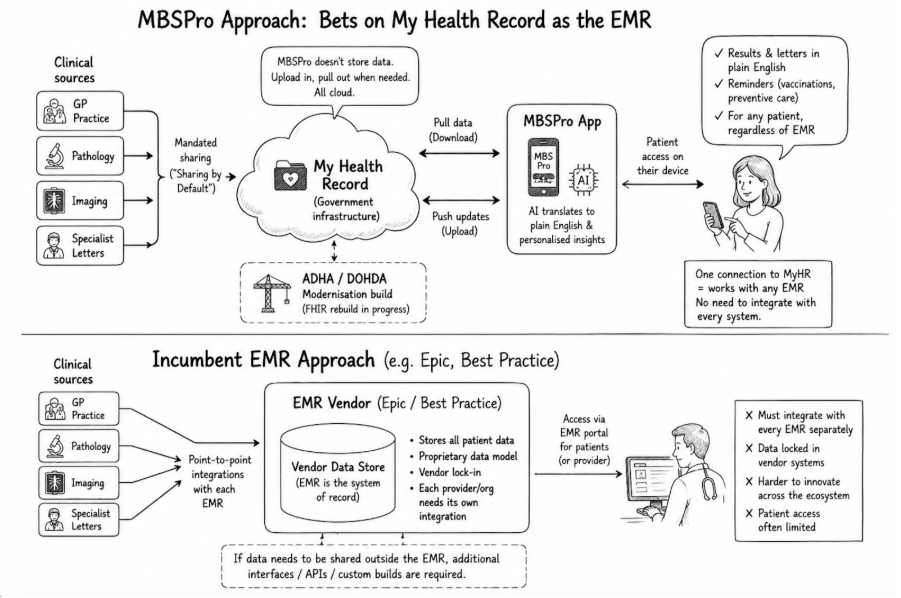
It’s being built as a general-use patient app, open to anyone, regardless of which clinical system their GP runs.
Patients get notified when they’re due for vaccinations or preventive checks based on what’s in their MyHR and get specialist letters and results translated out of clinical jargon automatically.
An interesting design choice sits underneath all that: rather than building a data store of its own, MBSPro’s plan seems to be to push everything back into My Health Record and pull it back out again when needed – upload and download, not build and hold.
All cloud.
Mr Going frames it partly as a security choice: not warehousing patient data yourself is, on its face, safer than the alternative.
But it might turn out to be a shrewd strategic one.
It means MBSPro doesn’t need to solve interoperability with every EMR in the country one integration at a time – it just needs one connection, to MyHR, and lets government-built plumbing do the rest.
Better still the government isn’t so far planning on making every vendor and provider work to one set of sharing standards and open APIs like the US government did with 21st Century Cures Act. It’s mandating bit by bit, so far, all sharing to the My Health Record as first stop.
That’s not a great strategy, but if they stick to it, MBSPro might end up in a good spot.
My Health Record’s own architecture isn’t finished being built for this kind of thing so the strategy has a downside.
MyHR is still mid-transition: Telstra Health’s FHIR rebuild of its data architecture is only partway through a three-year build, and most of what flows into MyHR still arrives as static, uploaded documents rather than atomised, queryable data.
An app leaning entirely on MyHR as its backend is, in effect, betting on infrastructure that’s still being poured.
It’s also, deliberately or not, about as government-friendly a strategy as a health vendor can run.
It means MBSPro’s roadmap lines up neatly with the Australian Digital Health Agency and the Department of Health, Disability and Ageing’s own stated direction – sharing by default, the MyHR modernisation build, the whole “everything flows through the record” architecture we’ve spent months picking apart.
Whether that architecture is actually the right one long-term is a different question. Either way, Queensland Health funding for exactly this kind of build suggests the government is happy to back vendors who play inside its own system rather than around it.
The interesting dynamic here is that the DoHDA and the ADHA have shown a penchant for backing single vendors running national infrastructure. See ERx.
Also in today’s edition:
- Four-week deadline sharpens questions over Northern Beaches SDPR go-live
- Updated: Government abandons plan to fold CHSP into Support at Home
- ‘Not until 2028’… except for the NDIS rules changing next week
- One in five Australians putting off mental health care over cost
- Bupa bids to enter primary care funding arena ‘with humility’
- Smoking rates are down, so why are there so many tobacconists?
- Medibank’s underlying profit edges up as health arm surges
It’s a different path to the one Heidi and Lyrebird appear to be walking.
Where MBSPro is explicitly avoiding building its own patient data store, Heidi’s new “Patients” tab session files a persistent patient record, sitting entirely inside Heidi’s own infrastructure – looks like the early skeleton of a system of record that doesn’t depend on MyHR at all.
Mr Going, who’d seen the Heidi feature, called it “looking like an EMR lite”.
But both Lyrebird and Heidi are betting they can force their way into the enterprise hospital market. Heidi by flooding the hospital zone with its free version and seducing the clinical leadership to specify them when the time comes for a formal scribe tender, which means that any integration to Epic or Oracle will be directed by that hospital.
MBSPro frames its ambition as an “intelligence health layer” – making a patient’s own information more accessible to them and their doctor, not replacing the record itself.
But the direction of travel across the AI scribe category looks the same regardless of the branding: more of these tools are quietly accumulating longitudinal patient data, one way or another.
Some, like Heidi, are building the store themselves or trying to seduce their way into markets and incumbent EMR integration.
Others, like MBSPro, might be betting that government’s own record will end up doing that job for them.