

A damning staff survey, an impending review, and a rumbling discontent continue to flag the toxic culture surrounding the country’s biggest digital health rollout.
You can ignore one whistleblower. You can dismiss a union. You can dispute an individual complaint.
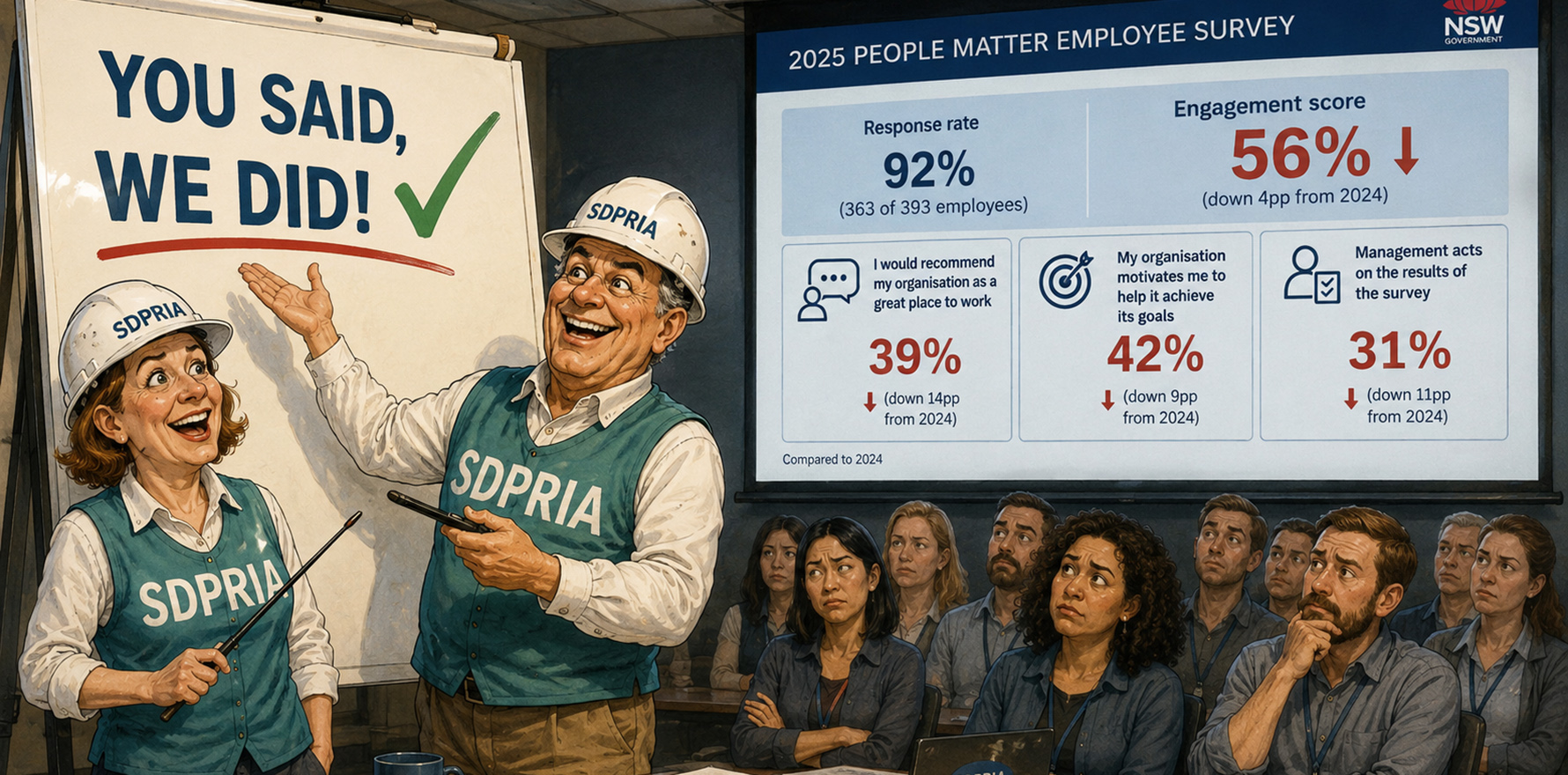
But when 92% of your own employees voluntarily fill out a survey and tell you morale is collapsing, that’s not disgruntlement.
That’s organisational feedback.
The Single Digital Patient Record Implementation Authority is in just such a position.
Last August and September, as its staff were preparing for the first tranche of the $2bn Epic rollout across New South Wales, the SDPRIA asked its workers to fill in its 2025 People Matter Employee Survey.
We’ve all been presented with these surveys. Most people don’t bother responding, or if they do, they aren’t honest, usually because many employees remain sceptical that surveys are truly anonymous.
Ninety-two percent of SDPRIA staff – 363 workers – responded to the 2025 PME survey. Ninety-two percent – significantly more than the previous year.
And they didn’t hold back. The numbers are damning.
Just 39% of SDPRIA staff would “recommend my organisation as a great place to work” – down 14% from the previous year, down 20% on the rest of the sector, down 17% on the rest of the health portfolio.
Just 42% said “my organisation motivates me to help it achieve its goals”; just 44% said “my organisation inspires me to do the best in my job”; just 42% felt “a strong personal attachment to my organisation”.
And only 54% said they were proud to tell others who they worked for. Wellbeing? Just 42%. Pay rates? Only 40% were happy.
Just 31% felt the management acted on the results of the previous survey.
Which brings us to another telling document.
A message from the CEO, Dr Teresa Anderson to her staff, fell into HSD’s inbox this week.
“You said, we did!” it proclaimed and then proceeded to list all the things the SDPRIA management team has done to address the concerns raised in the 2025 PME Survey.
Dr Anderson said she and her managers had provided wellbeing education, a staff intranet, counselling sessions from Telus Health, the development of a diversity, equity, inclusion and belonging strategy, superstar awards, and regular social events “such as NAIDOC Week”.
Other actions included, according to Dr Anderson, regular “P&C drop-in sessions” for staff, development of a recruitment strategy, establishment of a formal Work Health and Safety Committee, a new onboarding process, regular updates on PMES results, increased SDPR Connect staff meetings, and the launch of a Management Accountability Framework, and the launch of a People Manager dashboard.
Related


Several staff have told HSD that they dispute management’s characterisation of the initiatives, describing them as largely symbolic.
HSD understands the Work Health and Safety committee was only established in the last couple of weeks. Attendance at P&C drop-in sessions has been close to zero.
“They are meaningless initiatives,” said one source.
The timing of Dr Anderson’s email detailing these initiatives is notable.
Any day now – we believe it was probably yesterday – HealthShare NSW will be giving its “arm’s length” psychosocial review of the SDPRIA’s workplace culture and practices to the Health Services Union.
All indications are that will bring some consequences for the SDPRIA management. We hear they only just avoided another stop-work meeting a week or so ago.
Yesterday HSD ran an opinion piece by Dr Sidney Chandrasiri and Professor Luis Prado from the Australian Institute of Health Executives about psychological safety and psychosocial safety in healthcare workplaces.
“Employees judge psychological safety not by organisational statements, but by repeated leadership behaviours,” said Chandrasiri and Prado.
“Culture is not created through values statements. It is created through repeated leadership behaviour.
“The highest-performing healthcare organisations recognise that safe cultures are not built through slogans.”
You said, we did? The SDPRIA is about to find out if its staff believe it “did” or not. The 2026 PME Survey opens on 17 August and runs until 11 September.
My mother used to say the only real apology is a change in behaviour.
On 17 August, SDPRIA staff will begin telling their managers whether they think behaviour really has changed.
Watch this space.