

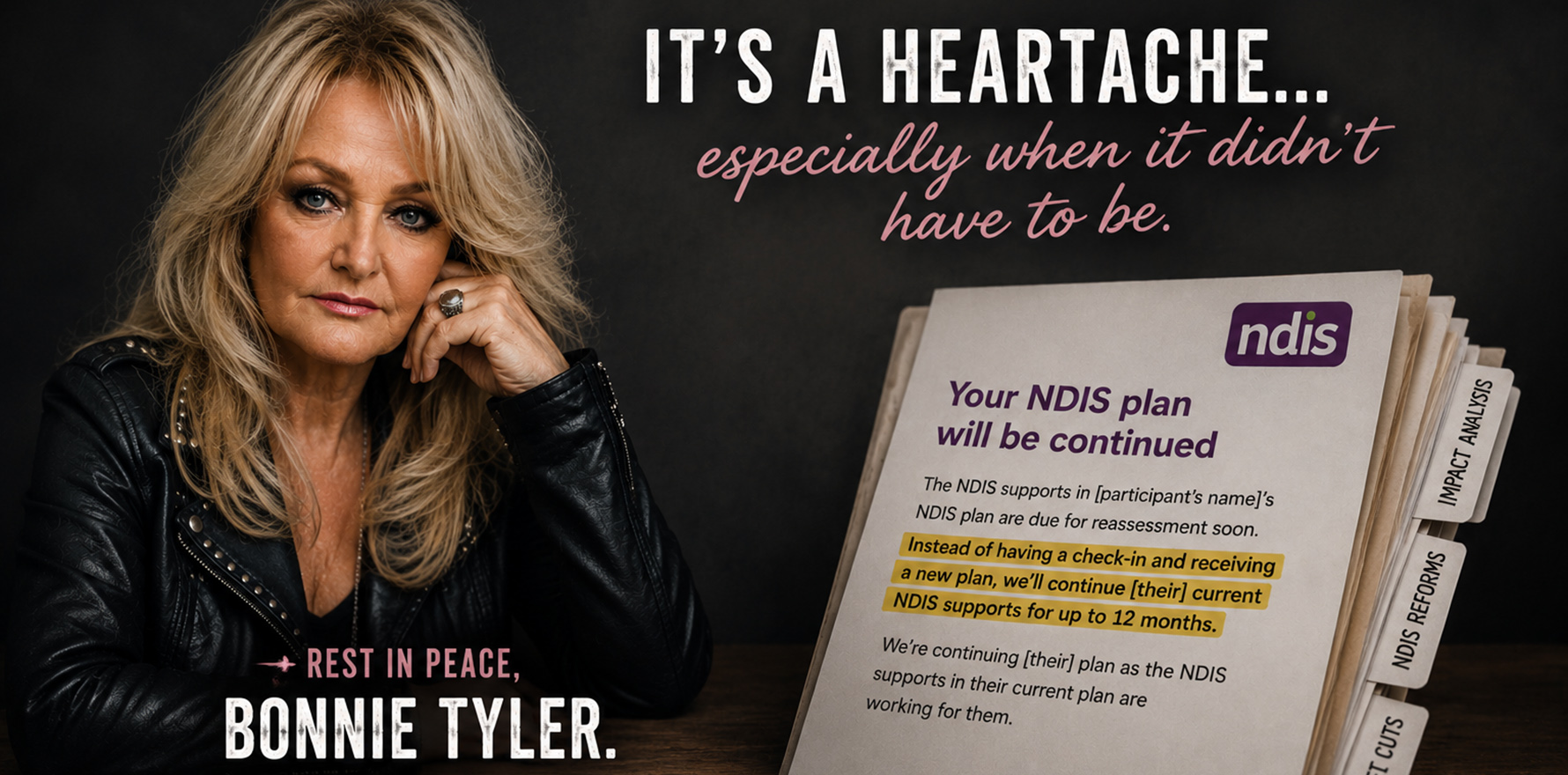
Bad communication or bad policy? Does it even matter anymore? The result is the same in the end.
Bonnie Tyler died this week. Like most people of a certain vintage, I spent a few minutes down a YouTube rabbit hole revisiting her greatest hits.
Which, oddly enough, is also a pretty good soundtrack to the Department of Health, Disability and Ageing’s handling of the NDIS reforms.
At the risk of being repetitious, what the hell, DoHDA?
This week HSD was handed two examples of the exact kind of obfuscation and corporate weasel words from the DoHDA that it feels like we have been banging on about for months.
Total eclipse of the facts
On Tuesday, while noodling around the government websites, as you do, we came across a nugget of weirdness that makes every journalist’s spidey senses tingle. It led us to writing this story, right here.
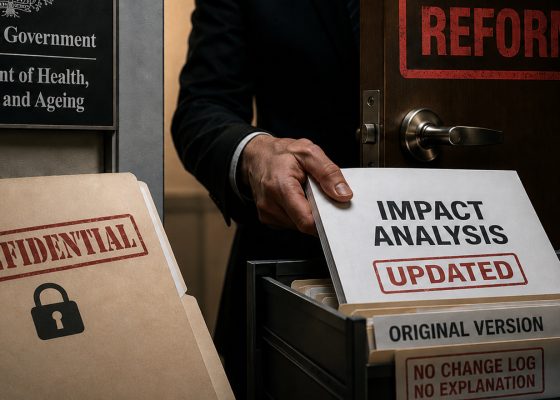
You don’t have to be a subscriber to read that one in full, but to save you a click or two, here’s the summary. The DoHDA changed two things in its own impact analysis of the NDIS reforms bill.
One was a column in a table about the number of NDIS participants receiving funding for Supported Capacity and Capability Program.
The second was a single sentence about the NDIA’s claims about the amount of fraud in the system. The change narrowed the claim from 90% of NDIS providers, to 90% of NDIS providers servicing less than 100 clients.
The next day, of course, the DoHDA brushed it all off as administrivia. Nothing to see here. Just a correction of an error (duplication of a table column), and – well, they didn’t have anything specific to say about the change in the fraud indicators statement.
Neither had an impact on policy, they said.
To all of this I say two things.
One, bullpuckey. And two, you’ve missed the point, dear DoHDA, yet again.
Bullpuckey because, whether it was a typo or not, when you change “only 30% of people with a psychosocial disability need SCCP funding” to the reality that actually 96% of them do, that fundamentally alters some pretty basic foundations of your own modelling.
Modelling which – in your own impact analysis on pages 37 and 60 – specifically says you’ve modelled a 50% cut to SCCP funding.
Now, of course, the DoHDA will argue that its policy was based on the corrected numbers all along, it just published the wrong numbers.
Which leads me to number two – you have missed the point, DoHDA.
If the changes were inconsequential why did you not make them public? Why did you squirrel them away in a line in a table which only someone who has tracked the versions of the IA report since Mr Butler’s announcement back in April, would have noticed?
If the changes are inconsequential it surely would squash all inferences of at best, a stuff-up, and at worst, deliberate obfuscation, to say, “hey we made a couple of typos, here’s the corrected version”.
Which brings me to the second example of weasel word chicanery for the week.
Related

It’s a (needless) heartache
I have a close friend who has an adult son who has been an NDIS participant for a number of years. It has been a bumpy ride getting him the supported independent living and supports he needs but he is at long last living his best life – which is of course what the NDIS was set up to do.
She called me this week to tell me she was filled with joy to receive a letter from the NDIS titled “[Her son]’s NDIS plan will be continued”.
The joy lasted less than 30 seconds, because as we are all learning, all is not what it might first seem with the NDIS these days. It’s all in the fine print, although in my friend’s case she didn’t have to read past the first paragraph to find the joy-killer.
“The NDIS supports in [her son’s] NDIS plan are due for reassessment soon. Instead of having a check-in and receiving a new plan, we’ll continue [her son’s] current NDIS supports for up to 12 months,” the letter began. (Our emphasis.)
“Given everything I have read and heard from other families and in the media about the cuts being made across the board, I felt such relief,” my friend told me.
“Preparing for an NDIS review is not for the faint-hearted. It means hours and hours of time, therapists and support staff needed to write extensive reports, which also have to be paid for and can cost thousands of dollars.
“Because my son has such an amazing team – all of whom are accredited and registered NDIS providers – we had already started. But I was so happy to feel that pressure taken away. It also meant no more sleepless nights worrying about how I would fill in the gaps when his funding was cut.”
But then she read the letter again. The words “for up to 12 months” kept jumping out. And her heart sank like the proverbial stone. There it was. The devil in the detail.
“So, what this letter is saying that while his plan is being continued, it could be 12 months, it could be six months, it could be one month,” my friend said.
“I would rather have the review. Instead we will now live on tenterhooks waiting for the next letter that says his plan is being reviewed.”
There was another paragraph in the letter that also sticks in my friend’s head.
“We’re continuing [her son]’s plan as the NDIS supports in their current plan are working for them,” the letter said.
“How could they possibly know this?” my friend asked.
“And if they truly believe it, why would they need to review it ever, unless they heard from us that it wasn’t working.”
When my friend’s son was diagnosed more than two decades ago, there was no NDIS. There wasn’t even a Medicare subsidy to help with the thousands and thousands of hours of therapy he needed. It was up to his parents to find that money.
The NDIS has been a life-changer for him and his family. He can have a job and live independently from his family with the support he needs. He is a poster child for the success of this scheme.
But it’s back to sleepless nights and worry for my friend. Maybe the NDIS and the DoHDA didn’t actually mean to cause anxiety with their terrible communication strategy, maybe they did.
It doesn’t matter now. Job done.
Holding out for a hero
I know I sound like a public radio station with a limited supply of music to play.
But if the DoHDA and the NDIS want to be a little less Bonnie Tyler and a little more Rick Astley they need to lift their games.
Trust, unfortunately, doesn’t come with a catchy chorus.
Rest in peace, Bonnie. Legend.