


The government has funded more than 20% of residential aged care homes to have clinical grade virtual care infrastructure but a large proportion still isn’t being used. Why?
Over 200,000 emergency department presentations each year involve residents from aged care homes and it is estimated that up to half of these may be preventable.
The associated costs of these potentially preventable admissions equate to around $312 million dollars per year to the health system.
Of the many strategies available to address this problem the most effective is connecting residential aged care facilities to regional care providers via clinical grade virtual care systems.
Unbeknown to a lot of people is the fact that a couple of years back the federal government funded primary health networks one off to the tune of about $10 million to try to address this problem. As one result of what many PHNs ended up doing, more than 520 RACFs equipped themselves with clinical-grade virtual care infrastructure from Visionflex, capable of delivering hospital-level assessment at the bedside.
Today, much of this capability remains underutilised, but it doesn’t have to be.
A system under pressure but with the key starting asset now in place
The functionality of the kit in these 520 RACFs includes connectivity to primary care and, crucially, semi-acute diagnostics such as comprehensive vital signs, ECG, ultrasound, heart and lung assessments with multi-filter stethoscopes, ENT imaging, wound and skin assessment, and more.
The potential to transform care delivery and reduce ED presentations is substantial yet is being largely underutilised outside a few highly engaged aged care providers, PHNs and GP clusters.
Those RACFs which aren’t using their new gear properly yet are not that hard to engage but someone needs to now take what is in play and work out how to pay for the nexus between them having the gear and using it.
The important part of anyone picking up this problem is that the return on investment for both the RACF and for the hospital system is huge. But who joins those dots in a funding paradigm that doesn’t recognise the opportunity and isn’t designed to help such a situation?
Also in today’s edition:
- ‘Mixed emotions’ as NSW IRC orders one-off reset of nursing wages
- ‘Totally gutted’: Cohealth patients brace for another GP services shock
- Reluctant pharmacists and confused GPs big barriers to 60-day dispensing
- Why Australia must act now on chronic disease
- Coalition says transparency bill ‘not ready’ as it clears senate inquiry
- Over 90% of us want more federal funding for dental care
- NDIS tops 761,000 participants as growth steady ahead of budget crunch
- SEQ identifies growing digital health needs
This is not a technology problem
Scale and reach into 520+ RACFs exists at a capacity that the ROI at scale is big.
The kit in all these locations can deliver real-time clinical access to semi-acute diagnostics and virtual ED level support inside residents’ homes which could avert unnecessary ED transfers and hospitalisations.
The federal government has made a significant infrastructure investment. The ongoing cost of deploying and operating virtual care is comparatively low, especially when spread across a large network of homes but it’s hard for the RACFs to fund it themselves because the ROI is mostly upstream in the hospital system.
States or the federal government are the most likely candidates to understand this opportunity and the ROI, but there are so many siloed programs, and the politics can be so tricky that seeing the wood for the trees in hospital avoidance can be very difficult.
In addition to this established infrastructure, the covid era accelerated virtual care adoption across states and territories, creating a much more ripe landscape, albeit still fragmented, for scalable, state and nationwide implementation.
The opportunity is not technical, it is structural
Fragmentation exists across federal and state funding models, PHNs and local commissioning, workforce capability and training and clinical governance and integration.
It’s essentially a combination of all these factors, operating in an efficient manner, that prevents this investment from being fully realised.
What could happen next
At a state or federal level, it would not be hard to map the 520 RACFs and prioritise some of them based on the dynamics of the particular RACF – their willingness and ability to engage – and, more importantly, regional need.
Such a program would not be expensive and it could be piloted easily and quickly, based on understanding just how well those RACFs that are using the infrastructure are doing, including the effect of having local RACFs engaged and using the infrastructure on local ED presentations.
With sufficient seed funding and co-ordination, the higher priority locations could be encouraged to partner with state-based virtual health services to implement consistent clinical governance frameworks, escalation protocols, and data-sharing agreements between aged care providers, PHNs, and the states’ virtual health services.
Related

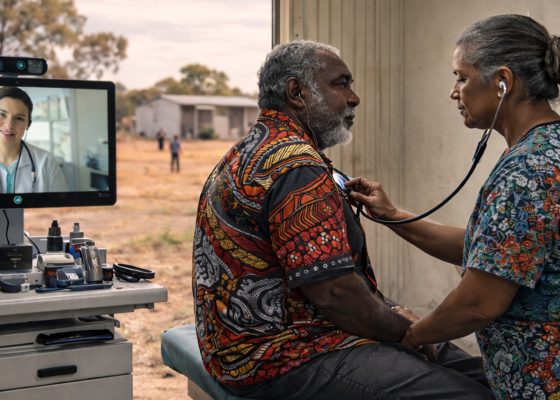

As a part of the program local GP and nursing capability could be used to help conduct remote diagnostics including triage, ECG interpretation, ultrasound, and wound assessment, through accelerated training and real-time telehealth support.
Seamless referrals to virtual ED services or rapid on‑site clinician response when remote assessment indicates higher acuity.
The current infrastructure could even unlock opportunities to deliver care from the virtual services into the patients’ homes.
The program would also establish standard metrics for ED avoidance, hospital admission reductions, resident outcomes, and cost savings to demonstrate return on investment.
This is a high-potential, low-risk opportunity to reframe how residential aged care is supported nationwide via already implemented state-based virtual services with federal funded infrastructure.
The opportunity is not technical, it’s strategic and political.
The question is not whether we can build it. It is whether we are willing to use it.
Ben Chiarella is the director of clinical innovation at Visionflex.