


A report from the Great Prevention Pivot workshop, Canberra, June 2026.
By most measures, Australia has a high-performing health system. For example, we rank well on primary care experience and patient trust, and our survival rates for serious illness compare favourably with most OECD nations. But as outlined in the first two articles in this series, we have a chronic disease problem, and a prevention system that is relatively underfunded compared to many other OECD countries.
The federal government’s National Preventive Health Strategy aims to lift prevention spending from 3.1% of total health expenditure to 5% by 2030. That is a critical commitment. What initiatives are most important? What will deliver the best Return on Investment?
On 16 June 2026, approximately 160 health leaders, clinicians, policymakers, researchers, and consumers gathered in Canberra for the Great Prevention Pivot. The workshop was designed to discuss the current state of prevention and explore initiatives for improving prevention across the full spectrum, from primordial & primary prevention through to secondary and tertiary prevention (including chronic disease management). Participants worked through structured table activities, heard from a panel of key leaders, and voted on key questions via live polling.
This report captures key insights from this workshop.
The prevention spectrum
For the purposes of this workshop, prevention was defined to operate across six domains, each addressing a different category of prevention.
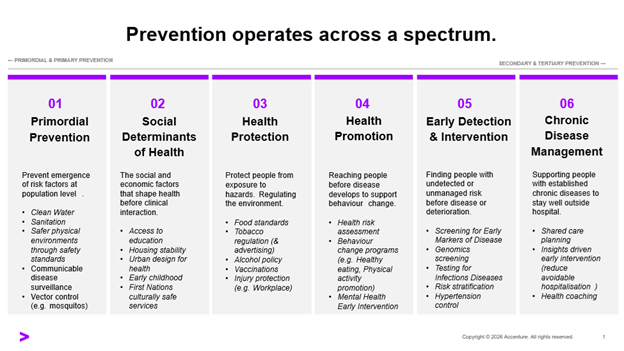
01. Primordial Prevention addresses the emergence of risk factors at a population level: such as clean water, sanitation, safer physical environments, and communicable disease surveillance.
02. Social Determinants of Health covers the social and economic factors that shape health before clinical interaction: such as access to education, housing stability, urban design, early childhood, and culturally safe services for First Nations communities.
03. Health Protection regulates the environment to protect people from hazards: such as food standards, tobacco and alcohol policy, vaccinations, and workplace injury protection.
04. Health Promotion reaches people before disease develops to support behaviour change: such as health risk assessments, risk-based behaviour change programs such as healthy eating and physical activity promotion, and mental health early intervention.
05. Early Detection and Intervention identify people with undetected or unmanaged risk before disease or deterioration: such as screening (including genomics), risk stratification for key diseases, and risk factor management (e.g. hypertension control).
06. Chronic Disease Management supports people with established chronic diseases to stay well in the community setting and avoid unnecessary hospitalisation: with initiatives including shared care planning, insight-driven early intervention, and health coaching.
The workshop explored all six topics at a high level.
Where would workshop attendees invest?
Before the workshop discussions began, participants were asked a direct question (via a ‘Menti’ survey to be completed on attendees’ phones): if you had $100 million to invest across the six prevention domains, where would you invest it?
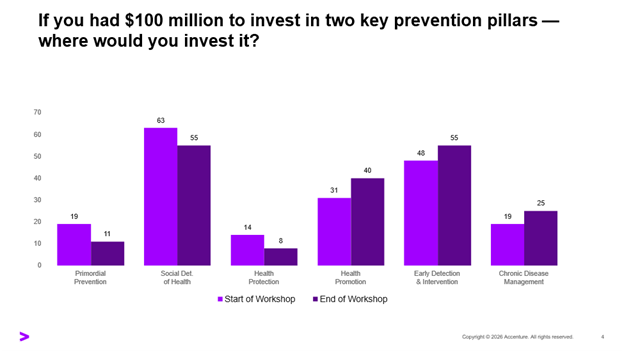
Interestingly, social determinants of health led at 63%, followed by early detection and intervention at 48%, and health promotion at 31%. Primordial prevention and chronic disease management were each selected by 19% of participants. Health protection attracted only 14%.
Attendees were asked the same question again at the close of the day, after four hours of discussion, evidence and debate. The rankings shifted. Social determinants held firm as the top priority at 55%. But early detection and intervention rose to 55%, matching social determinants. Health promotion also gained ground, moving from 31% to 40%. Chronic disease management rose from 19% to 25%.
It was an interesting shift. Moreover, it demonstrated the diversity of opinion regarding where investment is needed across the prevention domains.
What the tables said: domain by domain
Primordial Prevention and Social Determinants
Participants were clear that significant focus and investment is required for groups with the highest modifiable risk factors and burden of chronic disease – such as people in poverty, First Nations communities, those with poor housing, and people with lower levels of education. These cohorts are often poorly reached by conventional health programs.
Australia performs reasonably well at the basics of primordial prevention. For example, 99.7% of Australians have access to safe drinking water and 96% of wastewater is safely treated 1. But there is more to do, including more than 400 remote communities still lacking access to safe drinking water 2, and social determinants account for an estimated 35% of the First Nations health gap 3. Homelessness results in many poor health outcomes, such as increase of the risk of HIV by 55% 4. These are illustrative statistics, but they highlight that there are significant gaps to close.
Mass campaigns do not reach many of the people who need preventive assistance. Targeted investment through trusted community relationships, culturally safe services, and place-based models is critical. The health workforce is not just health workers; teachers, peer educators, community workers, and sporting coaches have a key role to play, and are already embedded in the ecosystems where Australians live their daily lives.
First Nations health was raised repeatedly and pointedly. The diphtheria outbreak in the Northern Territory was cited as evidence of how far primary prevention has failed in some communities. A key theme and noted by one participant: “Why are we at this point?” The response was that issues in prevention are not always a clinical problem, but weaknesses in our basic social infrastructure that underpins health.
Health Protection
Health protection attracted significant debate and told a more complex story. This included the potential power of regulatory levers: such as the ‘sugar tax’, food labelling reform, restrictions on junk food advertising, and the role of urban design in enabling or inhibiting healthy behaviour.
On some measures, Australia has genuine achievements. The adult smoking rate is 10.6%, below the OECD average of 14.8% 5, the result of decades of increases in tobacco excise, plain packaging legislation, and advertising bans (that have since been adopted by 19 other countries14 . Childhood immunisation coverage sits at 93.2% for five-year-olds, although this remains below the 95% threshold required for measles herd immunity 6.
The “Red Rooster theory,” as one panellist described it, neatly captures the problem: if the unhealthy option is cheaper, faster, and easily accessible, then health literacy campaigns cannot close the gap. From an environmental design perspective, various attendees highlighted Finland’s requirement that all policy carry a health impact assessment before sign-off, and Denmark’s investment in safe cycling infrastructure and active transport.
Sugar tax was heavily debated and the most contested topic in this domain, but the general direction was consistent: the food environment needs regulatory attention, and the current approach of voluntary industry action is not delivering.
Health Promotion
Health promotion attracted significant energy with the critical question being “how do you get people to engage with their health before they are sick?”
The data suggests that engagement is a serious problem. One in five Australian men did not see a GP in the last 12 months 7. Only ~17% of Australians aged 45-74 have had a cardiovascular risk assessment 8. And 40% of Australian adults lack the health literacy needed to engage with everyday health information 9.
A consensus was that better outcomes may not correlate with a better information campaign. What may be required is a shift in design logic whereby engagement in preventive education or intervention is tied to critical moments in life: seeing any clinician, having a child, a family member’s diagnosis, the period immediately after hospitalisation, a significant birthday. These are contextual windows when people may be better influenced and ready to act.
Accenture experience across multiple preventive health programs has identified that significant headwinds to preventive health engagement is not ignorance or indifference. It is that most people are already ‘at capacity’, that mental bandwidth is finite, andthat the populations with the most to gain from preventive care face diverse barriers in accessing it. What works are programs, tools and solutions that are frictionless, integrated, and proactively reduce load.
Health literacy is a foundational gap. Australia’s health literacy rates are low by OECD standards, and the system’s response has largely been more information: better brochures, clearer websites. Attendees called for a stronger structural response: including health literacy embedded in the school curriculum, starting in primary school, covering how the health system works and the criticality for how to participate actively in your own care.
Early Detection and Intervention
For this domain, some current performance data illustrates the scale of the gap. For example only, approximately 55% of women had breast cancer screening in the most recent reporting period, well below the 70% national target benchmark10. Around 41% of eligible Australians did not complete the bowel cancer screening test, despite diagnosed patients being 40% less likely to die from the disease11, and 39% of Australian adults have hypertension, with only 40% of those having it under control12, a condition the National Hypertension Taskforce has set an explicit target to improve, aiming to lift control rates to 70% by 2030. They are sobering examples of many Australians failing to take simple actions to prevent disease.
Attendees discussed that Australia’s Medicare-funded screening is structured around age bands of 45–50 and then 75-plus. However, disease onset for many conditions may occur well before age 75. There is a gap – roughly 51 to 74 – where the population is not systematically screened, and where early detection could make significant difference. The overwhelming recommendation was to explore structured five-year screening focused on key age cohorts.
A meaningful pivot is required to improve access to health checks and to improve the cultural norms and incentives to drive significantly greater uptake.
Chronic Disease Management
Chronic disease management was the focus of Articles 1 and 2 in this series. Naturally, workshop participants saw the prevalence of chronic diseases as the downstream consequence of the ‘upstream prevention system’ not working as well as it should.
For example, 47% of Australians have at least one chronic condition13 and “multi-morbidity” is a serious challenge. Moreover, relative to the OECD average, Australia is not performing as well as it should regarding preventable hospitalisations, with Australia considerably higher than the OECD average (i.e. preventable hospitalisations in Australia is 606 per 100,000 people with the OECD average being 473 per 100,000 people).
We currently have ineffective care planning, with GP Care Plans not accessible to other clinicians. Even with a care plan, patient’s often lack the “Health Literacy” to help with management of tasks. Over time, risks may not be detected, early indicators not measured, or patients are not acting on changes in key indicators. There can often be “gaps in care”. As such, exacerbation of problems can frequently lead to potentially preventable hospitalisation.
A dominant theme was the criticality of improved care coordination, evolving the national eHealth infrastructure, and enabling insights from data.
We need to focus on improving the critical care capabilities, clarifying roles in the ecosystem, and accelerating digitisation across the sector – including additional national eHealth infrastructure such as “Shared Care Plan”. There is also a critical need to improve the quality of data and enhance advanced analytics capabilities.
Polling of attendees explored the question of how chronic disease management should be governed. Not surprisingly, participants see a critical role for Federal leadership with 43% voting for a hybrid partnership between national-versus-local leadership, and 22% voted for fully centralised national leadership. Only 10% chose full decentralisation. The overarching theme is criticality of national direction and local delivery.
On technology and data analytics, 72% rated technology and analytics as having significant impact on early intervention and chronic disease management. The appetite exists, but as a nation we have more work to do to close the gaps.
Five things Australia needs to do
Across the workshop, five clear imperatives emerged.
1. Commit to national leadership with local delivery that holds beyond political cycles. Delivering on the promise of prevention requires national leadership, adoption of standards, improved investment, and accountability, with local implementation adapted to community context.
2. 3. Invest across the full spectrum of prevention and provide a more transparent and stronger approach to key measures. We need to close gaps across the 6 prevention domains and consider a more transparent set of measures regarding health status today versus national targets. This includes transparency on the ROI of investments into prevention initiatives.
A stronger focus on “strategy to execution” to help improve health and wellness. This requires a stronger “programmatic approach”, with strategic investment now, to avoid costs in latter years. We need to explore stronger alignment of policy frameworks, funding and financial incentives. Further investment should be supported by agreements between levels of Government for jointly funded programs that seek a balance of incentives. Australia should consider an expert-led board to provide independent advice, with national transparency and a strong evaluation framework
5. Improve the design for the person, not the system. The current approach to prevention is highly fragmented, with a system that often lacks the “consumer centricity” required for preventive health. The shift required is a design philosophy, which considers many factors, such as key personas, stages of life, risk based and culturally sensitive early intervention, behavioural science, and stronger incentives.
4. Build the digital and data infrastructure that prevention requires. Stronger foundations are required. For example, we need to close key gaps in technology, continue to drive adoption of national data standards, and mandatory sharing of structured clinical data. Deliver a national analytics capability to enable insight-driven care.
This report draws on findings from the Great Prevention Pivot workshop, Canberra, 16 June 2026. Approximately 160 health leaders, clinicians, policymakers, researchers, and consumers participated. Table discussions were conducted under Chatham House rules.. Mentimeter polling data reflects live responses from 86–97 participants per question.
Produced by Accenture ANZ in partnership with Wild Health
References
- SDG6 Data Portal, Australia. https://sdg6data.org/en/country-or-area/Australia ↩
- Closing the Gap 2025, p.52. https://www.closingthegap.gov.au ↩
- Closing the Gap 2026, pp.8, 29. https://www.closingthegap.gov.au ↩
- The Lancet. https://www.thelancet.com/journals/lanpub/article/PIIS2468-2667%2821%2900035-9/fulltext ↩
- National Preventive Health Monitoring Dashboard 2024. https://www.health.gov.au ↩
- Australian Government Department of Health: Childhood Immunisation Coverage. https://www.health.gov.au/topics/immunisation/immunisation-data/childhood-immunisation-coverage ↩
- ABS National Health Survey 2024–25. https://www.abs.gov.au ↩
- RACGP Australian Journal of General Practice, April 2023. https://www1.racgp.org.au/ajgp/2023/april/uptake-of-the-australian-heart-health-check-before ↩
- Australian Commission on Safety and Quality in Health Care: Understanding Health Information. https://www.safetyandquality.gov.au/supporting-your-health-care/understanding-health-information-health-literacy ↩
- Cancer Australia: Breast Screening Rates. https://ncci.canceraustralia.gov.au/screening/breast-screening-rates/breast-screening-rates ↩
- Bowel Cancer Australia. https://www.bowelcanceraustralia.org/a-new-approach-needed-to-boost-bowel-screening/ ↩
- Australian Institute of Health and Welfare: Hypertension. https://www.aihw.gov.au/reports/risk-factors/hypertension/contents/how-common-is-hypertension ↩
- Commonwealth of Australia, Department of Health (2021) National Preventive Health Strategy 2021–2030, Australian Government, Canberra. https://www.google.com/url?sa=E&q=https%3A%2F%2Fwww.health.gov.au%2Fresources%2Fpublications%2Fnational-preventive-health-strategy-2021-2030
- Australian Cancer Council – Plain Facts – A compilation of information and research about plain (standardised) packaging of tobacco products. https://www.cancervic.org.au/plainfacts/timelineandinternationaldevelopments