


Workforce shortages and rising chronic disease demand make it ‘laughable’ to think today's healthcare model can simply be expanded to meet future needs.
Australia’s healthcare system must shift decisively towards prevention because the current model cannot be scaled to meet the demands of an ageing population, demographer Simon Kuestenmacher has warned.
Addressing delegates at HSD’s Prevention Summit in Canberra, Mr Kuestenmacher – co-founder of The Demographics Group – argued that demographic change, workforce shortages and rising rates of chronic disease would place increasing pressure on a system already struggling to meet demand.
“It is absolutely laughable to assume that we can just take the healthcare system as it is today and we scale it up to our needs even as soon as 10 years’ time,” he said.
“That doesn’t work, that doesn’t add up anymore.”
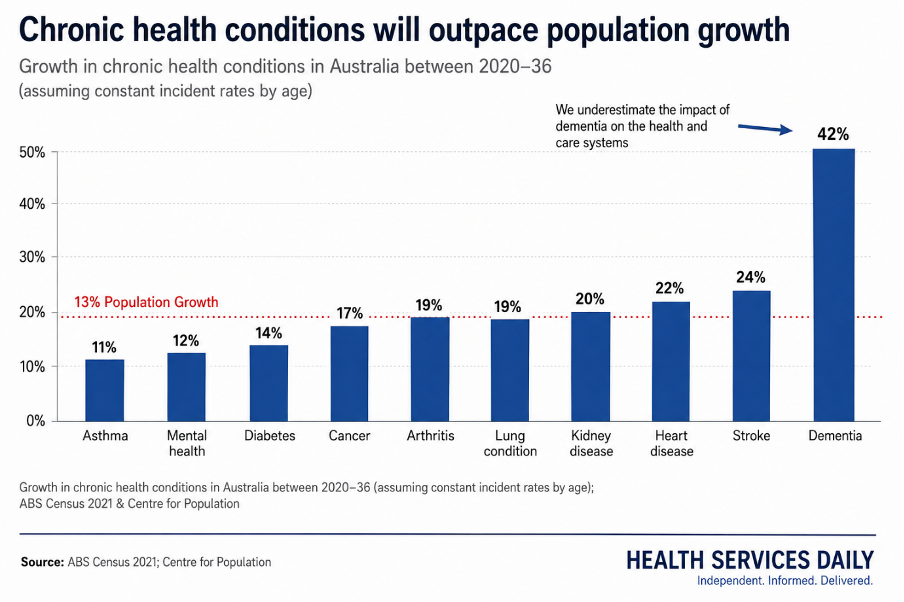
Using demographic modelling, Mr Kuestenmacher said health conditions were projected to grow faster than the population itself over the next decade.
“We see that we grow over the next 10 years, we grow the population base by 13%,” he said.
“If we assume that the rate of different diseases remains absolutely the same by age … we can estimate by how much certain kind of conditions might grow.”
He said the analysis suggested chronic conditions would increase more rapidly than overall population growth, highlighting dementia as a particular concern.
“You see that health conditions will outpace the growth of the population,” he said.
“And then you have fun outliers like dementia that you need to grow at a rate that’s about three times as high as the general population growth rate, so that’s comically difficult to solve this.”
Mr Kuestenmacher linked those pressures to broader demographic changes, including a rapidly ageing population and severe workforce constraints.
Earlier in his presentation, he warned Australia would need to effectively double its aged care system over the coming years as the number of people aged 85 and older rises sharply.
“Over the next 14 years, we’re doubling the 85+ cohort in this country from 600,000 people today to 1.2 million people by 2040 and that’s guaranteed to happen,” he said.
“That means we must more or less double the aged care system in 14 years.”
Related



He also argued that workforce shortages would make traditional expansion of healthcare services increasingly difficult.
“As it turns out, this skill shortage in aged care is only the single most extreme example of what is going to be a universal problem,” he said.
“We keep running out of workers, even under a high migration scenario.”
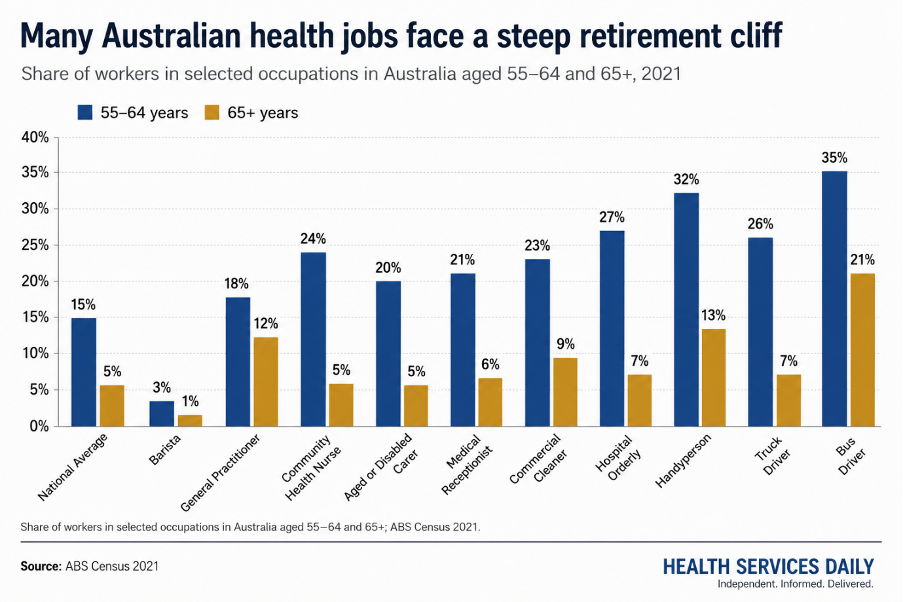
The retirement profile of key healthcare occupations was particularly concerning, he said, noting that 12% of GPs were already aged 65 years or older while large numbers of nurses and aged care workers were approaching retirement.
Against that backdrop, Mr Kuestenmacher said prevention offered the most realistic path forward.
“We must really think about things in a preventative way,” he said.
“The later in the chain we intervene, the more costly, the more labour-intensive an intervention becomes.
“And of course, if you start successful preventative measures early on, you can do this with less money and with less labour.”
Mr Kuestenmacher called for large-scale trials to identify effective prevention strategies, arguing that Australia already possessed extensive health data that could support more ambitious research programs.
“We could actually, if we wanted, set up decent large-scale trials to figure out how to prevent certain kind of health conditions,” he said.
“And I’m not talking about comically silly little trials with a couple of hundred or 1000 people that we do in the medical world, that is much, much too small, and this is much too serious to still just go around the edges.”
Summarising the challenge facing policymakers and health leaders, Mr Kuestenmacher said demographic pressures left little alternative but to rethink how care is delivered.
“Running our system right now, just at a larger scale, as we grow, that is comical, that cannot work.
“So, therefore, we must kind of think about new ways.”