The boundaries of the hospital are changing.
Hospital in the Home, virtual hospitals and connected hybrid models are extending hospital-level care beyond traditional physical settings. Specialist care may be delivered across hospitals and clinics, multidisciplinary teams may work across different services and locations, and virtual care is increasingly becoming part of the broader patient journey.
This creates enormous opportunity for health services. It also creates a challenge.
How do we prevent new models of care from becoming new points of fragmentation?
A patient may enter through a digital referral, complete pre-admission remotely, receive care in hospital, be seen by several clinical disciplines, connect with a specialist virtually and continue their care after leaving the hospital.
For the patient, it is one journey.
For the health service, it can involve multiple teams, locations, services, applications and processes.
The connected hospital is therefore becoming about more than what happens inside the hospital. Increasingly, it is about maintaining continuity of information, workflow and care wherever the patient happens to be.
Discharge is a transition, not an endpoint
Perhaps nowhere is that more apparent than when a patient leaves hospital.
Discharge planning, correspondence, referrals, follow-up and communication with other providers are critical transition points. Information needs to move with the patient rather than stopping at the hospital door.
Interoperability is an important part of that equation.
CareRight can support information moving beyond the inpatient environment through services including My Health Record and secure messaging, patient portal, online assessments with escalation workflows and electronic care pathways, while integrations with technologies such as Coviu and Microsoft Teams can support virtual interactions as part of the broader patient journey.
At South Pacific Private Hospital, General Manager Leah Hammond says connecting information across that journey has delivered practical benefits for clinical and operational teams.
“For us, having information connected across the patient journey is critical. CareRight gives our clinical and operational teams a shared foundation for managing patient information and supporting coordinated care. Connecting that information with services such as My Health Record has further improved access to critical information, reduced administrative burden and helped our teams make more timely, informed decisions.”
It is an example of a broader shift: discharge does not necessarily represent the end of care. Increasingly, it represents a transition between settings.
Connecting care across services and locations
The same challenge exists when healthcare organisations operate across multiple services and locations.
Hospitals, day hospitals, specialist clinics, allied health and other services may sit within the same organisation while operating with different teams, workflows and requirements.
Connecting them does not mean making them identical.
CareRight can configure access, workflows, forms and permissions around different locations, teams and roles. This allows organisations to maintain a common patient information foundation while individual services continue to operate in ways appropriate to their models of care.
Julia Hannan, Chief Financial Officer at Ngala Community Services, says this ability to connect services, people and information has been central to the organisation’s digital transformation.
“Digital transformation at Ngala is not simply about technology; it is about improving the way we support families. CareRight provides a modern, integrated platform that connects our services, people and information, enabling a more coordinated and personalised experience for clients. The system enhances data integrity, improves reporting and insights, streamlines processes, and reduces duplication, allowing our teams to focus more of their time on delivering high-quality support. As Ngala continues to grow and evolve, CareRight provides the scalability and flexibility needed to innovate, strengthen service delivery, and improve outcomes for the communities we serve.”
For multi-site and multi-service organisations, that balance becomes increasingly important: connect the organisation without forcing every service into the same operating model.
Connecting multidisciplinary teams
Care is also becoming increasingly multidisciplinary.
A patient may interact with doctors, nurses, allied health professionals and other clinical and operational teams throughout a single journey.
A shared record does not mean every person needs the same access or works in the same way.
Within CareRight, access and activities can be configured around locations, groups and roles. Assessments, forms, workflows and tasks can similarly be configured around the teams responsible for completing or progressing them.
The result is a common information foundation around which different disciplines can contribute to the patient’s care.
For organisations supporting people with complex needs, that ability to connect information across a team can be particularly important.
Gillian Gilchrist, who acted as Digital Transformation Lead at Jericho Road, the organisation behind Allowah, describes the impact:
“For an organisation supporting people with complex needs, having current information available across the team is incredibly important. CareRight has given us a more centralised view of each client’s care, with clinical and operational information brought together in one place. That has helped improve visibility, interdisciplinary coordination and the way important information is captured, shared and acted on by our teams.”
This points to an important distinction in connected care.
The objective is not simply to collect more information. It is to make relevant information available to the right people and connect it to what needs to happen next.
The foundation still matters
None of these emerging models removes the need to get the fundamentals of hospital care right.
A connected journey still needs to support what happens before, during and after an admission.
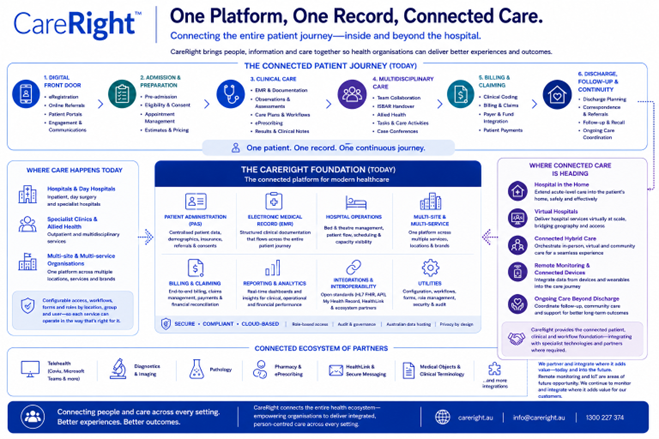
CareRight provides a cloud-based, configurable foundation spanning patient registration, referrals and digital pre-admission through patient administration, bed and theatre management, clinical documentation and workflows, multidisciplinary care, billing and claiming, reporting, discharge and follow-up.
Clinical, operational and financial processes can therefore form part of the same broader patient journey rather than operating as entirely separate environments.
For organisations operating multiple locations or services, that foundation can be configured around different workflows, forms, roles and access requirements without necessarily creating a separate system for each part of the organisation.
The technology foundation is important.
But increasingly, the bigger question is what that foundation allows a health service to do next.
Beyond the hospital
Hospital in the Home, virtual hospitals and connected hybrid models are beginning to challenge the traditional distinction between inpatient, outpatient and community-based care.
As those models develop, health services will increasingly need to connect care delivered across physical and virtual settings, internal and external teams, and a growing ecosystem of specialist technologies.
That does not mean one platform needs to provide every specialist capability.
CareRight already provides many of the foundations around which these models can operate — patient administration, a shared clinical record, configurable workflows, multidisciplinary care, billing and claiming, reporting and interoperability.
Where specialist capabilities such as remote patient monitoring are required, the opportunity is to integrate with appropriate technologies and partners while maintaining continuity with the broader patient journey.
The role of the core platform can therefore be to provide the patient, clinical and workflow foundation around which an increasingly diverse ecosystem of care connects.
Building the connected hospital
The connected hospital is not necessarily one where every specialist system has been replaced by a single application.
It is one where the important parts of the patient journey work together.
And as hospital-level care increasingly extends beyond traditional physical settings, that distinction becomes more important.
The question is no longer simply: what system do we use inside the hospital?
Increasingly, the question is:
How do we keep the patient, their information and the teams caring for them connected wherever that care occurs?
For CareRight, that is the opportunity ahead.
One platform does not need to mean one rigid workflow. One record does not mean unrestricted access. And connected care does not require every component of the healthcare ecosystem to come from the same technology provider.
It requires a foundation capable of connecting the patient journey while allowing different locations, services, disciplines and technologies to play their appropriate role.
As the boundaries between inpatient, outpatient, virtual and community-based care continue to change, that foundation will become increasingly important.
One platform. One record. Connected care — inside and beyond the hospital.

Author: Tim Macdonald, Commercial Director, CareRight.