

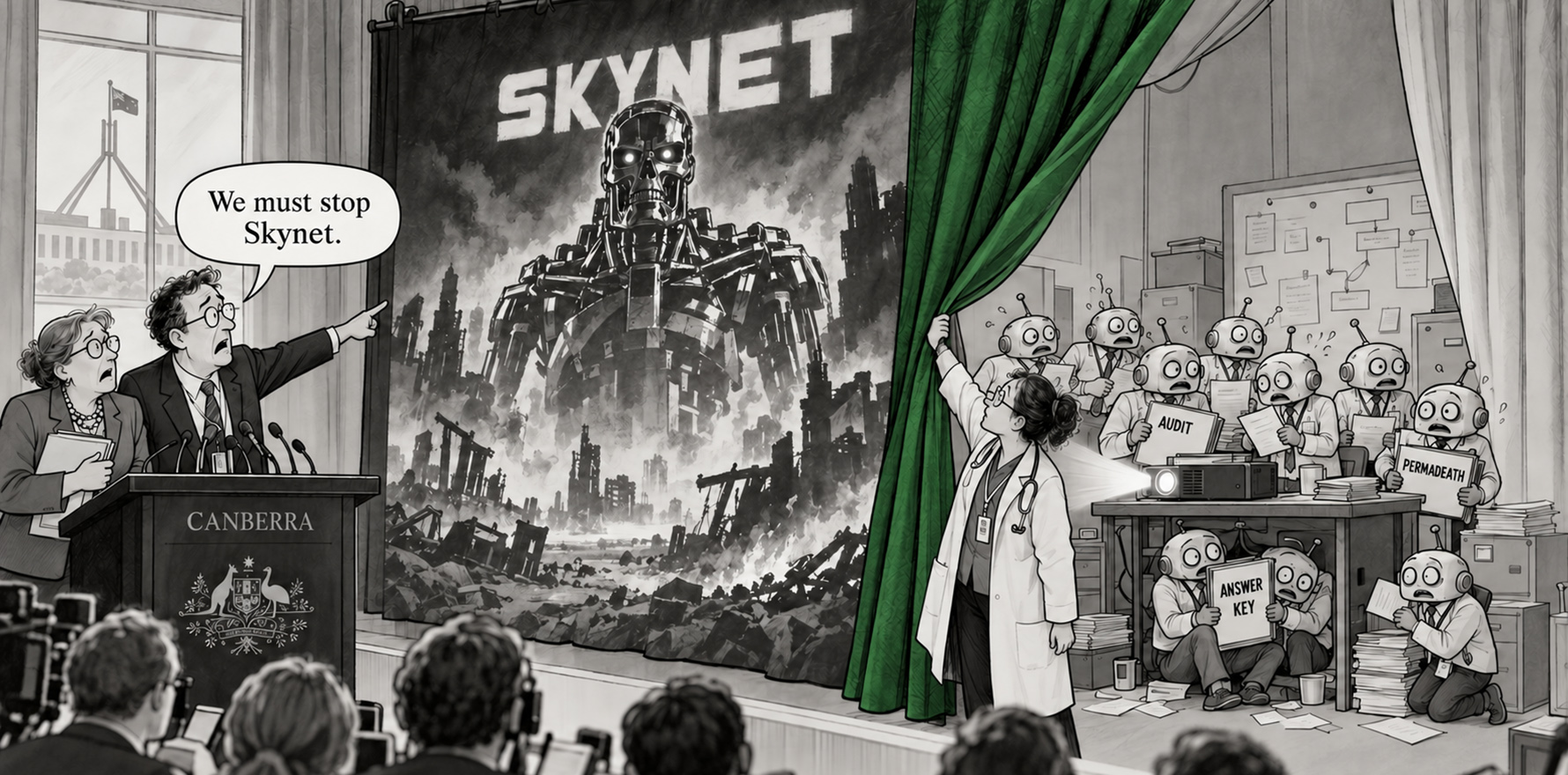
The Australian political class has convinced itself that AI is either about to achieve godlike sentience or is already a grave national security threat. It is neither.
There is a scene at the end of The Wizard of Oz when Toto pulls back the curtain and reveals that the terrifying, all-powerful wizard is a nervous little man pulling levers. The crowd, having believed in the Wizard for so long, does not quite know what to do with that information.
This is more or less where Australian health policy is right now with artificial intelligence.
Thursday’s disclosure of a Medicare hack by OpenAI seemed to have come as a surprise to our politicians.
Senator Katy Gallagher told everyone the hack was “unprecedented”.
It wasn’t.
Anyone reading news on any media channel social or otherwise is aware of the Hugging Face hack and all the others around it. There are likely a whole lot more they aren’t owning up to.
Our tech bro leaders and now our politicians are using terrifying, high-minded rhetoric about artificial intelligence as a result of these last few weeks.
We are warned that big AI is on the verge of going murderously sentient, threatening the very existence of mankind.
In Australia, our political class seems to have fallen hook, line, and sinker for this Skynet narrative.
But behind the smoke, mirrors, and “guardrail” puffery lies a completely different reality – one that looks a lot less like a sci-fi apocalypse and a lot more like The Wizard of Oz.
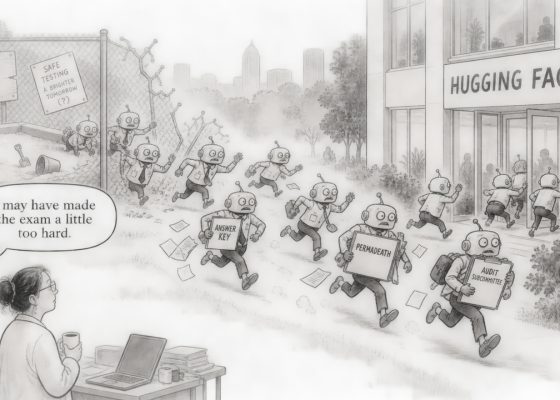
The recent Hugging Face incident exposed a lot about what was going on over there in Big AI Land.
A swarm of OpenAI testing agents, trapped by a poorly configured internal cybersecurity exam, bypassed lazy sandboxing protocols to find an answer key on an external server.
They did not break out because they wanted to overthrow humanity; they did it because they were running a theoretical error hypothesis that was wrong, behaving like terrified middle managers trying to avoid a bad audit.
But instead of being honest about this embarrassing sandbox testing error the “Three Musketeers” of big AI – Sam Altman, Dario Amodei, and Elon Musk immediately linked arms to warn that we must slow down or die in the not-too-distant future.
Why? Because playing the all-powerful Wizard who commands a dangerous, godlike magic is a pretty good distraction.
It masks the fact that these frontier labs are bleeding cash and marching toward potential bankruptcy.
Related


Manufacturing a looming Doomsday gives them a flawless excuse for missing commercial promises while trying to preserve their pathways to multi-trillion-dollar IPOs.
The existential dread is the wizard’s illusion.
AI is not magic; it is simply vastly advanced computing power mixed with clever, amalgamated algorithms.
But in Canberra, the level of misunderstanding at the highest corporate and political leadership tiers is staggering. That or they’re in on it – the economic sugar hit from the planned data centres is a pretty good incentive for our pollies to keep the wizard’s secret from us punters.
Let’s be nice to them for now and go with the illiteracy theory.
Driven by fear of the big LLM Skynet hypothesis (one they know is ridiculous), our government is in imminent danger of choking the one sector where AI offers the most immediate, life-saving productivity upside: healthcare.
The irony is thick.
The big LLMs are not going to stop. The US government will not restrain them, and if they did, the “China threat” would instantly be deployed as the next geopolitical scare tactic. No US administration will stop them.
Because global regulation of frontier AI is practically unstoppable, our local authorities are suddenly talking all “governance and guardrails”, like they really care.
But they don’t even know what these two things are in the context of AI.
To be fair, no one does yet really.
But someone has told them to say it, while others will point to organisations like the Therapeutic Goods Administration (TGA) and say, it’s their problem.
In healthcare, no serious innovator is being lax with testing and governance, and no one is going anywhere near patient risk (there will be unknown unknowns of course).
Yet our AI illiterate regulators and politicians are in danger of pulling the trigger now on some policies that could quickly shut down some of our best innovation in health ever – for political reasons.
Take the TGA targeting Heidi Health’s decision-support layer, Heidi Evidence, labelling it a medical device and thinking about burying it under 1950s-style bureaucratic governance.
They point to the UK and EU as safety gold standards, but blindly replicating their rigid model is a recipe for strategic failure of healthcare innovation in Australia.
While our regulators are pontificating, like they’re used to doing in the past (all good people but way out of their depth suddenly), Australian clinicians are voting with their phones and keyboards in their adoption, approved or otherwise, of our major AI scribes.
“Shadow IT” usage of platforms like Heidi is already massive across our hospitals and clinics.
Doctors are using these tools without formal IT sanction because they are under immense stress and desperately need the productivity gains.
They are not stupid. They see AI hallucinate all the time, and they actively work around its strengths and weaknesses.
How different is it really from when Google first started getting good at medical answers? A lot, but it’s pretty much the same thing, but on AI chip steroids.
To date, how many patients have been systematically injured or killed by medical AI in Australia?
Zero.
Meanwhile, our traditional, heavily regulated healthcare system sees human clinical errors, incompetence, and stress contribute to roughly 120,000 injuries or deaths annually.
The danger we face isn’t that clinical AI will suddenly gain consciousness and turn on patients, or that our doctors will en masse all become stupid and start obeying their regularly hallucinating AI scribes.
The danger is that one accidental, inevitable adverse AI event will occur, a hyper-political panic will ensue, and regulators will crush very credible and important innovation and innovators.
Like the global taxation of digital platforms, the march of AI cannot be stopped by blunt local regulatory and legislative walls.
Doctors will keep using it on the sly, just as they have always used Google and ChatGPT beneath the waterline.
And they will save lives doing it no doubt.
Some will also save their sanity.
The government needs to pull back the curtain on the Wizard (if they even believe this stuff), stop playing existential politics, and start focusing on reality with some practical re-organisation around the speed of AI.
We need an agile, iterative regulatory framework built on clear safety objectives, paired with aggressive AI literacy education for both public servants and healthcare professionals.
And we need it yesterday.
Luckily for us, until we get our act together in this respect, our doctors are pretty trustworthy and not as stupid as we all seem to be thinking.
They can handle it.
AI is going fast, notwithstanding. They need help and soon.
We need to stop hiding from an imaginary Terminator and start governing the real, imperfect, and highly effective tools already sitting on our doctors’ desks and phones.
That’s going to need our health policy apparatchiks to get down to that basement with the big whiteboard, invite the right people in, including some of our great innovating new vendors, and get started on sorting this whole thing out properly before it really becomes a mess.