


At least that’s what the salary packages say. Budgets are huge and so are the payrolls, but health public servants don’t rate against their non-health colleagues.
For a government department with the country’s second-largest budget and a significant workforce, the Department of Health, Disability and Ageing’s public servants would appear to be underpaid compared with their non-DoHDA colleagues.
Public service newsletter The Mandarin has released its inaugural Public Sector Salary Guide detailing the salaries of state and federal public servants across the country, and health representation in the upper ranks was surprisingly low, particularly federally.
DoHDA controlled the second highest budget of all major commonwealth portfolios, at about $120 billion – second only to the Department of Social Services at around $200 billion.
It employed about 7400 people, the most of any federal portfolio, but just a fraction of large agencies such as Services Australia (35,210) and the ATO (21,400). State government health departments, which run hospitals and health services, can employ up to over 100,000 people.
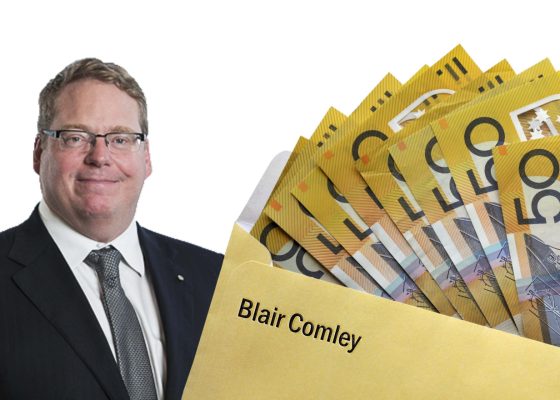
Only one DoHDA public servant made the top 100 earners list across Australian jurisdictions – secretary Blair Comley, whose annual pay packet of $972,552 put him at 51st on the list.
David Hazlehurst, boss of Services Australia, came in 67th with a salary of $879,568.
Australia Post dominated the list, with eight entrants, six of them in the top 10, including the highest paid public servant in the country, Paul Graham, AP’s group CEO and managing director, who took home $3.3 million a year.
NBN Co CEO Ellie Sweeney was second, and she was also the highest-earning woman on the list, with $1,922,819 in total remuneration.
At least 46 Australian public servants earned over a million dollars last year, and almost all of them worked for government corporations; 74% were on the federal payroll and 65% work for government corporate entities.
Mr Comley was mid-table when it came to the federal secretaries – with Stephanie Foster, boss of Home Affairs, top of the table with a remuneration of $1.084 million, putting her 27th on the Top 100.
State-based public servants
Health departments were consistently the largest spending areas in each state and territory. In most jurisdictions it accounted for 25-35% of total government spending.
NSW, Queensland and Victoria had the largest budgets (and populations) at about $35 billion, $33 billion and $31 billion respectively.
Nevertheless, again, health bureaucrats struggled to reach the upper echelons of earners.
In NSW, no health public servants were in the top five salary earners, with Essential Energy CEO John Cleland top of the tree with a $1.26 million pay packet.
NSW was one of several states with rigid guidelines around executive pay. Department heads, including NSW Health secretary Susan Pearce, were paid equally, with their salary – $648,220 – determined by the remuneration tribunal.
In Victoria, Monash Health CEO Andrew Stripp was the third-highest paid public servant in the state, with a remuneration package worth $770,000.
“Victoria’s decentralised health-management system also creates more variance in the salaries of local health network chief executives,” said the Mandarin.
Related

“The fact that Ewa Piejko led the Department of Health for a full year at an acting rate resulted in the unusual situation where at least three other LHN bosses earned more than the secretary of health — they were David Plunkett from Eastern Health, Russell Harrison from Western Health, and Adam Horsburgh from Austin Health.”
Ms Piejko’s unique situation – an acting rate of $558,000 – landed her at the bottom of the department secretaries’ list, headed by Chris Barrett at Treasure and Finance and Jeremi Moule at Premier and Cabinet ($760,000 each).
In Queensland, no health bureaucrats made the top five earners, but director-general of Queensland Health, Dr David Rosengren, was the second highest-paid DG in the state with a pay packet of $809,000.
Calculating DG salaries was complicated in Queensland by the change of government at the end of 2024 with a number of exiting, acting and short-term appointments. For example, the only DGs who served the full year were the four lowest-paid.
In South Australia, SA Health CEO Dr Robyn Lawrence was the equal fifth-highest earner ($611,000), and also the equal second-highest earner among government department chief executives.
In Tasmania, no health bureaucrats made the top five earners, but secretary of Health David Webster was middle of the state’s pack with a pay packet of $524,000.
In WA, again, no health bureaucrats were in the state’s top five. Dr Shirley Bowen, director-general of WA Health, was the third highest-paid public servant in the state with a yearly package of $592,000. WA directors-general fell into two distinct pay bands. The heads of policy and regulatory departments earned $425,000 to $500,000.
In the ACT, Dave Peffer, CEO of Canberra Health Services, made the top five earners list, coming in equal second with a remuneration package of $580,000.
Mr Peffer was unique in the country in that he was the health chief with the largest burden of patients coming from over the border.
Director-General of ACT Health, Rebecca Cross was the second lowest-paid DG in the territory, taking home $471,000.
In the Northern Territory, no health bureaucrats were in the top five. It had the lowest paid department heads in the country and, like in NSW, all were paid equally, with a salary of $419,909.