

The healthcare delivery era has arrived, and the most interesting signals are already visible on the ground.
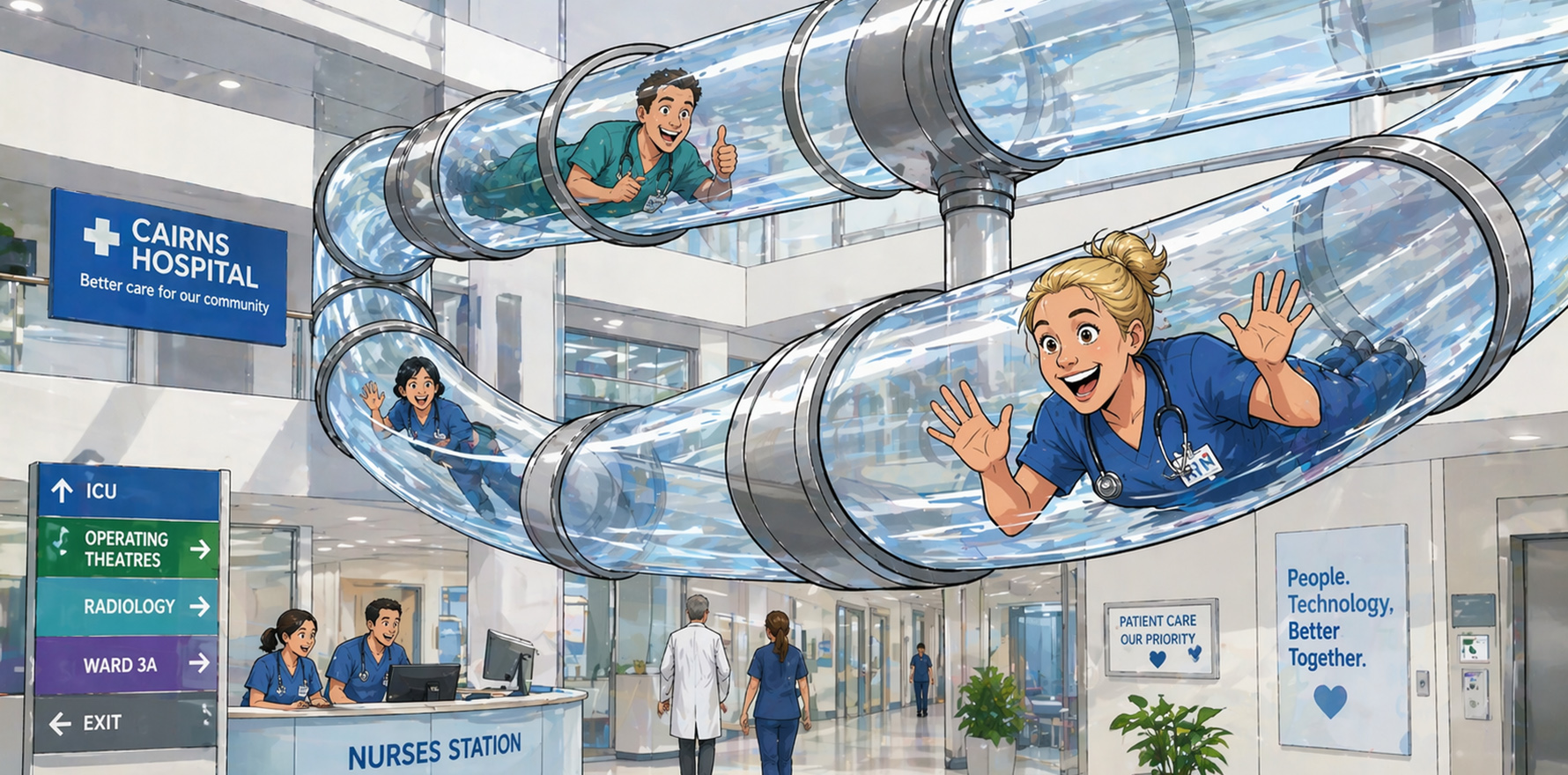
A Cairns Hospital April Fool’s post joked about sending staff through widened pneumatic tubes as part of a billion-dollar expansion.
It was funny because it borrowed from a truth every clinician and health leader already understands. Australian healthcare is under enough pressure that almost any idea promising faster movement, less friction and better flow feels believable for a moment.
The added bonus, having lived in northern Queensland, monsoon season would be a lot more fun.
That is what makes this moment interesting.
The most important changes in Australian healthcare are no longer sitting only inside federal announcements and budget papers.
They are showing up in real services, real builds, real leadership appointments and real delivery models.
Across the country, health systems are trying to move care closer to home, strengthen access, reduce pressure on hospitals and respond to rising complexity with more targeted infrastructure and smarter models of care.
The federal backdrop remains significant.
The Commonwealth has expanded bulk-billing incentive eligibility to all Australians from 1 November 2025, framing primary care affordability as a central reform priority.
National Cabinet has also locked in an additional $25 billion in public hospital funding over five years, which tells you exactly where the pressure still sits.
Chronic disease reform has been refreshed through a new national framework and integrated care funding, while aged care reform is moving further into pricing, transparency and operational delivery.
Those national settings matter, but the more revealing story sits underneath them.
In Western Australia, a welcome leadership update – Dr Clare Huppatz has been appointed chief health officer. It is a signal that public health capability still matters deeply in a system balancing prevention, communicable disease control, emergency preparedness, regulation and Aboriginal health.
Leadership appointments like this allow us the ability to shape how systems think, respond and prioritise. They rarely dominate headlines, but they influence the tone and quality of reform far more than most people realise.
In Victoria, Mildura Base Public Hospital has showcased a new mobile screening truck through its foundation. It brings together skin screening technology, mobile mammography and integrated health checks in a model designed to deliver care closer to home.
This is the kind of practical regional innovation that deserves more attention and one which reflects a health system trying to reduce distance as a barrier, build partnerships across technology and service delivery, and push preventive care out into the community rather than waiting for demand to arrive downstream.
Also in today’s edition:
- Rae flounders in wake of co-payments backflip
- Shock, sadness and ‘mass anxiety’ in wake of Butler’s NDIS ‘betrayal’
- Reset welcomed, but can government deliver aged care reforms?
- The independent review that prompted Butler’s $3b aged care bed boost
- Which NDIS claims are genuinely fraud, anyway?
- More clinical trials coming to regional Victoria
- ADHD cost-of-living relief welcome, but some aren’t feeling it yet
- Avive to open second Melbourne mental health hospital
In Central Queensland, Moura Multipurpose Health Service continues progressing its aged care expansion.
On the surface, that looks like a local infrastructure story. In reality, it speaks to one of the most important system issues in Australian healthcare: what happens after acute care.
Aged care capacity is one of the quiet determinants of hospital flow. Every additional bed, every better-designed local facility and every stronger residential option helps relieve pressure that would otherwise be absorbed by hospitals already carrying too much.
In western Sydney, a new specialised unit has been announced for patients experiencing heightened distress or aggression.
The rationale is hard to ignore. Presentations involving mental health or behavioural-related issues have risen sharply, and services are looking for better ways to respond that reduce sedation, restraint, length of stay and time to be seen in emergency departments.
This is where reform becomes concrete. It is not abstract system language. It is a service redesign built around safety, dignity, clinician workload and patient flow.
Even workforce signals tell their own story.
A recent director of clinical governance role in Cairns points to continuing investment in quality, safety and patient experience leadership.
That matters. During periods of strain, health services still need strong governance architecture. Pressure does not reduce the need for safety oversight. It increases it.
Taken together, these developments show an Australian healthcare system moving on several fronts at once.
Related



Some reforms are national and highly visible. Others are local and easy to miss. Many of the most consequential shifts are happening in delivery models, community access points, behavioural health responses, aged-care capacity and leadership structures that make better decisions possible.
That is also why the Cairns April Fool’s joke landed so well. It was playful, but it also captured the mood of the sector.
Everyone is looking for smarter ways to move people, care, information and decisions through a system under sustained pressure.
The real answer will not come from staff transport tubes, sadly for anyone hoping to commute between wards at high speed with a coffee in hand. It will come from something less theatrical and far more important: better-connected services, stronger out-of-hospital capacity, targeted infrastructure, clearer governance and reforms that hold up in operational reality.
That is where Australian healthcare is heading now. The delivery era has arrived, and the most interesting signals are already visible on the ground.
Sarah Hughes is a registered nurse working in occupational health and safety in the mining sector of WA. She is executive adviser for ADAPT, and a founder and managing director of NurseFusion.
This article was originally published on Ms Hughes’ LinkedIn feed. Read the original here.