

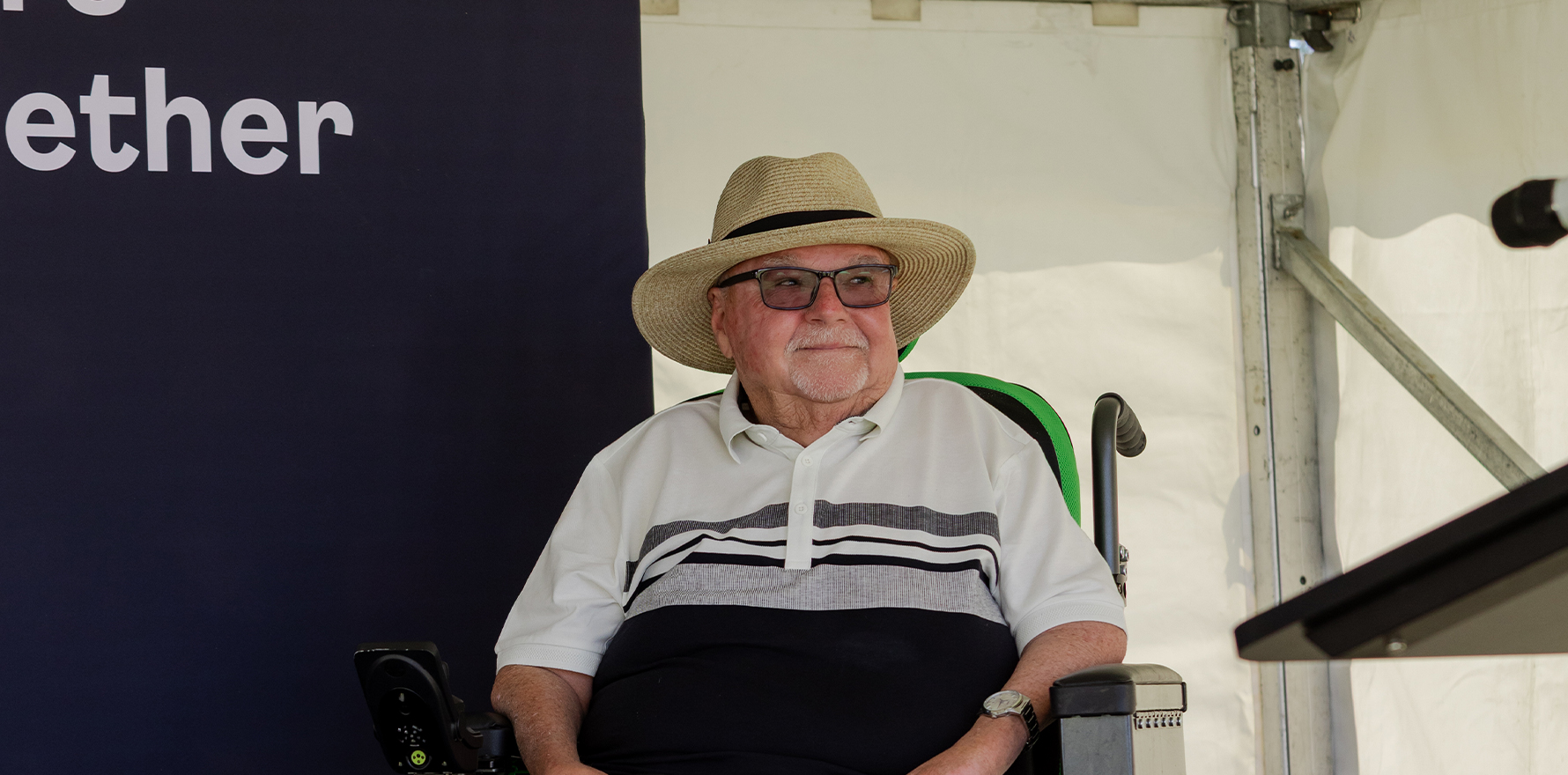
Kevin Finlayson has witnessed an extraordinary transformation in attitudes, opportunities and support for people with disabilities. But as uncertainty surrounds the future of the NDIS, he fears some of those hard-won gains could be lost.
When Kevin Finlayson received his first pay packet from Australia Post, he climbed onto the steps of Sydney’s Railway Square Post Office and savoured a moment he had been told time and time again would never come.
For most young men, getting their first job is an important milestone. For Kevin, who was born with a severe physical disability and spent much of his childhood in hospitals and institutions, it was something much more.
But at that moment, with his first wages in his hands, he had proved his doubters wrong – including his own father, who had told him he would never get a job.
“It was a dream come true, because my father said to me – you will never get a job,” Kevin recalls.
“Well, I proved him wrong.”
Now 74, Kevin has spent his entire life challenging expectations about what people with disability can achieve.
His journey from an isolated childhood and segregated residential accommodation to independent living, meaningful employment, and community advocacy reflects the enormous changes in Australia’s disability sector.
But while he celebrates that progress, he fears for the future of the National Disability Insurance Scheme (NDIS) and what changes to support arrangements could mean for people who cannot advocate for themselves.
Born with arthrogryposis multiplex congenita, a condition affecting the joints and muscles, Kevin spent much of his childhood at the former Camperdown Children’s Hospital and other institutions, including the Royal Far West in Manly, on Sydney’s northern beaches.
He remembers a childhood defined by restrictions, isolation, and limited opportunities.
“I was basically a prisoner in my own home,” he says.
“I wasn’t allowed to go to school. I wasn’t allowed to do this. I wasn’t allowed to go down the street.”
His grandmother was one of the few people who provided consistent emotional support.
Kevin did not learn to walk until he was 11, eventually getting around using callipers and crutches. He would not receive his first wheelchair until he was 30.
As a young adult, he moved to Afford’s Cherrywood Village at Llandilo, near Penrith, a sprawling 22-hectare residential facility specifically designed for people with disability.
The village offered accommodation, a swimming pool, sporting facilities and employment opportunities. For someone who had experienced such a restricted childhood, it initially represented freedom.
“Cherrywood Village was amazing at the time,” Kevin says.
Yet the facilities came at a cost. Residents were largely separated from the surrounding community, and their lives were governed by institutional rules and expectations.
A turning point came when social worker Anne Mansfield recognised his potential and encouraged him to pursue opportunities beyond the village.
She helped him secure a place at Mount Wilga, where he spent three years developing the skills and confidence to enter mainstream employment.
“If it wasn’t for Anne, I wouldn’t be where I am today,” he says.
His first job was operating lifts at Australia Post’s Railway Square premises, transporting teleprinters and other equipment between floors.
He stayed there for five years before moving to Telstra, where he worked for another 16 years. More importantly, he found acceptance among colleagues who treated him as an equal.
“There was no discrimination in this job. The blokes treated me as normal,” he recalls.
It was an experience that reinforced his belief that people with disability should have the same opportunities to work, socialise and contribute as everyone else.
Another defining chapter was his friendship with James ‘Jimmy’ Flynn, a man with spina bifida whom he met through Cherrywood Village.
The two became lifelong friends, with Kevin providing care and support to Jimmy for 34 years.
“We had no services in those days. No home care. Nothing at all,” he recalls.
Kevin worked during the day before returning home to prepare meals and manage household responsibilities.
“We used to do the whole lot ourselves,” he remembers.
When Jimmy died about seven years ago, Kevin found himself facing another major transition. After decades of caring for someone else, he began thinking about what he wanted from his own life.
With support through the NDIS, he moved into a two-bedroom apartment in Thornton, near Penrith, where he has lived for three years.
He now employs four support workers himself and uses an electric wheelchair to travel independently. In six months, he has travelled almost 2000km in that chair. He is also working two jobs.
At Active Care Network, he promotes transport and social support services for older people and those experiencing disadvantage. He also works with Solution Ideas, an organisation led by people with lived experience of disability.
His work takes him across Sydney, meeting people, promoting services and showing exactly what meaningful participation looks like.
For Kevin, employment provides much more than income. It brings purpose, friendships and connection to the wider community.
And the NDIS has been instrumental in making that possible.
“I’ve had NDIS support [for] the last nine years,” he says.
“It has changed my life.”
With assistance from his support workers, Kevin can complete his morning routine and leave home for work far more efficiently than he could manage alone. He describes the improvement in his independence as extraordinary.
“Basically, it has improved my life 100%,” he says.
Yet the scheme that has helped transform his life has now become a source of considerable and constant anxiety.
Kevin is particularly worried about the potential loss or reduction of community participation supports and the consequences for people who depend on those services to maintain friendships, develop skills and avoid social isolation.
Related



Unlike Kevin, many people with disability cannot access employment as a source of social connection.
“How are they going to get out and about?” he asks. “A lot of them do rely on that social interaction.”
He is also concerned about proposed changes to support coordination and whether people with complex needs will receive sufficient assistance to navigate the NDIS.
His greatest fear is for people who cannot easily communicate their needs or challenge decisions affecting their support.
“I will advocate for myself, but I’m a bit concerned about the ones that don’t have a voice,” he says.
He believes policymakers need a better understanding of the everyday realities of living with disability before making decisions about essential services.
“Come to meet us, talk to us, communicate with us,” he challenges the politicians who have vowed to rein in the costs of the scheme.
He would like those politicians to spend a week actually experiencing his daily routine before they begin dismantling the scheme that has allowed so many Australians to live their best lives.
“They can come and live at my place,” he says. “Come with me, see what I do.”
“I think the system needs to be simplified, and it needs to be fair for everybody. It can be simplified if you have the right people doing it.
“Unfortunately, we don’t have that because half these people in Canberra, they wouldn’t know what time of day it was.”
After witnessing the shift away from institutional care towards individual choice and community inclusion, Kevin worries that inadequate support could leave future generations facing renewed segregation.
And as a person who has lived in both worlds, he is adamant any move towards more segregation is a backward step that must be avoided at all costs.
“We’ll be going back to the old model,” he warns.
“I can tell you that is not what people want, whether they are people with disabilities or those family and friends who want the best for them.”
His hopes for the NDIS are straightforward – a simpler, fairer system that recognises lifelong disability, protects essential supports and gives participants genuine choice and control.
He believes people with permanent disabilities should not repeatedly have to justify their eligibility for assistance.
“You shouldn’t have to keep doing it. If you are born with a disability, you should not have to keen justifying it year after year,” he says.
He also wants employers, particularly not-for-profit organisations, to create more opportunities for people with disability.
He points to young people pursuing university and TAFE qualifications who have valuable skills but may struggle to find employers willing to accommodate their support needs.
His story also reflects the evolution of Afford, which marked its 75th anniversary in September.
Kevin returned to the organisation’s celebrations as master of ceremonies, a striking contrast to the young man who once lived within the confines of Cherrywood Village.
Afford’s head of Engagement, Nicole Bryson, says his experience demonstrates what becomes possible when people with disability are supported to build lives on their own terms.
“Today, we know that people should have choice, independence and the opportunity to be fully included in their communities,” she says.
For Kevin, those principles are not abstract policy ambitions. They are the foundations of a life he has worked hard to build.
He remains active, employed and determined to continue advocating for others. He has seen how far Australia has come from the days when people with disability were routinely hidden away, denied opportunities and expected to accept whatever support was offered.
His hope is that the next generation will inherit a system that expands independence rather than limits it. A system that truly embraces the absolute human right that every person with disability should have the opportunity to live their best life – whatever that may look like.
He has no intention of remaining silent while those gains are put at risk.