


What really happens when nobody is watching?
The culture of a healthcare organisation is not what it says about itself, it’s what happens when there is no audience.
Healthcare organisations invest enormous effort in describing their culture. Values are displayed on walls. Behavioural standards are embedded in policies. Leadership programs teach respectful communication. Staff surveys measure engagement. Boards receive dashboards containing indicators of safety, workforce wellbeing and organisational performance.
Yet there is a deceptively simple question that is rarely asked: What happens when nobody is watching?
- What does a clinician do when they notice a colleague has made an error but there is no supervisor nearby?
- What does a nurse do when a senior doctor dismisses a concern?
- What does a manager do when reporting a problem could make their department look bad?
- What does an executive do when a target can be achieved by quietly transferring risk somewhere else?
- What does a board do when the uncomfortable information is inconvenient, politically difficult or reputationally uncomfortable?
These moments are where culture becomes visible. Not in the values statement. Not in the annual staff survey. Not in the leadership retreat.
In the moment when doing the right thing has a personal cost. That is where culture lives.
The problem with how we currently assess culture
Most approaches to organisational culture rely heavily on what people say. We ask:
- Do you feel psychologically safe?
- Do leaders listen?
- Do you trust management?
- Do you feel valued?
- Do people speak up?
- Does the organisation learn from mistakes?
These questions matter. But they have a fundamental limitation – they measure perception. They do not necessarily measure behaviour.
And the two can be very different.
An organisation can score reasonably well on psychological safety while still having an environment where challenging a senior clinician is career-limiting.
A hospital can have excellent policies for incident reporting while staff quietly learn that reporting too many incidents makes their department look dysfunctional.
A health service can promote “just culture” while individuals still experience blame when something goes wrong.
A board can receive a green culture dashboard while frontline staff have developed sophisticated ways of working around the system.
This creates an important distinction:
Culture is not simply what people believe. Culture is what people learn they can safely do.
That is a much more demanding proposition.
The ‘nobody is watching’ test
The Australian Institute of Health Executives proposes a different way of thinking about healthcare culture. We call it the “nobody is watching” test.
The premise is simple:
The strongest evidence of culture is found in discretionary behaviour when formal controls, supervision and reputational pressure are absent.
Healthcare is particularly dependent on discretionary behaviour:
- A clinician decides whether to escalate;
- A nurse decides whether to question an order;
- A manager decides whether to report a near miss;
- A junior doctor decides whether to challenge a senior.
- A team decides whether to disclose an error immediately or try to fix it quietly;
- An executive decides whether bad news reaches the board.
These decisions cannot all be controlled through policy. They depend on what people have learned about the organisation. And that learning comes from experience.
People watch what happens to others. They notice who gets listened to. They notice who gets labelled “difficult”. They notice whether incidents lead to learning or punishment. They notice whether leaders want the truth or merely good news.
Over time, those observations create the organisation’s behavioural operating system.
The AIHE culture integrity framework
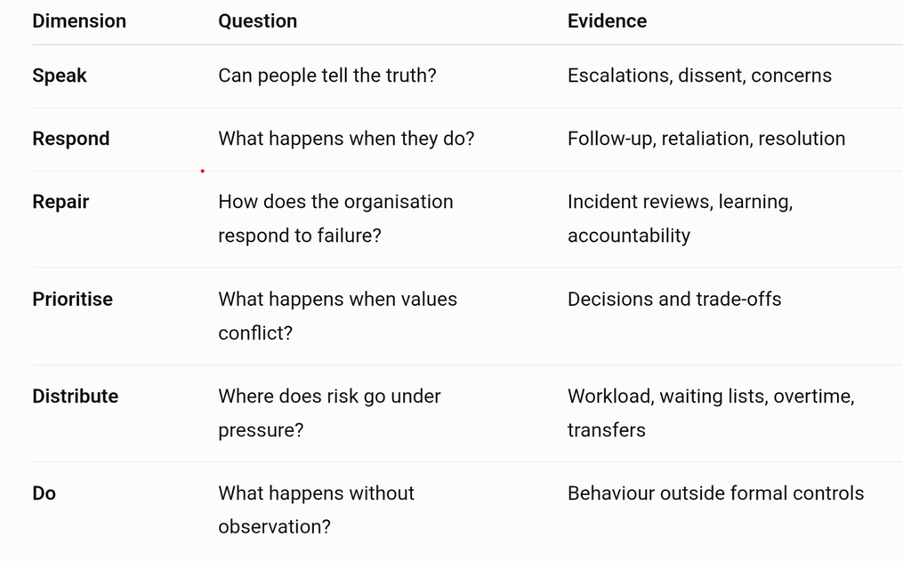
To move culture assessment beyond surveys and statements, AIHE proposes six dimensions.
SPEAK – can people tell the truth?
The first test is whether people can raise uncomfortable information.
But the question is not simply: “Do people feel safe speaking up?” The better question is: What happens to the person who speaks up first?”
Look for:
- escalation of clinical concerns;
- challenge to senior clinicians;
- reporting of near misses;
- disagreement in meetings;
- complaints from staff;
- dissenting board opinions;
- concerns raised about high performers.
The critical measure is not the number of concerns raised. It’s what happens after they are raised.
A healthy culture does not necessarily have fewer concerns. It may have more visible concerns and fewer hidden ones.
RESPOND – what happens after someone speaks?
This is where psychological safety becomes a governance issue.
An organisation can encourage speaking up and still have an unsafe culture if the response is poor.
Consider two organisations:
In Organisation A, a nurse raises a concern about a medication process. The concern is investigated, the nurse is thanked, the system is changed and the outcome is communicated.
In Organisation B, the same concern is raised. The manager becomes defensive, the nurse is described as “negative”, and nothing changes.
Both organisations technically have a reporting mechanism, but only one has a culture that supports speaking up.
The real test of psychological safety is not whether people can speak. It is whether the organisation can respond without punishing the messenger.
Healthcare boards should therefore examine the response pathway, not simply the volume of reporting.
REPAIR – what happens when something goes wrong?
Every healthcare organisation experiences failure. The cultural question is what happens next.
When an incident occurs, does the organisation instinctively ask: “Who made the mistake?” Or: “What made this mistake possible?”
This doesn’t mean removing accountability. Quite the opposite. Strong cultures distinguish between:
- human error;
- system weakness;
- risky behaviour;
- reckless behaviour;
- deliberate misconduct.
Without this distinction, organisations can fall into two equally dangerous traps:
Blame everything on individuals. Or: Explain everything as a system problem.
Neither is sufficient. A mature culture combines learning with accountability.
The question for leaders is therefore:
Can your organisation hold people accountable without making people afraid to tell the truth?
That is a cultural capability worth measuring.
PRIORITISE – what happens when values collide?
Culture becomes particularly visible when there is no perfect answer.
Healthcare leaders constantly face competing priorities:
- Safety vs access;
- Efficiency vs workforce wellbeing;
- Financial sustainability vs service availability;
- Individual autonomy vs organisational risk;
- Short-term performance vs long-term capability.
An organisation’s true values are revealed when those values conflict.
It is easy to say: “Safety comes first”. It is much harder to observe what happens when achieving the safety objective means missing a financial target; or when protecting staff wellbeing means reducing throughput; or when doing the clinically right thing creates a politically difficult conversation.
Therefore, culture assessment should examine trade-off behaviour. Ask: When our values conflict, which one wins – and who carries the consequence?
This question can reveal more than another culture survey.
DISTRIBUTE – where does risk actually go?
One of the least visible features of healthcare culture is risk displacement. A problem may disappear from one dashboard while simply moving somewhere else.
For example:
- An emergency department reduces waiting times by redirecting pressure to inpatient units.
- A service meets its financial target by increasing workload elsewhere.
- A workforce shortage is managed through overtime rather than fixing the underlying staffing problem.
- A clinical governance issue is transferred to an individual clinician rather than addressed systemically.
The organisation may report improvement, but the system may actually be becoming more fragile. This creates an important cultural question:
When pressure increases, does the organisation solve problems or redistribute them?
A healthy culture makes risk visible. An unhealthy culture makes risk someone else’s problem.
DO – what happens when nobody will know?
This is the ultimate test.
Imagine there is:
- no audit;
- no manager;
- no board report;
- no performance metric;
- no media attention;
- no patient complaint;
- no reputational consequence.
What happens then? Does the clinician still follow the safer process? Does the manager still escalate the concern? Does the executive still disclose the bad news? Does the team still challenge unsafe behaviour? Does the organisation still do the right thing when doing so produces no recognition?
This is where culture moves from compliance to character. And it is perhaps the most important distinction in assessing healthcare culture.
Related



From culture surveys to culture evidence
AIHE proposes this framework with the suggestion that boards and executives should begin looking for behavioural evidence of culture, rather than relying solely on attitudinal evidence.
A practical culture review could therefore examine six evidence streams:
That is a much harder question, and a much more useful one.
The shadow culture
Every healthcare organisation has two cultures. There is the declared culture: what we say matters.
And there is the experienced culture: what people learn actually matters.
The gap between the two is what we might call the “shadow culture”. It exists in the informal rules people learn through experience.
For example:
- Declared: “We encourage speaking up.” Experienced: “Don’t challenge the senior consultant.”
- Declared: “We learn from incidents.” Experienced: “Don’t be the person who reports too many incidents.”
- Declared: “Staff wellbeing matters.” Experienced: “The work still has to get done.”
- Declared: “We value transparency.” Experienced: “Bad news travels badly.”
The shadow culture is not written down. But employees know it. Patients experience its consequences. And eventually, the board does too.
What boards should ask
Culture should not sit exclusively within the remit of HR. It is a clinical governance issue.
Boards have responsibility for understanding whether the organisational environment supports safe, effective and accountable care. That means asking questions that go beneath the dashboard.
For example:
- What concerns are staff raising that we are not seeing in our formal reports?
- What happens to people who challenge senior decision-makers?
- Where are we seeing repeated problems without repeated learning?
- What risks are being displaced rather than resolved?
- Where do our stated values conflict with operational incentives?
- What information might staff be reluctant to bring to this board?
- What happens when the highest-performing person breaches the expected standard?
- What evidence do we have that psychological safety exists in practice, not simply in perception?
And perhaps the most uncomfortable question:
If our board disappeared tomorrow, what would our people continue doing anyway?
The answer may reveal more about organisational culture than any values statement.
A culture audit should go looking for the exceptions
Traditional assurance tends to look for compliance. Culture assurance should look for exceptions.
Walk the floor and listen to handover conversations. Review what gets escalated, and what does not. Examine near misses. Look at complaints that never became formal complaints. Speak with junior staff without their managers present. Ask clinicians to describe the last time they disagreed with someone more senior. Ask managers what information they find hardest to escalate. Ask executives: “What is the bad news you least want to receive?” Then ask: “Why?”
The answers are data, not anecdote, not noise. Culture evidence.
The most powerful culture metric may be the first person
There is a final principle underpinning this framework. In every organisation, someone is eventually the first person to say: “I don’t think this is safe.”
The culture is revealed by what happens next. If that person is heard, protected and taken seriously, others learn: Speaking up is safe here.
If that person is ignored, humiliated, isolated or punished, others learn something much more powerful: Keep your head down.
That lesson can spread through an organisation without appearing on a single dashboard. And once people learn it, changing the culture becomes significantly harder.
Culture is what survives the absence of supervision
Healthcare organisations do not ultimately depend on policies. They depend on thousands of decisions made every day by people who cannot be continuously supervised.
That means culture is not a soft organisational attribute sitting alongside clinical governance. Culture is part of the control environment through which clinical governance operates.
A strong culture makes good decisions more likely when nobody is watching. A weak culture makes unsafe workarounds more likely when nobody is watching.
The distinction matters.
Because the most important question for healthcare leaders is not: “What culture do we have?” It’s: “What behaviour does our culture produce when there is no audience?”
That is where the real organisation is. And that is where culture should be assessed.
The AIHE proposition
At the AIHE, we believe healthcare leadership needs to move beyond describing culture towards assuring culture.
Culture should be treated as observable organisational behaviour. It should be examined alongside clinical, workforce, financial and operational performance. And leaders should be willing to look for the evidence that contradicts the story they tell themselves.
Because the most dangerous culture is not necessarily the one where people are openly unhappy. It may be the one where everyone knows the problems but nobody feels safe enough, motivated enough or responsible enough to say so.
When nobody is watching, culture stops being a statement. It becomes a decision.
And those decisions are what ultimately shape the safety, quality and integrity of healthcare.
Dr Sidney Chandrasiri is the CEO of the Australian Institute of Health Executives.
This article was first published by the AIHE. Read the original article here.