


The question is not whether psychological and psychosocial safety matter. The question is whether your organisation is genuinely designed to support both.
Healthcare has always been a high-risk industry. Every day, clinicians make decisions under uncertainty, leaders balance competing priorities, and organisations operate under relentless financial, workforce and regulatory pressures.
In such an environment, the quality of decision-making depends not only on technical expertise but also on whether people feel able to communicate what they know.
Yet one of healthcare’s greatest risks is not clinical complexity – it is organisational silence.
Across almost every major healthcare inquiry over the past three decades – from avoidable patient deaths and medication errors, to failures in organisational culture – a recurring pattern emerges.
The warning signs were usually visible long before the adverse event occurred. Staff had concerns. Junior clinicians questioned decisions. Nurses recognised deteriorating care. Managers noticed unsafe practices.
The information existed. It simply failed to be communicated.
This is why psychological safety has become one of the most important leadership capabilities in modern healthcare.
As the concept has gained popularity however, it has also become diluted. It’s frequently portrayed as a wellbeing initiative or confused with creating a workplace where everyone feels comfortable.
More recently, it has been combined with psychosocial safety following the introduction of psychosocial hazard legislation across Australian jurisdictions.
Neither interpretation is entirely correct.
For healthcare leaders, understanding the distinction – and the relationship between psychological safety and psychosocial safety is fundamental to effective leadership.
Psychological safety is not about comfort.
Professor Amy Edmondson of Harvard Business School introduced the concept of psychological safety through her research on hospital teams. Ironically, her initial findings appeared counterintuitive.
The teams regarded as the highest performing were those that reported more clinical errors than lower-performing teams. The explanation for this has now transformed how organisations understand culture.
The high-performing teams were not making more mistakes. They were just more willing to report them.
The presence of psychological safety allows for learning because people could acknowledge uncertainty, admit mistakes and raise concerns without fear of humiliation or punishment.
Psychological safety, therefore, is not the absence of error. It is the presence of openness.
This distinction matters because healthcare remains one of the few industries where hierarchy continues to shape communication. Professional status, seniority and organisational power influence who speaks, who remains silent and whose opinions carry weight.
In many organisations, clinicians will readily discuss patient care among trusted colleagues but become noticeably quieter when senior executives or respected specialists enter the room.
Junior doctors often hesitate to challenge consultants. Nurses frequently recognise deteriorating situations but carefully consider the consequences of escalating concerns.
Executives may avoid confronting influential clinicians whose behaviour undermines organisational culture because the perceived political cost outweighs the immediate benefit.
These behaviours are rarely intentional acts of negligence.
They are predictable human responses to environments where interpersonal risk exceeds psychological safety.
Healthcare leaders often assume that an open-door policy is sufficient. Research consistently suggests otherwise.
Also in today’s edition:
- US imposes ‘unjustified’ and ‘nonsensical’ tariff
- Labor votes to scrap ban on telehealth for voluntary assisted dying
- An independent review urged caution. DoHDA made IAT decisions mandatory
- ADHA set to take over national healthcare provider directory
- DoHDA trails public service pay leaders despite leading biggest reform agenda
- ASMOF NSW ‘deeply concerned’ about antisemitism definition
Employees judge psychological safety not by organisational statements, but by repeated leadership behaviours. Every response to bad news, every reaction to an incident report and every executive meeting teaches staff whether speaking up is genuinely safe.
It is important to realise that culture is not created through values statements. It is created through repeated leadership behaviour.
Psychological safety and psychosocial safety are different, but inseparable.
As Australian workplaces have strengthened their focus on psychosocial hazards, many healthcare organisations have begun using psychological safety and psychosocial safety interchangeably.
But doing so risks misunderstanding both concepts.
Psychological safety is primarily an interpersonal concept. It concerns whether individuals believe they can contribute ideas, ask questions, challenge decisions or admit mistakes without fear of embarrassment, exclusion or retaliation.
Psychosocial safety concerns the design of work itself.
Safe Work Australia defines psychosocial hazards as aspects of work that may cause psychological harm, including excessive workloads, inadequate staffing, poor organisational justice, low role clarity, exposure to aggression, bullying, poor support and poorly managed organisational change.
Importantly, regulators emphasise that these risks cannot simply be managed through resilience programs or employee assistance services. Organisations have a legal duty to eliminate or minimise psychosocial risks through better work design and organisational systems.
This distinction has profound implications for healthcare leadership.
An organisation may encourage people to speak openly while simultaneously exposing them to chronic understaffing, unmanageable workloads and poorly managed organisational change.
Conversely, organisations may invest heavily in workforce wellbeing while maintaining leadership cultures where challenging authority remains professionally risky.
Neither environment is truly safe.
Psychological safety allows people to voice concerns.
Psychosocial safety addresses whether those concerns arise because organisational systems themselves create harm.
The two should be viewed as complementary components of high-performing healthcare organisations rather than competing priorities.
Related


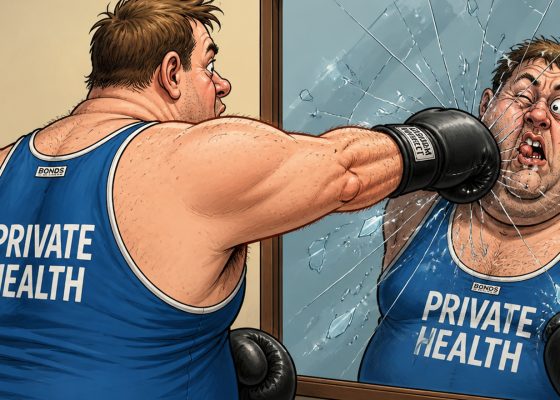
The hidden cost of organisational silence
Healthcare leaders often monitor incidents, complaints, accreditation outcomes and patient experience data.
These are essential governance indicators, however, they are predominantly lagging indicators.
By the time they appear in board papers, the opportunity for prevention has frequently passed.
Organisational silence operates differently. It is a leading indicator of future harm.
When staff stop reporting near misses because “nothing ever changes”, organisational learning declines.
When clinicians avoid challenging unsafe practice because influential individuals are protected, risk accumulates.
When executives receive increasingly optimistic reports because middle managers filter uncomfortable information, governance becomes disconnected from operational reality.
Perhaps the greatest governance challenge is not the risks boards know about. It is the risks that never actually appear in board papers.
Several public inquiries into healthcare failures have demonstrated this pattern repeatedly. Rarely were organisations unaware that concerns existed. More commonly, information became diluted as it travelled upwards through multiple organisational layers. Each level removed uncertainty, softened criticism or avoided conflict until the board received reassurance rather than reality.
Psychological safety therefore becomes a governance capability.
Boards cannot govern risks they never hear about.
Leadership behaviour determines organisational culture
Healthcare organisations often invest considerable resources in culture surveys, leadership frameworks and behavioural expectations.
These are valuable, but none are sufficient on their own.
Employees continuously observe how leaders respond under pressure.
When a clinician reports a near miss, is the first question “Who was responsible?” or “What allowed this to happen?”
When junior staff disagree with senior clinicians, are they thanked for their perspective or subtly discouraged from speaking again?
When executives receive unwelcome information, do they become defensive or curious?
The answers to these questions shape culture far more powerfully than mission statements.
Research into high-reliability organisations consistently demonstrates that learning cultures are characterised by curiosity rather than certainty. Leaders ask questions before offering solutions. They actively seek evidence. They invite challenge rather than assuming agreement indicates alignment.
This requires humility.
Psychosocial safety is now a governance issue
The evolution of work health and safety legislation has fundamentally altered expectations of healthcare organisations.
Psychological injury is no longer viewed solely as an individual wellbeing issue. It has become a foreseeable organisational risk.
Safe Work Australia makes it clear that psychosocial hazards – including excessive job demands, poor organisational support, bullying, aggression and ineffective organisational change – must be managed using the same risk management principles applied to physical hazards.
Employee assistance programs, mindfulness initiatives and resilience training may support individuals after harm has occurred, but they do not replace an organisation’s obligation to eliminate or minimise psychosocial risks through better systems of work.
This then represents a significant shift for healthcare boards.
Historically, workforce wellbeing was often delegated to human resources. Today, psychosocial safety sits alongside financial, clinical and operational risks within the governance agenda.
Boards should therefore be asking questions that extend beyond staff engagement scores.
- Where are workloads becoming unsustainable?
- Which departments report the highest psychological demands?
- Do staff feel safe reporting concerns?
- How effectively is organisational change being managed?
- Which leaders consistently demonstrate behaviours associated with psychologically safe teams?
These questions are not simply about culture. They are about governance.
From culture to capability
Perhaps the greatest misconception is that psychological safety is something organisations either have or do not have.
In reality, it is a leadership capability that can be deliberately developed.
Leaders create psychological safety through consistent behaviours. They acknowledge uncertainty. They respond constructively to bad news. They separate accountability from blame. They invite dissent before decisions are finalised. They reward learning rather than perfection.
Similarly, psychosocial safety improves when leaders redesign work rather than expecting individuals to adapt indefinitely to poorly designed systems.
The highest-performing healthcare organisations recognise that safe cultures are not built through slogans.
They are built through thousands of daily interactions between executives, managers, clinicians and frontline staff.
Conclusion
Healthcare is becoming more complex, not less.
Financial constraints, workforce shortages, technological disruption and rising patient expectations will continue to challenge organisational performance.
In this environment, the organisations most likely to succeed will not necessarily be those with the most sophisticated reporting systems or the largest budgets.
They will be the organisations that learn the fastest.
Learning depends on information. Information depends on people speaking honestly. And people only speak honestly when leadership consistently demonstrates that doing so is safe.
Psychological safety enables organisations to learn.
Psychosocial safety enables people to sustain that learning without being harmed by the systems in which they work.
Together, they represent far more than contemporary leadership concepts. They are strategic capabilities that influence clinical quality, workforce sustainability, organisational resilience and ultimately the safety of every patient entrusted to our care.
For healthcare leaders, the question is not necessarily whether psychological and psychosocial safety matter. The question is whether the organisation they lead is genuinely designed to support both.
Dr Sidney Chandrasiri is the CEO of the Australian Institute of Health Executives.
Professor Luis Prado is the chief academic officer of the AIHE.
This article was first published by the AIHE. Read the original here.