


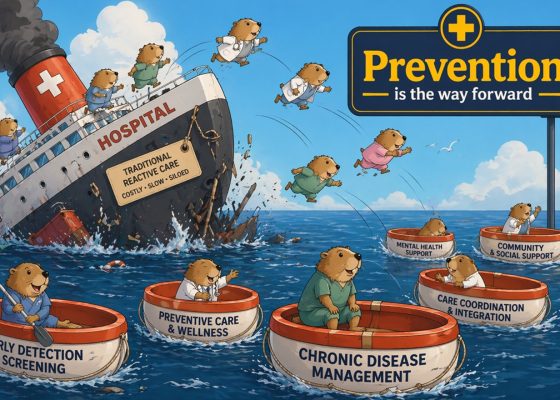
Prevention, as we currently define and deploy it, risks being one of the biggest unexamined failures in health system history. That makes it not just a problem but a reform imperative.
Dear Treasurer,
What follows is a relatively simple plan to execute systemic economic reform that would save us billions per annum over time – one you could start in a single budget cycle without adding to the deficit.
But first, a blunt observation.
Prevention, as it currently exists in Australia, is largely a scam.
That might sound provocative, but it’s hard to argue otherwise once you look at how the system actually behaves.
Every part of the health system claims to be doing prevention. Governments fund it. PHNs pilot it. Hospitals talk about it. Insurers experiment with it. Digital platforms promote it. Primary care is supposedly built around it.
And yet no one – not one entity in the system – can tell you, with any real certainty:
- what we are collectively trying to achieve;
- what we are spending in total;
- what is working;
- what is not;
- or what return the system is getting for the money.
Instead, prevention exists as a loose collection of initiatives, pilots and programs, each funded and promoted in isolation, each justified with the same vague promise:
“This will probably be good for the system in the long run.”
Sometimes it is. Most often, we don’t know. Too often, no one checks.
The result is not a prevention system, it’s a prevention narrative.
And it is one we collectively sell to the public as a supposed pillar of policy without taking any responsibility for whether it delivers to the public.
Who spends without knowing the return?
If you strip away the rhetoric and look at prevention through an economic lens, what you see is not just policy failure, it’s a capital allocation problem.
Across the system, hundreds of millions are being deployed into “prevention” without a national strategy, a consistent investment framework or a mechanism to measure return.
In any other sector, this would be untenable.
The treasurer should ask, what are we trying to achieve, what is the expected return, over what timeframe, and how will we know if this worked or not?
In prevention, we ask none of these questions in any sort of coordinated manner. Mostly as stakeholders we say, “we know prevention is a good idea, here’s another one” and leave it there.
Why rational systems behave irrationally
The explanation lies in structure.
Australia’s federated model creates exactly the wrong incentives for prevention.
- States fund hospitals, but prevention benefits often accrue to the Commonwealth;
- The Commonwealth funds primary care, but hospital savings accrue to states;
- Outcomes take years, but political cycles are short;
- Benefits land across portfolios, but budgets are siloed.
So rational actors behave irrationally. They invest in things that deliver visible returns within their own siloed and politically framed ecosystem.
But prevention is so obvious everyone needs to be doing it in some way. So it gets talked about endlessly and delivered erratically and inefficiently.
The Productivity Commission has already mapped the answer
The Productivity Commission has been unusually clear on the problem of prevention.
Its recent review, Delivering Quality Care More Efficiently, effectively says the problem is not that we don’t understand prevention, it’s that we lack the coordinating machinery to connect stakeholder initiatives and invest in it properly.
It points toward an independent evaluation of prevention investments, standardised modelling of long-term economic returns and a structured national investment and deployment framework.
In other words, treat prevention like infrastructure: assess it, plan it, coordinate all of it, fund it, measure it, scale it.
The logic is pretty simple.
The problem has been execution, because no one owns prevention.
So give it an owner
If this were energy policy, or infrastructure, or industry reform, the solution would be obvious. You would create an institution.
We created the Australian Digital Health Agency and funded it for billons once we recognised that national digital health infrastructure co-ordination was the only way to achieve meaningful national interoperability.
A prevention agency would likely deliver much bigger returns.
Let’s call it the Australian Preventative Health Agency.
Its job would be to:
- Assess all current initiatives at every point of the system;
- Create a national plan to coordinate the good and dispense with the bad;
- Set national prevention priorities to that plan;
- Coordinate Commonwealth and state investment and influence private investment by recommending legislation where necessary;
- Evaluate programs using consistent economic criteria;
- Track outcomes and return on investment;
- And report publicly and transparently on performance.
Not another advisory body – an investment and coordination body, one that would sit as comfortably in Treasury as it would in Health, because this is as much a fiscal problem as it is a clinical one.
You don’t need new money to start
The immediate objection, particularly in our upcoming budget, will be cost, of course.
But this is one of the few reforms that can be started largely with money already in the system.
The question isn’t whether we spend on national health infrastructure, it’s whether we are spending it in the right places for the next phase of the system.
That phase is the AI phase of the system, and a lot of things are going to change, very fast.
If we can get ahead of some of these changes, as some key healthcare leaders seem to be doing – for example, Bettina McMahon at Healthdirect – we can easily afford this initiative.
The ADHA needs surgery
Start with the Australian Digital Health Agency.
The ADHA was built for a different era – one focused on centralised infrastructure, national platforms and long-horizon interoperability projects.
Some of that remains essential. The My Health Record still matters. Core standards still matter. Secure identity and data access still matter.
But the Agency, as currently structured, is too broad and too slow for what comes next.
AI is already reshaping how information moves through the system.
The assumption that a centrally orchestrated national health information exchange will sit at the centre of that future is increasingly questionable.
At the same time, the system has seen relatively few transformative outputs in recent years that have materially changed clinical practice at scale.
Electronic prescribing – the last major shift clinicians actually felt – was driven as much by industry infrastructure as by central agency build.
This is not an argument to abolish the ADHA. It is an argument to sharpen it:
- focus on core infrastructure;
- strip back peripheral programs;
- and concentrate on what will survive into an AI-enabled system.
Then redirect what isn’t working.
In a recent conversation with a senior leader in the Department of Health, Disability and Ageing about getting out in front of AI, the leader said the government was going to need two speeds now: maintaining core programs still in play, and the AI stuff.
The ADHA needs to be redesigned with this philosophy in mind.
Healthdirect: don’t cut it, reposition it
Healthdirect is a different case but one where you could borrow a good chunk of money to start this new initiative – and knowing the leadership of this group, they’d probably help you work this out.
Healthdirect in the world of AI has become more relevant, not less. Under Ms McMahon, it has built something genuinely valuable: a national triage and navigation layer for patients who don’t know what to do.
But it is now facing a structural shift, because the future front door to the health system will not be a government website, it will be a global AI platform or two.
Patients are already asking ChatGPT and other systems what to do when they are unwell. That trend will accelerate rapidly.
The strategic question is whether Australia will help shape the trend, because there is no question that it is going to happen.
Healthdirect’s opportunity is to become the trusted national layer that:
- feeds high-quality, local clinical pathways into AI systems;
- ensures safe triage and escalation;
- connects advice to real services;
- and sets standards for how AI operates in the Australian context.
Such a role makes Healthdirect more relevant and critical to the system than it has ever been before.
Use what you already have to build what you need
Between a more focused ADHA and a refocused Healthdirect, there is a clear opportunity: reallocate a portion of existing funding to seed a national prevention agency.
This is not about cutting capability. It is about shifting resources toward the system’s most obvious structural failure and meeting AI in health head-on.
Why this is your problem, Treasurer
Prevention is framed as a health issue, but it’s not – it’s an economic issue.
If done properly, prevention affects workforce participation, productivity growth, welfare dependency, ageing costs, and long-term fiscal sustainability of both our health system and our budget overall.
This is the care economy you’ve been talking about, Mr Chalmers, practically delivered, complete with measurement and ROI for your hard-nosed friends in Treasury.
Right now, we treat prevention and health as a cost centre, when it should be treated as an investment portfolio.
But you cannot run an investment portfolio without a framework, a decision-maker, a capable deployment unit and a way to measure return.
Related


Start where the return is obvious
If the APHA is going to prove its value quickly, it should start with one thing: where cost is concentrated and we will get the most effective immediate and measurable return – chronic disease.
All this has a direct correlation to hospital demand and that’s where the current system is least efficient.
We have built a hospital system to manage conditions that should largely be managed in the community.
General practice is the natural anchor for prevention, because of continuity, trust and long-term relationships. But we fund it for throughput, not outcomes.
This isn’t going to be easy, because the idea of the little green free credit card – our Medicare card – has been political ecstasy.
Bulk billing and urgent care centres aren’t a bad investment initiative, and in many respects will be key to our future system, but if you want to release true value, you are going to need to get a lot more nuanced than a free green healthcare credit card for every punter in the realm.
Getting the states on board
The federation problem is real but it’s not new and it’s not an insurmountable problem for healthcare in the country.
Two good examples of solving it twice would be Healthdirect and the Australian Digital Health Agency (jury might be still out on this one, but it’s been a great idea).
Both are jointly funded, jointly governed and nationally accountable.
The same model applies here.
The pitch to states is simple and not dissimilar to the pitch that was used for Healthdirect: this is how you reduce hospital pressure.
The pitch to the Commonwealth about prevention is equally compelling: this is how you improve productivity and long-term fiscal outcomes.
The barrier and the pivot around it
None of this is technically difficult, but it is politically difficult.
Why? Because it redistributes control, forces accountability, requires longer-term thinking than typical political cycles and, hardest of all, it creates winners and losers.
Prevention is not failing because we don’t understand it. It’s failing because no one is responsible for making it work.
So, here’s the simple doable thing you could have a think on, Dr Chalmers.
In the next Budget, undertake a targeted review of national health infrastructure spending.
Start with the Australian Digital Health Agency and Healthdirect.
Then redirect a portion of that funding, or other obviously low-return monies in other areas, to establish an Australian Preventative Health Agency.
Not another strategy or policy position or pilot – an institution with a mandate to measure, coordinate and invest.
When you say it like that it even sounds like you might be able to lead with it as a bold creative new initiative of a party really thinking on its feet. Something perhaps to counterbalance your new tax ideas.
If prevention is genuinely a productivity priority, it should be funded like one, not just talked about like one.
Because until someone owns prevention, we will keep spending on it and never knowing what we’re getting back.
And, if you get it right, it won’t just be a health reform. It will be one of the few structural reforms capable of shifting Australia’s long-term fiscal trajectory.
Those opportunities don’t come along very often.
If as a system stakeholder you are interested in contributing ideas to this topic and getting an Australian Preventative Health Agency up and running, please come to Health Services Daily’s Canberra Health Leadership Workshop and Summit on Prevention on 16 and 17 June at the Hyatt in Canberra. The first five delegates to use this discount code will get a 50% discount on any ticket type: Extra50. If you’re reading this Jim, your ticket is on us. Program and tickets HERE.