


But what if the word is the problem?
Nobody ever built a trusted relationship by handing someone a contract and a performance framework, but that is essentially what we have been asking primary care to do for 30 years.
Let me tell you about a meeting I have heard described in different forms across different health systems, but the story is always the same.
A commissioner sits across the table from a for profit management team. There is a contract. There are KPIs. There is a monitoring schedule. The commissioner talks about outputs. The GP talks about consumers. Nobody is wrong. But nobody is quite speaking the same language either.
They shake hands at the end. They call it commissioning.
But what they have actually produced is a transaction. And transactions, the evidence keeps telling us, are exactly the wrong tool for the job in primary care.
Here is what the research consistently shows:
Even in health systems that have aggressively pursued market-based commissioning, primary care stubbornly remains relational. Commissioners and providers build trust over time. They collaborate. They make informal agreements. They solve problems together. They rarely switch providers. They rarely enforce contracts through legal mechanisms.
Researchers call this “the adaptive persistence of relational commissioning”.
I call it common sense that the system keeps trying to design out.
The real question is not whether commissioning in primary care will be relational. It already is. The question is whether we will design for it deliberately, or keep pretending the transactional model works while relationships do the heavy lifting in the background.
The good steward did not simply take as much wealth from the land as he could. He tried to leave it in better condition than he found it. That obligation is exactly what primary care commissioning demands of us.
The concept that captures this best is stewardship. Not management. Not purchasing. Not governance. Stewardship.
Stewardship asks a different question. Not: did we hit the KPI? But: is the system in better shape because of our decisions? Will the communities we serve be healthier in 10 years? Are we investing in people or just processing them?
Through studying primary care commissioning models internationally, eight characteristics consistently define systems where stewardship is working.
Trust is not soft. It is the governance mechanism
Meet Sarah.
Sarah is a CEO of a small charity in a mid-sized regional town. Her primary care network has had three different commissioning contacts in two years. Each one arrived with slightly different priorities. Each one left before the relationship had properly formed.
Sarah has stopped investing in those conversations. Why would she? Every time she opens up about what the community actually needs, the person she told is gone before anything changes.
The contract still exists. The relationship does not.
Where trust exists between commissioners and providers, governance works through shared values, honest conversation, and mutual accountability. Where trust is absent, you get performative compliance and expensive enforcement mechanisms that achieve very little.
Effective stewards invest in trust the same way they invest in infrastructure. It requires continuity of personnel, transparency about constraints, and the willingness to keep showing up even when things are difficult.
Also in today’s edition:
- Another big leap for Consultmed with Victorian contract win
- Rae blames ‘misinformation’ for complaints about integrated assessment tool
- Healthcare’s AI boom comes with an environmental price tag
- Third Degree: Choosing health insurance with the help of AI, from start to finish
- Medicinal cannabis has gone mainstream. But Australia’s struggling to cope
- Money talks, health talks more: RACGP
Short contracts destroy long-term thinking
Prevention does not show up in this year’s budget. A diabetic patient who never became a diabetic patient does not appear on a dashboard. A frailty program that keeps Mrs Chen out of hospital for the next five years costs money now and saves money later.
But most commissioning cycles are short term. Most financial planning horizons are two to three years. And most of the incentives push commissioners to solve this year’s crisis rather than prevent next year’s.
Effective stewardship means multi-year contracts – outcomes that matter to people, not just the system; year-of-care payment models that reward integration and prevention; and the courage to move resources toward what works even when the returns are slow.
The evidence is clear. Short-term incentives work against sustainable change. Systems that commission for the long term consistently outperform those that do not.
Providers are partners, not passive recipients
Meet James.
James leads a community health organisation that has been delivering mental health support in a low-income suburb for 12 years. He knows every referral pathway, every community organisation, every landlord whose properties are making his clients sick.
He was not invited to the commissioning design workshop. He received the new service specification six weeks before implementation.
The new model failed within 18 months. Nobody quite understood why.
James understood exactly why.
Research on large-scale commissioning failures consistently identifies the same pattern. Providers and communities are treated as passive recipients of commissioner-designed plans rather than active partners in design and governance.
Effective stewards build shared governance structures. They include GPs, community providers, the voluntary and community sector, and local government in strategic decisions. Not as consultation – as genuine co-design.
The knowledge that makes commissioning work lives in the people closest to the community. Stewardship means drawing that knowledge in, not keeping it at arm’s length.
Population health first. Services second
Traditional commissioning funds services. Stewardship-based commissioning starts with populations.
The question changes from “how many appointments shall we fund” to “what does this community need to stay healthy, and how do we organise resources around that”.
This requires population health data. It requires program budgeting that makes variation visible. It requires commissioners willing to ask the uncomfortable question: why are people in this postcode receiving twice the interventions of people in an equally unwell postcode three kilometres away?
And it requires the courage to act on the answer.
Health inequalities do not resolve themselves. They require deliberate redistribution of attention, investment, and care toward the communities whose needs are greatest and whose voices are quietest.
Evidence and relationship are not opposites
There is a persistent myth in health system leadership that rigorous, evidence-based decision-making is in tension with relational, trust-based governance. That you are either data-driven or relationship-driven.
This is a false choice.
Effective stewards use multiple forms of evidence together: population data, academic research, clinical expertise, provider intelligence, and lived experience from communities. None of these alone is sufficient. All of them together get close to the truth.
Data tells you what is happening. Relationships tell you why. You need both.
Culture change is the actual job
Meet the program that failed – a major integrated care initiative, 18 months of design, multiple consultants, a beautifully structured commissioning framework.
It failed to achieve meaningful change.
The post-implementation review found the same thing that most such reviews find. The structural solution was sound. The cultural conditions were not.
Local government partners felt like they were “in the room but not at the table”. Providers felt like passive recipients. Staff lacked the relational skills the new model demanded.
No contract can fix a culture. But a steward can build one.
Structural reforms without cultural change are expensive ways to rearrange the furniture. Effective commissioning stewardship requires leaders who understand that their primary task is creating conditions where good things happen consistently, not designing systems that compel compliance.
You cannot commission from a distance
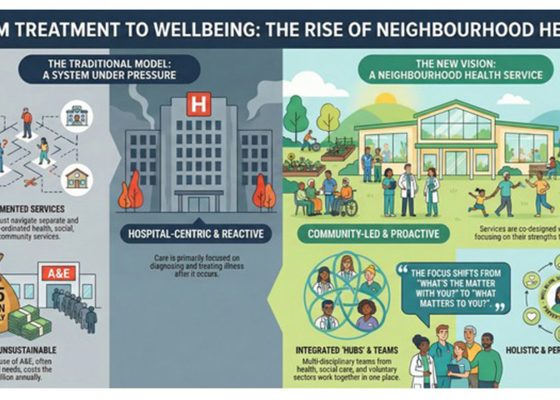
As health systems consolidate into larger structures, one of the most significant risks is the loss of local commissioning intelligence. The knowledge that makes primary care commissioning work is neighbourhood knowledge – who the trusted community leaders are, which providers have real capability and which have impressive documentation, what the community will actually use versus what looks good in a needs assessment.
That knowledge lives in relationships. It does not survive being managed from a regional office 20km away.
Effective stewardship in neighbourhood health requires commissioning structures that are genuinely local – place-level entities with real decision-making authority, people who know the community they serve, not just the dataset that describes it.
Skilled local commissioning managers, with both population health capability and strong community relationships, are not optional. They are the mechanism by which neighbourhood health actually works.
Related


Financial stewardship asks a different question
Conventional financial management asks: are we within budget?
Financial stewardship asks: are we using these resources in ways that will improve the health of this community over the next decade?
These are very different questions. And health systems that only ask the first one consistently make short-term decisions that create long-term costs.
Effective stewards use risk-sharing mechanisms that align incentives between commissioners and providers. They invest in prevention even when the financial return is years away. They are transparent with partners about how resources are being allocated and why.
The steward’s question is always: will the system be in better shape because of the decisions we made today?
We have spent 30 years designing relational care out of the commissioning system. The evidence says it kept coming back anyway. Maybe it is time to stop fighting it and start designing for it.
The shift that has to be made:
- From contract compliance to shared accountability;
- from annual targets to long-term outcomes;
- From arm’s-length monitoring to collaborative governance;
- From service volumes to population health;
- From transactional relationships to trusted partnerships;
- From his year’s budget to intergenerational sustainability.
None of this is easy. Relational stewardship requires skills that health system training rarely develops. It requires political courage to move resources toward prevention when acute pressures are screaming for attention. It requires continuity at a time when health system restructuring is constant.
But the evidence is not ambiguous.
The systems that work are the ones built on trust, sustained relationships, genuine partnerships, and a long view of what health is actually for.
The contract is a starting point. The relationship is the work.
Eugene McGarrell is general manager of commissioning and planning with the Sydney North Health Network, and former CEO of Health Australia.
This article was originally published on Mr McGarrell’s LinkedIn feed. Read the original article here.