


Are we building systems that wait for a collapse, or are we building systems brave enough to knock on a car window at dawn?
As the first light of dawn breaks over Dee Why, the sky turns a soft, pale grey. Inside a parked car, Lin Hua wakes to the familiar ache of a night spent in the passenger seat.
The engine is cold, the windows are cracked just enough for fresh air, and her belongings are tucked into the corners of what has become her only shelter.
Lin Hua’s presence here is the result of a devastating cascade. After her husband gambled away their savings and their home, she made the agonising choice to send her children back to China to live with their grandparents, a sacrifice made in the name of stability she could no longer provide.
Now middle-aged and alone, she navigates a “steady tide” of depression and the restless, scattered thoughts of ADHD diagnosed during the pandemic.
Her story asks a piercing question of our social fabric: What is the difference between a life rebuilt, and a life lost to the system?
As it turns out, the solution to homelessness and chronic illness isn’t just more hospital beds. Often, the path to recovery begins with a very specific type of human connection, a knock on a window before the crisis turns terminal.
The “lived experience” bridge is more effective than a clinical referral
In the first version of Lin Hua’s future, her recovery doesn’t start with a siren or a sterile waiting room. It starts with a woman named Mei.
Mei doesn’t approach with a clipboard or a badge. She approaches with a shared language and a shared history. When she speaks to Lin Hua in Mandarin, she isn’t just translating words; she is translating empathy.
By offering a bao and a coffee, Mei creates a rare moment of safety where Lin Hua’s guard can finally slip.
The beauty of this interaction lies in its refusal to treat Lin Hua as a “case number”. We call this “lived experience” engagement. For someone who feels invisible, a clinical referral can feel like a threat, but an invitation from someone who has “been there” is a bridge.
“你好, 我是 Mei,” she said gently, smiling. “I’ve been where you are. I want to help; would you like a coffee?”
The ‘neighbourhood health hub” as a one-stop survival shop
When Lin Hua agreed to go with Mei to the integrated health hub in Dee Why, she didn’t find a fragmented bureaucracy. She found a system that refused to compartmentalise her suffering.
The relief was immediate: she didn’t have to repeat her trauma to five different strangers in five different buildings. Instead, the care wrapped around her.
On that first afternoon, the hub functioned as a “one-stop shop” for her survival. Her experience included:
- Primary medical care: A GP performed blood tests and began treating a persistent, hacking cough;
- Diagnostic imaging: an on-site x-ray to ensure the cough hadn’t progressed to serious lung disease;
- Specialist mental health: a psychiatrist to manage her ADHD medication, which had run out months ago, and a psychologist for weekly support with her depression and anxiety;
- Social and financial navigation: a link worker to jumpstart social housing applications, while a peer worker walked her through the labyrinth of Centrelink to secure emergency funding.
This integrated approach acknowledges a fundamental truth: you cannot effectively treat a patient’s respiratory infection or mental health if they are simultaneously starving or terrified of where they will park their car at night.
Related
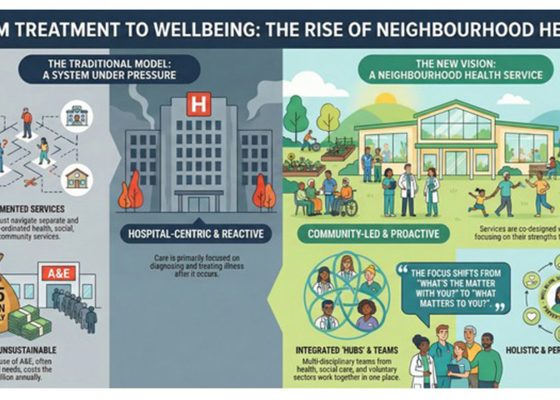


The ‘discharge trap’ and the failure of reactive medicine
But this path to recovery is not guaranteed; it is a policy choice. To understand the stakes, we must look at the alternative, the “discharge trap” that consumes those the system fails to see.
In a second, darker scenario where no one knocks, Lin Hua’s health plateaus and then plummets. Without intervention, her untreated ADHD leads to self-neglect, and her body begins to fail. She develops the visceral markers of uncontrolled type 2 diabetes: a constant, parching thirst, thrush, blurry vision, and the stinging pins-of-fire known as neuropathy.
When she eventually collapses and is rushed to the hospital, the medical team “stabilises” her. They treat her pneumonia and start her on insulin.
But then they hit a wall. Lin Hua is medically ready to leave, but she has no home to go to. Because she cannot safely manage insulin or recovery on the street, she occupies an acute care bed for four to six extra weeks simply waiting for a place to go.
This is the peak of systemic inefficiency, a failure of system design where an expensive hospital bed is used as a makeshift shelter because the social infrastructure has crumbled.
When she is eventually discharged back to the streets, the medical “cure” evaporates. Without a refrigerator for her insulin or a roof over her head, the cycle of readmission and decline begins again.
Health is a social outcome, not just a medical one
Six months after her first visit to the hub, Lin Hua’s life has regained its rhythm.
She lives in a modest, safe flat with a door she can lock. She works part-time at a local supermarket, stocking shelves and finding purpose in the routine. She even joined a walking group of migrant women, finding community among those who understand the weight of being far from home.
This transformation wasn’t a lucky break; it was the result of a deliberate, commissioned partnership known as the Wellbeing Collaborative.
This is the systemic engine of the model, a framework where local, state, and federal agencies stop working in silos and instead partner with local communities to deliver seamless routes to care.
In this model, “health” is recognised as a social outcome. Lin Hua’s pre-diabetes was managed not just by a doctor, but by a dietician who helped her plan meals she could finally cook in her own kitchen. Her mental health was stabilised not just by pills, but by the “place-based” support that connected her to her neighbours.
Conclusion: a choice of two futures
The “neighbourhood health hub” model represents a fundamental shift in how we view the public’s well-being. It moves us away from a reactive “wait for collapse” mentality and toward proactive, empathetic engagement.
We are faced with a choice of two futures.
In one, we continue to pay the high price of systemic inefficiency, watching as the “invisible” members of our community occupy hospital beds because we failed to provide them with a front door.
In the other, we invest in the infrastructure of empathy, hubs that treat the whole person and peers who aren’t afraid to reach out.
The question for our policymakers is simple: are we building systems that wait for a collapse, or are we building systems brave enough to knock on a car window at dawn?
Eugene McGarrell is general manager of commissioning and planning with the Sydney North Health Network, and former CEO of Health Australia. This article was originally published on Mr McGarrell’s LinkedIn feed. Read the original article here.