

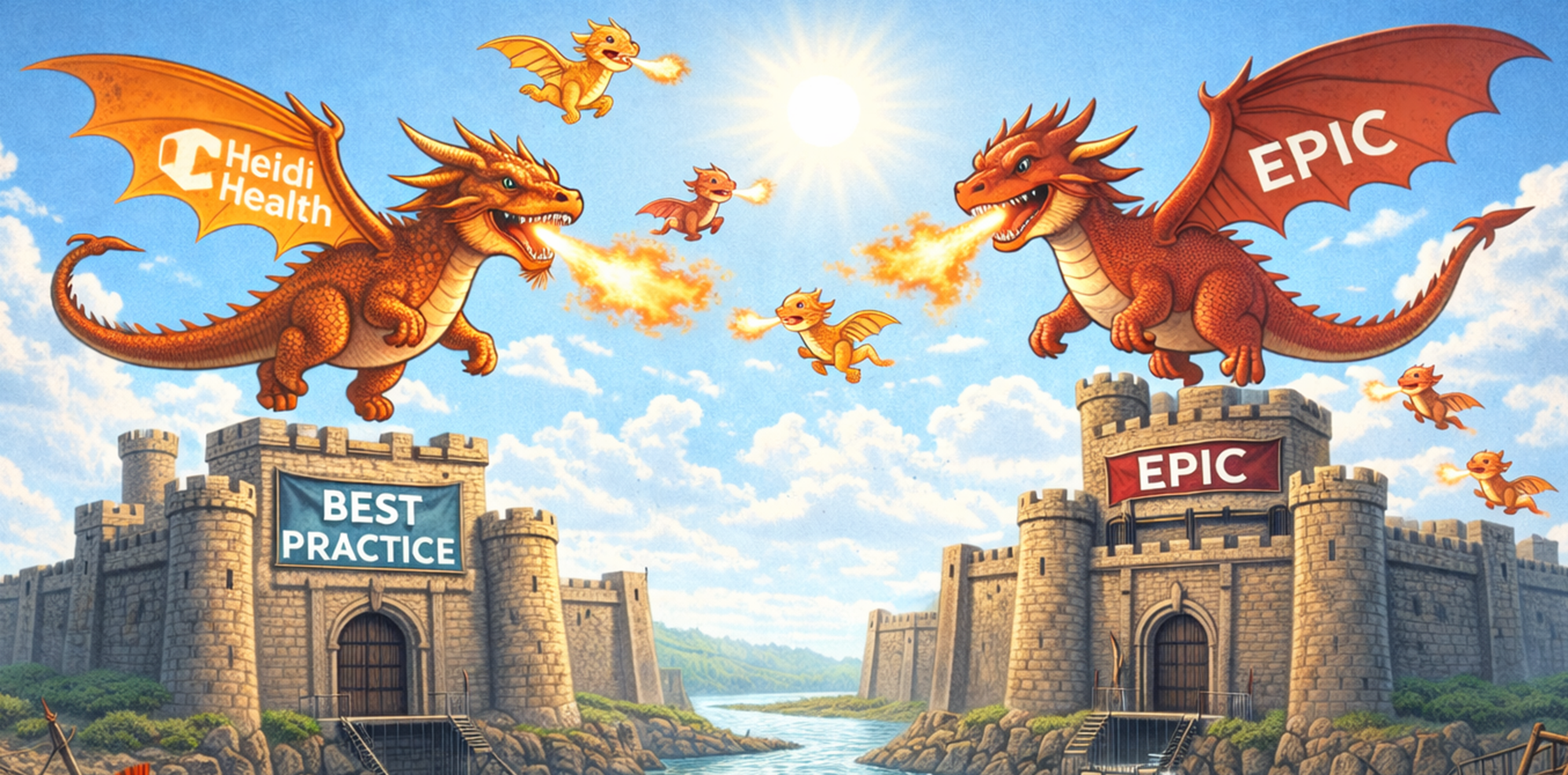
Arguably our most successful and powerful locally grown medical software platform is at a crossroads which will likely see a new controlling shareholder in the not-too-distant future, but who would be best to own this most prized of assets in this 'daze of disruption'?
Twelve years ago, I was serving out a one-year non-compete on my previous job – I’d been fired, but I still had a non-compete … that’s private equity for you.
So, I spent a year building an event in an area I had never worked in before, but which was at the time fascinating – digital transformation.
Back then digital disruption was in its heyday for major markets such as retail, finance, travel and media: most major incumbent companies faced extinction-level crises if they didn’t work out a way to reboot their old cultures and business models, get on the cloud quick- smart and reinvent themselves to compete with the digital native competitors.
That process was termed “digital transformation”, and at the time helping incumbent companies rise to the challenge of that transformation was big business, especially for the big consulting firms.
Our event, which became fairly popular, was called “Daze of Disruption”.
After my one-year non-compete was up I decided to go back into the healthcare sector and launched a GP newspaper called The Medical Republic.
Fast forward to today.
Before long I became very excited by the idea that healthcare seemed to be largely untouched by the whole digital disruption and transformation thing. It was a bit like the digital transformation version of the Land that Time Forgot.
I naively launched a dedicated healthcare event focused on digital disruption called Wild Health (you can look at our latest program and get tickets to our Canberra Wild Health Leaders’ Summit this year in June if you want, here).
While I had experience in GP media, I completely misunderstood the broader issues around the relationship between healthcare professionals, government policy, software provision and technology, governance, risk and change.
Yes, people loved the topic of digital transformation in health and turned up to talk about it. No, there was virtually nothing people would or could do about seriously engaging in the phenomenon that was sweeping other big sectors. There was too much complexity, risk, government money invested – state versus federal – silos fighting other silos, regulation and so on.
Digital change in healthcare was largely stuck in a deep bog. Outsiders who came from other sectors and thought they could make a killing because nothing had happened, usually got quickly killed by a sector with significantly different operational and regulatory dynamics.
Then covid punched us all in the face.
A lot of people in government and healthcare had to wake up and do big and obvious digital things quickly, notwithstanding a previous culture of glacial change, and all the rules around risk mitigation.
Some groups, private and government, pulled off miracles during covid. Witness the astoundingly rapid completion and deployment of the national electronic script exchange, a project that had been mired in the risk culture for years prior to the pandemic.
Today we have quite a bit of movement around trying to transform the entire infrastructure of our system to enable what the government has termed “sharing by default” – seamless real-time sharing of relevant patient care data between the provider silos and between the provider and the patient.
The Department of Health, Disability and Ageing has been – unusually for a government department – creative and forward-leaning in this trend and has to be given a fair bit of credit for what movement we are seeing.
But if you step back from it all, it’s all still pretty slow. The plans are good, big and grand, especially those from the Australian Digital Health Agency, but we’re talking about shifting decades of sclerotic, highly complex and, usually siloed, technology plays.
We haven’t really started building anything much yet. For example, the FHIR-enabled version of the My Health Record, a national health information exchange and a national FHIR-enabled provider directory.
If you’ve read this far it’s probably because you read the headline about Best Practice, you were interested in who might buy it and for how much, and you’re now wondering if I’m ever going to actually mention it, or just keep prattling on about health and digital disruption.
It’s a slow build-up, I’ll grant you, but important for context.
Related


Best Practice is easily our most iconic and important locally grown healthcare software platform play. At nearly 80% of share of our GP providers’ workflow desktops, with a maze of important third-party integrations, it’s become the gatekeeper of primary care access and data flow.
If you believe that the government is actually serious about getting on top of chronic care management as a means of managing our system efficacy into the future, and reigning in the exploding costs of acute care in our hospitals, then surely Best Practice is one of the most important and valuable technology assets in play if we are to get to that future.
There’s a lot to unravel here to truly understand how valuable Best Practice might be. Simplistically, MedicalDirector – its major competitor – sold five years ago to Telstra Health for $340 million when Best Practice only had 45% share of GPs, and HotDoc, the patient-facing platform version of Best Practice, just sold to PE for $250 million.
But as most people will now be painfully aware, there’s a new sheriff in town.
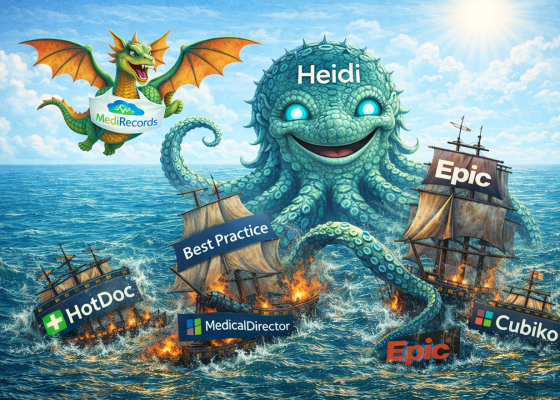
If you believe any of this recent take on Heidi, it’s maybe not so much a sheriff as an all disrupting and rapidly growing giant Kraken, set to wreak havoc on our old technology-based local medical software platform market.
But Heidi by itself isn’t even close to the biggest impending disruption for our vendors, patients, doctors and the whole system.
The new patient-facing AI engines, ChatGPT Health – which soft launched a few weeks ago – and Claude Health, which is going to launch here soon, are going to seismically change the playing field for all parties: patients, software vendors, the government, and possibly most of all, every type of doctor, including GPs.
Already the sudden emergence of these patient-side AI engines is causing government agencies to rapidly rethink everything about the past and future of healthcare in this country.
There’s a really good sign in all this: some people in and around government who manage and organise healthcare delivery at a high level – not usually the sort of people first off the blocks in this sort of “rupture event” – are all over what is going on and acting already to move to synchronise policy and infrastructure with what they is probably by far the biggest single step change in how healthcare will be done in the country, in history.
Let’s take as a quick but important example, Healthdirect (now 1800Medicare), and its enigmatic and creative leader, Bettina McMahon.
If you’ve been following the trajectory of ChatGPT and Claude Health and of the major global consumer AI engines overseas – you maybe now even use some of them day to day for your work – you wouldn’t have to be a genius to work out that one of these patient-side AI engines stands a very good chance in the next couple of years of, among many other disruptive things, replacing much of what the $230 million per annum budget HealthDirect has been using for many years now with its humanly manned telehealth triage service .
In simple terms, the power and utility of these new AI engines for the patient are very likely to make them universally used by patients quickly as a part of their day-to-day healthcare regime, which is in turn likely to make them the largest digital front door for patients in the country.
If this does happen, the ramifications for every point of the healthcare system are almost incalculable. Some left-field things that might happen include:
- Healthdirect decides to work with one or more of the AI engines to hand over IP and surrender its previous key strategic objective of becoming the single digital front door for patients in Australia, with a view to having some say and governance control in how our healthcare system integrates with a platform that is going to hand so much information and power back to patients – an “If you can’t beat em, join em” move, with a view to doing what is possible in compliance and safety for patients if you manage to get on the inside of one of these behemoths of data and technology;
- DoHDA, in the same vein, makes the new more agile My Health Record instance it is building able to be integrated to a consenting patient’s MHR easily with these new AI engines, to optimise how they manage their own care, and to give them a personalised AI integrated MHR on their phone for interoperability purposes;
- The big patient-facing booking engines, both of which are currently racing to install new AI features to make their patients’ journey into and out of the healthcare system far more friendly and practical, will have to somehow pivot to figure out what their role will end up being in the patient journey, given the new competition. That’s if these AI engines end up as the patients’ new major best friend in healthcare.
These are just a few things that could happen.
But by far the biggest challenge for any stakeholder in the healthcare system will be for the healthcare providers themselves, particularly the doctors.
Doctors have always had an information advantage over their patients. That and they are the only ones we grant the authority to prescribe complex drugs.
They have been highly trusted gatekeepers. Gatekeepers of very complex and vital information, but information and context which has largely been locked away in a secret regulatory garden until now.
AI hasn’t got any or much respect for this dynamic (which will likely be both bad and good), so doctors will need to adapt, and very quickly.

The doctor-patient relationship is about to change massively because much of the information advantage that doctors have will be levelled up by these new AI engines. A patient, with access to most of the special information doctors have spent years learning and relearning, who is deeply embedded in their own healthcare issues, who will be able to research and get lots of context for what is happening to them, is an entirely new beast for doctors to be engaging with.
Note: Heidi launched a new offering this week and is pitching its AI offering against these new patient AI engines as offering “special unbiased evidence based doctor-grade decision support”, an appeal to doctors who might be freaked out by how much the patient AI engines are going to help their patients understand medicine better.
For any doctors with their hackles up here, doctors aren’t going away. In fact, the advent of this AI-driven rupture is quite feasibly going to make doctors more important in system care than ever, in a whole lot of new ways – ways that most doctors you’d imagine would want to embrace because they are going upstream fast in their care management role.
The change is almost incalculably big and fast. All the fundamentals of how doctors learn, train and do ongoing professional development will need to be entirely redesigned.
But that’s another story, and I’ve again walked off the planned main path of this story: Best Practice.
It’s not by accident that Best Practice is a great company and product – not that all GPs love it but in relative terms what it has done for GPs over the years has been world class.
Its founders, Lorraine Pyefinch and Dr Frank Pyefinch, have both been clever, dedicated and constant developers of their product. Their most important skillset in building out the product though is arguably just how customer-facing they have been.
From the start, when he originally founded Medical Director, Dr Pyefinch was pushing technology to its limits all with a view to making things much better for GPs, their patients and the system. He has always been a frustrated technology entrepreneur who never formally learnt coding, constantly thinking and striving to meet that purpose in how his products work.
Sometimes he can come across cantankerous and a bit scary, but if that’s happening you’re just probably keeping him away from what he loves, making his products work better for the doctor, the patient and the system.
Both Dr Pyefinch and Mrs Pyefinch, although they’ll never admit it, have also been very good at the cut and thrust of business and competition, which is why today Best Practice stands in its near-monopoly position as the gatekeeper of what is probably the most important data transactional hub for the future of our system, general practice.
But here’s the thing.
Both Frank and Lorraine, while wanting their baby to keep going with the same purpose and trajectory, realise they can’t be the people running it forever. If it’s going to keep going it needs new blood, and – am I allowed to say this? – some younger guns helping.
Maybe some younger guns with those wise elders looking over their shoulder and providing the wisdom that you only really get by doing something for so long , making so many mistakes and learning from them.
So, acting on a few things I heard with a couple degrees of separation, I sent Frank and Lorraine a note and asked them point blank: are they planning on getting out, and if they are, what do they think that might look like?
It was one of my late afternoon Hail Mary emails.
If you know Frank well (I don’t but I know some people that do) this email could have had a few things happen to it: a gruff and cursory hrumphhh followed by no action (but he’d definitely note that if I had the story, things were going on he’d need to be aware of), a short but still cursory note thanking me for my interest but he has no comment, or, right up to an all embracing, “sure, come to Brisbane if you like, let’s have a bottle of white wine over lunch and have a chat about stuff…”
I unfortunately didn’t get the lunch invite. But I did get this, which is interesting:
“Yes, Lorraine and I still own 51% of Best Practice and Sonic own the other 49%.
“We are not currently in any discussions with anyone regard selling any of our shares. If we were made a reasonable offer by a buyer whose vision we shared, we would consider it.
Our agreement with Sonic includes a ‘first right of refusal’, so they could make a counteroffer if anyone approached us, but that has not happened at this point.
“HotDoc’s owners have never made us an offer.
“Hopefully that clarifies things for you. I’m happy for these answers to be on the record.”
A short but revealing answer:
- The beating-heart founders Frank and Lorriane still control Best Practice but they would like to sell their shareholding, probably in the near term;
- Most importantly, and I know this is vital to them from chatting to them in the past about a huge offer they were made once by Telstra Health for the business before that group acquired MedicalDirector, they require a “buyer whose vision we shared”.
- Sonic has first right of refusal, but as I’ll discuss below, Sonic buying the controlling shareholding probably doesn’t make sense, or indeed may not even be possible from a regulatory point of view.
It’s almost impossible to believe that Frank and Lorraine aren’t being courted as we speak, so maybe Frank’s reply is a bit cagey. If they are it’s not going to hurt to see this article spruiking the business to anyone else who might meet the criteria they’ve just advertised and have the money to afford it.
Who would buy it that could meet that criteria and have the money? How much money? Is AI going to disturb the dynamic of a sale?
It didn’t seem to with HotDoc just a couple of weeks ago.
A few quick guesses here, although if you saw my articles on HotDoc prior to it being sold I might be off easily by a factor of at least two.
How much?
North of $300 million, making a controlling share north of $160 million.
I’d normally say here this is the easy part but it’s probably not. It could go much, much higher if you look at recent multiples and the market position of Best Practice, or, it might end up lower if we see AI disruption sooner rather than later and buyers start to get nervous.
A higher valuation would take into account just how strategically important owning the gatekeeper to GP access and data might be in this new and now, actually disrupted, world of healthcare.
A buyer could easily come to the conclusion that Best Practice’s moat of market share, embedded workflows, switching costs, patient data and GP loyalty and trust, is big enough to give a new buyer enough breathing space to defend the group from the obvious charge of new AI players into the space via utility (including decision support) and rapid customer acquisition.
Someone put the AI and Heidi argument for potential dominance to me the other day by asking, “when was the last time you ever talked to a doctor that was actually ‘delighted’ with the functionality of their new software? Answer: ‘until Heidi and few others came along with AI scribes…never’.”
Best Practice, like most of our software platform vendor sector, has some serious technology legacy issues, notwithstanding a very clever bridging strategy of building out a cloud “connector” company called Halo Connect.
Actually getting a real cloud product which they will need, stuffed with AI goodies will take time, talent and a lot of money.
Quick note on talent which is ominous: anyone who is anyone in healthcare technology in this country is either already working for Heidi, thinking of working for them, being made an offer by them, or has being given a pay rise so they don’t work for them.
Any buyer would be assessing what all the major incumbent software platform companies are assessing at the moment: if we own the customer and distribution, we can be the ones in the end to deliver the customer AI uplift, not these pesky newcomers.
It’s sort of the biggest question in the markets around the big SaaS companies as well: who has the customer lock, the money and the smarts to simply use their customer loyalty and distribution to beat the new AI guys to it.
This is probably the key strategic question for Best Practice as well in a buyer’s mind.
Who could buy it and meet the buyer’s needs?
To start with, either Potentia, the PE firm who just acquired HotDoc, or Sonic, but both would have their issues you’d think.
The attraction of Potentia would be that it could probably get the money needed, but mostly, that it owns HotDoc, which is the patient-side access and distribution equivalent of Best Practice.
You’d own access and distribution on both sides – doctors and patients. If you invested enough, and with the right management and technology talent you’d have a good chance of integrating those two massively powerful distribution monopolies and beating AI.
You’d do this largely by building the relevant AI yourself and feeding it through your unique distribution channel before AI could get you.
Sonic has first right of refusal but Best Practice is not its core capability or its market. That’s pathology. It owns 49% because it keeps it firmly in the game on its major downstream reselling channel, GPs, something it probably would not lose with the right new owner of Frank and Lorraine’s 51%.
Sonic could easily run into a lot of regulatory trouble trying to buy it as well. Too much power for the ACCC in a vertically integrated ownership of data from the GP all the way through to pathology testing. Also, not too many GPs would be happy with Sonic, who is their major competitor through its GP corporate arm, IPN, having that sort of power and access to their data.
Who else?
Well, depending on its investors’ appetite for Australia, Heidi could go there. It probably won’t because it’s going to cost a lot, and it would be seen as a big distraction given Heidi is a global play and Australia is only a small market. Best to keep expanding its footprint rapidly and developing its AI powers, particularly now around evidence based decision support.
Magentus and Pacific Equity Parners?
Magentus has the market leading specialist PMS Gentu and Genie, gets on very well with Best Practice, has a suite of other healthcare software platform plays and is backed by one of our largest local PE firms, Pacific Equity Partners, so it has good access to capital.
Gentu is slowly becoming a good bottom up architected cloud product and that might help Best Practice with its long term problem of birthing a real cloud product and transitioning between its older product and a cloud one.
Finally, Magentus has smart management, a suite of products that give it a broad understanding of the technology options and the market.
All this feels like that could line up with Frank and Lorraine’s wishes.
It’s probably my front running bet.
Telstra Health?
That would be pretty bold given it owns the much-denuded competitor MedicalDirector that it bought only five years ago and didn’t manage to leverage.
When it bought MedicalDirector both it and Best Practice were nearly neck-and-neck in market share but Frank and Lorraine outsmarted Telstra and today MedicalDirector is a shadow of itself (go far back enough in its history and it once had 90% share of the GP market).
Also, quietly Telstra Health seems like it is working on a completely reinvented version of MedicalDirector (on a Salesforce platform), probably with ex-Best Practice product director, and all-round smart technology operator, Danielle Bancroft at the helm.
Past this, you’d need a private equity firm that Frank and Lorraine felt were committed to their vision. PE will say they are, and they will be, until they aren’t, which is when they strip mine an asset, take the money and run.
So that’s up in the air as well.
What about EPIC?
It’s got a huge capital base, already has a one software to rule them all strategy with its own ambulatory module in the US serving GPs, and, is tilting big time into AI delivery to its customer base through its enterprise hospital product.
It’s possible, if EPIC sees the financial upside in ruling all of Australian healthcare and Frank and Lorraine accept it will do the right thing with their baby.
No matter who comes calling on Best Practice, everyone will be closely watching what happens to this cornerstone asset of Australia’s digital healthcare system infrastructure.
I once thought healthcare could never be disrupted like other markets. That Daze of Disruption would never be a part of the highly risk averse and regulated healthcare landscape.
Turns out it can and it is.
Starting now.