


It all boils down to the question of who actually owns the data in a practice management software system.
Is Best Practice Software protecting its customers from Heidi or are they protecting their commercial model?
Let’s start with Heidi – Dr Thomas Kelly’s quote from yesterday’s HSD article sums it up best:
“We’ve been trying to integrate with Best Practice for three years, and they’ve not made any attempt to give us actual reasonable access … we don’t have access to real decision makers, they create a fairly opaque process for partners to actually work with them.”
Best Practice Software takes issue with Heidi jailbreaking their product.
“Under the terms of the End User Licence Agreement, you are prohibited from allowing any third party to access, use, or modify the Software or Database without Best Practice’s prior written consent … Best Practice has not given that consent for Heidi II, and Best Practice considers that using Heidi II with Bp Premier would constitute a breach of the End User Licence Agreement,” the email to Best Practice users read.
“To avoid any confusion, we are updating the End User Licence Agreement with the Oxford SP2 program update to Bp Premier to make clearer that the use of bots, scraping tools, and robotic process automation is not permitted with Best Practice Software.”
Heidi has built a useful product for GPs to provide better and more efficient care.
Related



BP has throttled access to the source of trust (the underlying PMS) so Heidi has hacked its way around it with a bit of a dodgy solution. Which also happens to live outside of BP’s revenue share model.
BP’s concerns are valid – having random bots running rampant in a secure clinical environment under clinical logins is super unsafe and inappropriate.
It bubbles up a ton of questions that have been in the background for years but not spoken out loud:
1) Who truly owns the data in the PMS?
2) How are licence holders allowed to control access to that data in a meaningful fashion?
3) Who controls the innovation pathway moving forward?
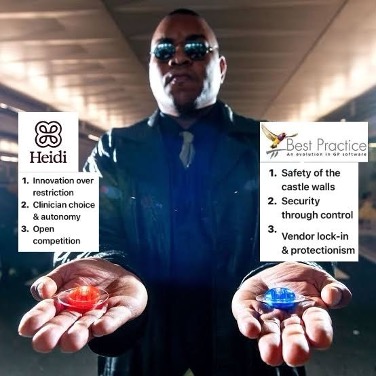
If you’re taking an innovation-based approach in Australian general practice you’ve likely faced this before – the walled garden of BP provides a familiar and secure space out of the box for clinicians.
But it severely throttles your ability to do anything different or new as it’s incredibly difficult to layer solutions on top.
BP’s partner-based approach is extremely selective and often has backend revenue share models that benefit BP significantly.
But in turn it markets to licence holders that they are the responsible adult in the room – this approach ensures only the most trustworthy of vendors will engage with your patient’s data and you can trust their marketplace implicitly.
This dilemma is the same issue GPs face when considering competing primary care services – are you being paternalistic (and exclusionary) because you know better than your end consumer? Or are you just protecting your business model?
Like most arguments in the modern world, it’s probably a little of both.
But that doesn’t fit into a meme, so let’s all yell at each other instead.
Dr Max Mollenkopf is a GP and practice owner in Newcastle, NSW.