

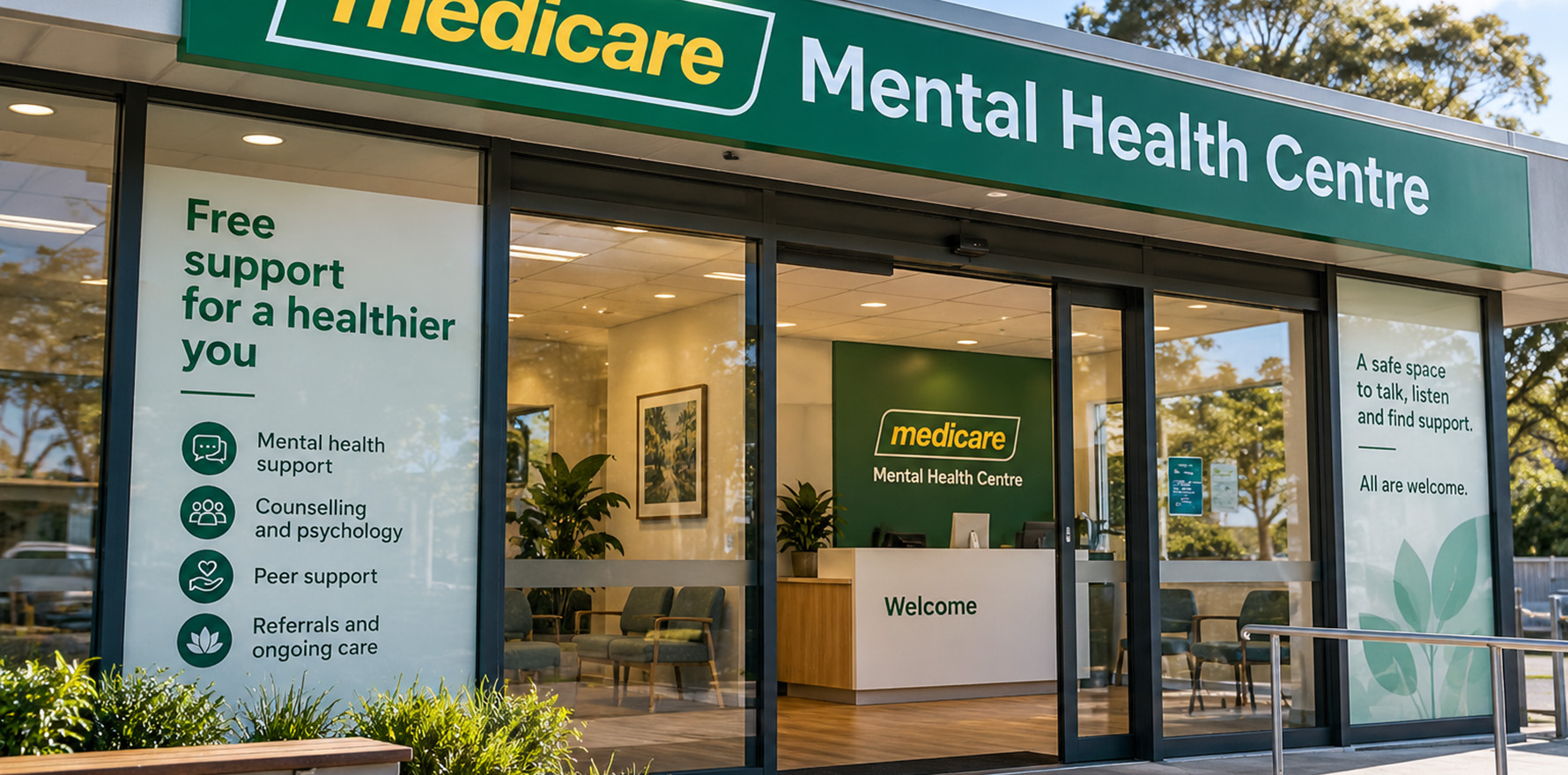
The uncomfortable truth about Australia's Medicare mental health centres.
Australia has built the first genuinely universal front door to adult mental health care in Medicare’s history – no referral, no appointment, no Medicare card, no fee. Walk in, and someone with clinical skill and lived experience will sit down with you.
It is a remarkable achievement. It is also, for millions of Australians, a building they will never see.
The Medicare mental health centres, formerly Head to Health, now operate at 61 locations nationally, with 31 new or upgraded centres funded under the Commonwealth’s $1 billion mental health commitment.
The early impact evidence is genuinely impressive. But if we only tell the success story, we do the sector a disservice. The more important questions are harder: who is this system actually for, who is still standing outside, and who is going to staff the thing?
To answer those properly, it helps to understand why these centres exist at all.
A reform born of the ‘missing middle’
For two decades, Australian mental health policy has wrestled with the same structural hole: people too unwell for a few subsidised psychology sessions, yet not acute enough for state community mental health teams.
The 2019-20 Budget finally moved on it, committing $114.5 million to trial eight adult mental health centres aimed squarely at this “missing middle”, as the Department of Health’s service model set out.
Covid then stress-tested the concept, and the 2021 Budget scaled it nationally with a further $487 million.
What emerged broke Medicare convention in almost every direction. Walk-in access. No gatekeeping. No fees. Peer workers alongside clinicians. Services co-designed with the communities they serve.
Not everyone was convinced.
Critics warned of duplication with state services, dismissing the expansion as “the Emperor’s new clothes” in a pointed Australasian Psychiatry commentary. At the time, it was a fair challenge.
What makes the debate more interesting now is that we no longer have to argue from theory. The evidence has started to arrive.
What the impact data actually shows
The most instructive findings come from co-evaluation research led by Neami National with The ALIVE National Centre, spanning five centres including an urgent mental health care centre. Three results deserve every health executive’s attention.
First, the centres reach people nothing else reaches. Nearly a third of guests are seeking mental health support for the first time. Between 65% and 85% self-refer. And 26% said they would not have sought support anywhere else.
That last figure is the one that matters most, because it represents new demand being met rather than existing activity reshuffled between services.
Second, they divert acute demand. Eight percent of guests said they would otherwise have presented to an emergency department. At the urgent mental health care centre, that figure climbs past 40%. The diversion case for the model is no longer theoretical.
Third, the blended workforce is the mechanism, not a garnish. Guests consistently credit the combination of peer workers and clinicians with making them feel seen and heard for the first time.
We have talked about lived experience workforces for a decade. These centres are actually operationalising one.
Context sharpens the significance of all three findings.
As Sebastian Rosenberg’s analysis of Medicare data shows, Medicare-funded mental health access has effectively stalled, with around 1.3 million GP mental health treatment plans written in 2024-25.
Better Access remains capped, gap fees keep climbing, and private psychology waitlists run to months. Against that backdrop, the centres are not competing with the existing system. They are catching the people falling out of it.
Which raises the question the sector has been slower to ask: falling out of it where?
Now the uncomfortable part: geography
Here is the challenge I want to put to the sector, and I hope it stings a little.
Around seven million Australians, roughly 28% of the population, live outside major cities. As the National Rural Health Alliance has long documented, they experience mental ill-health at comparable or higher rates, face suicide rates that climb steeply with remoteness, and have the thinnest service coverage in the country.
Government-commissioned analysis found people in very remote areas accessed Medicare-funded mental health services at just 81 encounters per 1000 people, a small fraction of metropolitan rates.
Now overlay a network of walk-in centres on that reality. A walk-in model is, by definition, a proximity model. It delivers extraordinary value to the person who lives 20 minutes away, and precisely nothing to the person three hours from the nearest centre, on a property outside a town of 800 people, where the local GP left two years ago and the psychology waitlist is measured in seasons.
This is not an argument against the centres. It is an argument about what “universal” means in a country where vast stretches of the landmass have almost no services at all.
If the equity test is “free at the point of care”, the model passes. If the test is “equally reachable by the farmer in the Mallee and the office worker in Marrickville”, it does not. Not yet.
Geography, though, is only half the constraint. The other half is people.
Related



The workforce reality: who staffs the revolution?
Every mental health reform in Australian history has eventually collided with the same wall: there are not enough clinicians. This one will be no different unless we are honest about the numbers.
Australia has roughly 4500 psychiatrists, 36,900 psychologists and 28,300 mental health nurses, according to the AIHW’s workforce data.
That sounds substantial until you distribute it.
Government workforce modelling projects a 20.7% undersupply of psychiatrists by 2048, with regional and remote areas hit hardest, and the Department of Health’s own supply and demand study estimates a psychologist shortfall already in the thousands and growing toward 7000 by 2038.
Now consider what we have just asked of that workforce: 61 walk-in centres staffed with blended clinical and peer teams, every centre upgraded to provide psychiatrist and psychologist access on-site or on-call, plus a national digital service, plus the existing headspace network, plus a Better Access system already straining at the seams.
We are building demand for a workforce we demonstrably do not have.
This is where the virtual care market stops being a side conversation and becomes central to whether the model survives.
The virtual tier is growing up: My Mirror, Psych2U and the new ecology
While the Commonwealth has been building centres, a parallel industry has been quietly solving the supply problem from the other direction.
Platforms like My Mirror now deliver Medicare-rebated and, for eligible clients, zero-out-of-pocket psychology sessions with AHPRA-registered psychologists via telehealth, typically within days rather than the months a suburban private practice can offer.
It is telling that My Mirror is now itself listed as a provider on the Medicare Mental Health service directory: the public front door and the private virtual market are already interpenetrating.
On the psychiatry side, services like Psych2U (spun out of the GP2U telehealth stable, one of Australia’s earliest virtual specialist models) offer video psychiatry consultations nationally, compressing what is often a six-to-12-month wait for a psychiatrist appointment, if you can find one taking patients at all, into days.
For a patient in Dubbo or Broome, this is not a convenience. It is the difference between psychiatric assessment existing or not.
The point is not to advertise any particular platform. The point is structural.
These services have built three things the public system desperately needs: a distributed clinical workforce unbundled from geography, rapid-access scheduling infrastructure, and triage technology that matches need to availability at national scale.
The Medicare Mental Health Check In service, which launched in January this year offering free guided low-intensity CBT by phone and video, is essentially the public system adopting exactly this playbook as The Conversation’s analysis explains.
And the evidence says the playbook works, with one crucial caveat.
Guided low-intensity digital care delivers real outcomes: 68% of users of Beyond Blue’s comparable NewAccess program improved after around five sessions. Purely self-guided tools are far weaker, with large studies suggesting fewer than one in 10 users benefit.
Digital is a genuine equity and workforce lever only when a human is attached to it. An app is not an outreach strategy, and a chatbot is not a clinician.
A scoping review of rural and remote access by Kavanagh and colleagues reinforces this: workforce scarcity, cost, stigma in small communities and digital exclusion all compound at once.
A virtual platform does nothing for the household with patchy connectivity, the older person who will never download an app, or the First Nations community for whom a commercial website is not a culturally safe entry point.
Which brings us to the one clinician who is already everywhere, already trusted, and already carrying more of this system than anyone admits.
The missing link: the regular GP
Here is an uncomfortable statistic hiding in plain sight: those 1.3 million GP mental health treatment plans written each year make general practice the de facto front door of Australian mental health care, and always have.
The centres were designed to bypass the GP gatekeeper. The smarter play is to make the GP the most powerful referrer in the network.
Right now, that connection is embryonic. Some PHNs have built GP referral smartforms that plug practices directly into the Medicare Mental Health intake line on 1800 595 212, so a GP can refer a patient into the centre network in the same workflow they would use for any other referral.
But coverage is patchy, awareness among GPs is low, and the information flow is largely one-directional: the patient goes in, and the GP hears nothing back.
That has to change, because the clinical logic is overwhelming. The GP holds the longitudinal record: the comorbidities, the medications, the family history, the previous suicide attempt that a walk-in centre cannot see.
The centres hold what the GP lacks: immediate access, time, peer support, and no gap fee.
The virtual providers hold what both lack: specialist capacity on demand. A patient with deteriorating anxiety and early cardiovascular disease does not need three disconnected services. They need a loop.
The evidence for what that loop looks like already exists. Research on integrated primary care and mental health models consistently shows that co-located or tightly linked mental health clinicians working alongside GPs improve both access and outcomes. The Medicare Mental Health architecture gives us, for the first time, somewhere for the GP’s referral to actually land, and the virtual psychiatry and psychology tier gives the GP somewhere to escalate to without a 12-month wait.
What is missing is the plumbing: shared care protocols, feedback into the practice record with patient consent, direct booking from practice software, and explicit step-up and step-down pathways between the GP, the centre, the virtual providers and state services.
Build that, and 1.3 million mental health treatment plans a year stop being paperwork and start being pathways.
How the model stacks up
Precision matters, because “free mental health service” covers very different machines.
Better Access is a subsidy, not a place. It scales with private workforce supply, which is precisely what rural Australia lacks, and it requires a GP referral and increasingly a gap fee. Its telehealth extension was a genuine equity reform, and the virtual platforms show what it can do, but the session cap and the gap fee remain structural barriers.
headspace proved the low-barrier, walk-in model for 12 to 25-year-olds across more than 175 centres, including many regional sites. The adult centres finally correct the absurdity of ageing out of free, accessible care on your 26th birthday.
State community mental health services are clinical, often excellent, and rationed by acuity. They were never designed for the missing middle, and expecting them to absorb it was always a category error.
The virtual platforms, My Mirror, Psych2U and their peers, are fast, scalable and geography-blind, but they sit outside the free universal tier for most users and depend on the same scarce specialist workforce, simply redistributed by video.
Internationally, the closest analogue remains England’s NHS Talking Therapies program, which in 2024-25 supported nearly 100,000 people to recovery, at a recovery rate around 42%, and publishes outcomes by service every quarter.
Australia’s centres are broader in scope and far less measured. We cannot claim equity, or deny it, with data we do not collect.
Step back and the picture is genuinely striking.
Australia has assembled, almost by accident, the components of a true stepped-care system: digital low-intensity support at the base, walk-in centres for the missing middle, headspace for young people, GPs as the universal trusted entry point, virtual psychology and psychiatry as the specialist spine, and state services for high acuity.
What it lacks is not components. It is connection between them, workforce to run them, and coverage across the map.
All three of those gaps are fixable. That is the opportunity.
The opportunity: from buildings to a network that actually reaches
If we take the equity, workforce and integration challenges seriously, six moves follow.
Measure reach, not just activity. Publish a national outcomes and access framework, as England does, including distance-to-service and referral-source data. If remote Australians are absent from the guest numbers, we should have to say so out loud.
Fund the virtual tier as core business, not an add-on. Guided digital and phone-delivered care is the only version of this model that scales across geography and workforce scarcity. It deserves the same investment and quality standards as the physical centres, and it should partner with, or commission, the virtual providers who have already solved the scheduling and distribution problem.
Make the GP the hub of the pathway. Universal smartform referral, feedback loops into practice records, and shared care protocols would convert the existing 1.3 million treatment plans a year into actual coordinated care. This is the single highest-leverage integration available to us.
Put peer workers on the phone, not just in the foyer. If lived experience is the mechanism that makes people feel safe walking in, it is also the mechanism that could make a farmer comfortable calling.
Grow the workforce the model actually uses. The centres run on peer workers, mental health nurses, social workers and provisional psychologists as much as on psychiatrists. Training pipelines and supervised placement pathways into the centre network would grow capacity where the model needs it, rather than competing for the scarcest specialists.
Protect the design principles as 31 new centres roll out. Speed of construction is the enemy of co-design. An expensive building with the wrong model in the wrong town is worse than none.
My challenge to you
Australia has built something genuinely new: the first free, no-gatekeeper entry point to mental health care for adults in Medicare’s history. The early evidence says it works where it exists.
But a universal service that is only universal within driving distance is not universal. A network built on a workforce we do not have is not sustainable. And a front door that does not connect to the GP surgery down the road is not a system.
So here is the question I would like this community to wrestle with: should the next $1 billion buy more buildings, or should it buy reach, integration and workforce?
And whether you are running a centre, a virtual practice or a GP clinic, referring in or locked out, what would a genuinely connected system look like from where you stand?
Simon Taylor-Cross is a healthcare consultant, and chief commercial officer for Atidia Health. Formerly he was a director (NSW and ACT) of the ForHealth Group.
This article was first published on Mr Taylor-Cross’ LinkedIn feed. Read the original here.