

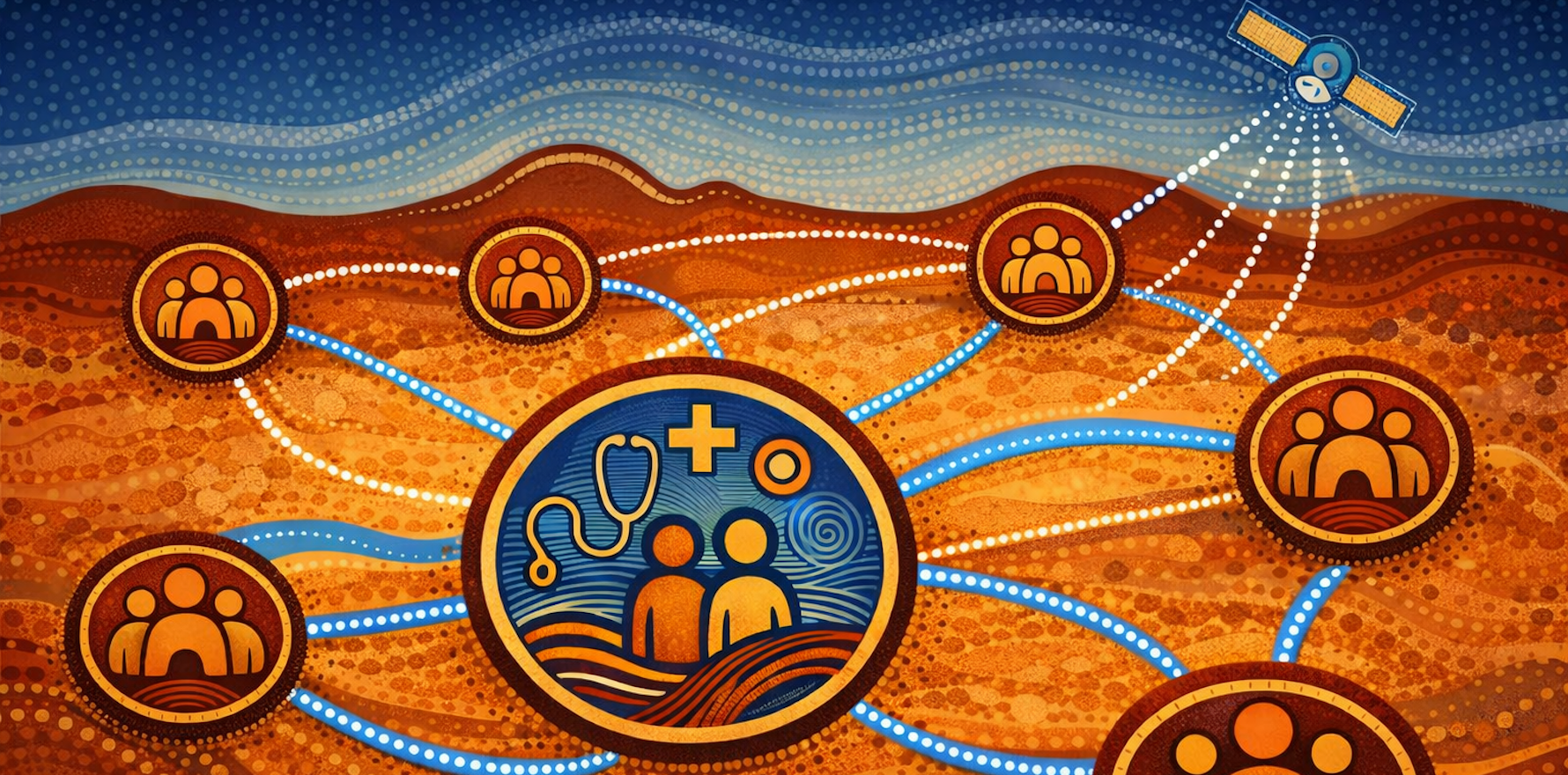
Unwrap the gory detail of a particular ACCHO telehealth project in the Northern Territory and what you get is a fascinating update on how we can, with a bit of leadership, effort and lateral thinking, tackle many of the wicked issues involved in servicing very remote and under resourced communities in Australia with a much better healthcare provider experience.
A big promise of new telehealth tech and expanding rural internet coverage, especially after a big attitudinal adjustment post covid to the technology, was that we would rapidly be able to much better service remote communities with a healthcare provider experience which actually had as a baseline good continuity and governance.
Turns out, as it so often does in digital health, things were a little more complex.
For one thing, the promise of vastly improved rural and remote internet connectivity turned out to largely be a political three card trick: go to a remote town centre and you might get 4G, even 5G in the town centre, but walk few blocks downtown and, more often or not, nothing.
Not ideal as connectivity is really first base for this delivery model.
Then there’s the people and culture side of things: no workforce with rural and remote experience to man a telehealth program and a lot of complex cultural issues, most especially if you’re intending on servicing a first nation community.
Then there’s the funding maze for rural and remote telehealth which isn’t helped presently by an MBS with an eye on the greater system not what happens at MM4 and beyond.
Suffice to say, the promise of significant advances in community and overall system ROI from what is a relatively fast evolving rural and remote telehealth sector, is still, largely, a pending one.
At the moment it’s a patchwork of different bespoke solutions between various state and federally funded organisations trying to solve different and complex needs in different, and often, inefficient, ways.
Sharing IP on successful strategies and coming to common denominators of innovation hasn’t been easy.
It’s not surprising that we seemed to have become a little bogged down.
When the rubber hits the road on these projects things get complicated quickly, starting with, “the bleeding internet doesn’t even work”.
You need good and determined management bringing together good people, thinking laterally, to solve some pretty curly problems.
In rural and remote there’s hardly any one size fits a few, let alone one size fits all.
Things are moving though
Having said this, we are starting to see some base learnings from some of our more interesting projects. Some benchmarks and ‘how to protocols’ for the vast range organisations dealing with and trying to solve their rural and remote telehealth problems are beginning to emerge.
One such project is the current program being rolled out by the Urapuntja Health Service in Utopia, Northern Territory.
Utopia is made up of 16 separate and self-managing first nations communities spread across some 3500 square kilometres of desert, 350km northeast of Alice Springs.
Named for the former pastoral lease which covered most of the region, it is one of just a few first nation communities that was never a mission or government settlement, and whose people repudiated any municipal establishment, choosing instead to live in 16 separate outstations or clan sites, each with a traditional claim to the land.
If you wanted a more complex and tough physical and cultural testing ground for creating some sort of continuity of professional healthcare provision, using telehealth as a core platform of delivery, you possibly couldn’t get a more difficult one.
It sets a high bar for challenging circumstances in which to try to manage continuity of care.
Connectivity
First stop connectivity in such a distributed and remote community set up.
As things turn out, the solution to bad coverage is now pretty simple and relatively inexpensive.
It’s just not very politic.
It’s not just that a lot of people abhor Elon Musk either. It’s apparently pretty embarrassing for the federal government that they have nothing to match this crazy guy’s Starlink service.
The government doesn’t like it. They say it’s a potential sovereign risk and a single point of failure for users, owned by an at times erratic (at times?) billionaire.
But the smart money isn’t buying NBN, or Telstra either these days. It’s buying Starlink, because it’s not expensive in relative terms and it works (gulp).
Visionflex, CEO Joshua Mundey – says Visionflex is a major growing provider of purpose built clinical virtual care equipment and software.
“Seven out of ten of the setups we do in those regions are all set up from the get-go with Starlink. And… they work wherever they are,” he says.
Mr Mundey points out that connectivity is still hardly ever simple notwithstanding.
But with the right people doing the right tinkering, he says you can connect anywhere now if you really need to and you also have the right offline procedures for any downtime or when the ROI on connection isn’t there for some care scenarios.
Providers can “ go out with iPad or a laptop, they’ll take all the observations, take photos and videos offline… then come back to base, and then all of that information uploads in the place with the connectivity”, he explains.
The learnings on connectivity for other groups might be summarised as:
- Deploy Starlink widely in remote clinics (sorry Canberra and Telstra).
- Use ‘store and forward workflows’ when connectivity isn’t available; and
- Have good capability in your workforce set up for on-site technical problem solving and workarounds – even train your clinical stuff if need be.
Above average health outcomes
You’d think the Utopia region might score below average on health outcomes of first nation communities given its situation, but over time it has done the opposite.
By rights, the Urapuntja Health Service Aboriginal Corporation, although relatively well funded Aboriginal Controlled Community Health Organisation, should struggle more than a lot of other ACCHOs to deliver good continuity of care given its isolation and distributed 16 community segment structure.
But in this case, adversity (and almost certainly good continuity of management and culture) seems to have bred some pretty unique and effective innovation.
Urapuntja has long been above average in care delivery, something that analysts universally seem to agree stems from the organisation’s deep heritage of being community controlled.
A key seems to have been that at its core there is cultural safety and community trust.
After that, according to current CEO Mel Hinson, there is the important rest: a core focus on primary care, a holistic approach to care, and, staying at the vanguard of continuity of care, both from a technology perspective and a workforce perspective.
Many ACCHOs problems with delivering care continuity begin and end with workforce:
- Fly in fly out doctors, which is both expensive and is difficult for trust and continuity.
- High staff turnover both in the region and for telehealth delivery of services.
- Not enough locally employed and trained workers.
- And so on.
Health Services Daily is running a FREE webinar in the lead up to The Great Prevention Pivot Summit in June. Hear from some of the speakers mentioned in this article. Register now HERE to join us live online and hear from some leading experts. All HSD webinars are recorded, so if you cannot attend live you can still register to access the recording.
Workforce continuity – it’s not the technology stupid
Of the many groups Health Services Daily spoke to for this piece, all of them were clear about the key problem rural and remote health services face in terms of telehealth, and “it’s not the technology stupid”.
But with so much good new technology often healthcare services are putting most focus on, or even starting with, the technology.
Ms Hinson had always struggled with workforce, but when she got a good technology partner eventually, she recognised just how much that the technology was the least of her problems.
In fact the only problem with the technology was that with such high GP turnover, the retraining time was expensive.
“One of our biggest challenges out here has been [our ability to] to secure permanent GPs and locals. [It’s hit and miss, but they come in for two weeks, we’ve got to orientate them, provide accommodation, and then they’re here for a short period of time,” says Ms Hinson.
“They don’t know community. And then there’s no follow up after they leave with, you know, [with] our scripts and referrals and everything else…”
It’s the main issue for most ACCHOs in their delivery of care. It’s of course a major issue for most rural and remote towns these days as well.
Enter the sometimes frowned upon private sector healthcare workforce provider.
Hinson was frustrated with her never-ending and expensive FIFO problem and one day Mr Mundey, who is essentially her technology provider but also a part time advisor, suggested she call Aspen Medical and see if they could help.
He’s seen them help quite a few other groups in her situation where Visionflex was implementing in remote areas.
Visionflex supplies a lot of kit to the aged care sector, a good chunk of it for remote locations. Some of the problems felt similar.
Ms Hinson was initially taken aback.
She only wanted two or three GPs max, and she wanted some pretty special ones.
Ones that wouldn’t leave.
Ones who understood and had worked with first nations communities.
Ones who understood the importance and intricacies of culture in care delivery.
And…ones who would be OK to work largely via telehealth.
Not asking for much there right?
The first GP that Aspen Medical managed to snag on behalf of Urapuntja was taken aback in a different way to Hinson.
“I didn’t initially reach out to Aspen Medical, because I just thought, no, that’s not going to work,” says GP Dr Rebekah Ledingham, whose background has been almost exclusively in Aboriginal Health.
Dr Ledingham wouldn’t be the first GP to think “a big corporate service provider” like Aspen was likely going to be a mismatch for the cultural intricacies of Aboriginal health.
“Ok, even it has great clinical governance protocols, good working conditions and pays well, and understands leading edge telehealth, surely this is a group whose business model involves scale and uniformity in delivery? After all they’re after profit right”…our words not Dr Ledingham’s (we’re intuiting the GP mind here).
What Ledingham actually told us was “it felt like a mismatch”.
Turns out Dr Lendingham was right… and wrong.
Wrong in that Aspen Medical was far from a mismatch.
It delivers workforces across radically different cultural settings globally, often in extreme service delivery situations.
It understands the important baseline of a fit between culture and your workforce maybe better than any other Australian workforce provider.
But they certainly aren’t averse to making money from scale, as their global portfolio of services and businesses would suggest.
Why would they be?
Aspen Medical has found a grand total of two GPs for Urapuntja and it turns out that with flexibility of telehealth model implemented, that’s all they need for now.
Not exactly scale here but keep reading.
Ms Hinson doesn’t care about scale or corporates: she just wants her GP continuity problem solved and she’d love to pay less for the favour.
Aspen Medical, in combination with Visionflex, look like they may have done that in spades.
Aspen Medical found the right GPs, and their telehealth delivery business model, being pretty flexible, suits their chosen workforce.
Both GPs have experience with First Nations community health, but both, for various reasons are mostly anchored to capital cities, for the time being at least.
In the case of Dr Ledingham she’s in that part of her life where she needs the big city (if you could call Adelaide that) for bringing up younger kids.
She loves the idea that she can still do the remote work, live in the city, and, as the Aspen Medical model and Urapuntja Health both agree she must, occasionally visit their patients face to face, for those important elements of care that simply can’t be delivered by telehealth alone.
The corporate model in this case has a fair bit to offer.
The contract has service level elements which essentially promise continuity, should one of the only two GPs involved fall over.
Aspen Medical can usually do that because the organisation has, wait for it…scale.
Sometimes the bad things you can think about a corporate can turn out to be good things, in the right context.
Aspen Medical has experience, at scale, of working in culturally complex situations, very often resource constrained and remote, sometimes challenged by the even greater extreme of a mass disaster event, or even war.
Turns out Aspen Medical is a pretty good fit for remote Australia in many respects.
It’s well known and proven, can operate with very clear clinical governance within the context of complex cultural situations, is trusted (not by all GPs maybe but maybe that’s GP culture too), is well capitalised to pick things up quickly if things do go wrong, has a lot of providers on its books, and, perhaps most importantly, is a very forward leaning organisation in terms of integrating the most up to date telehealth technology into its delivery models.
What Dr Ledingham says about the Aspen Medical model in the case of Urapuntja is that it gives her “enough wiggle room and structure” to make her role viable and aligned with Aboriginal health values.
Ms Hinson is loving it so far: her FIFO costs are through the floor, so she’s saving a lot of money, her continuity of workforce problem is vastly improved, but vitally, Urapuntja communities are being served better on a more frequent basis.
She knows this because the communities are accepting, even enthusiastic, about the new set up.
“We don’t have the logistical issues now of having to drive into town, pick up doctors, bring them out here, find accommodation,” she told HSD.
There’s been continuity.
“What we’ve seen now is that we’re managing our 715 [the Medicare item number for Aboriginal and Torres Strait Islander assessment], we’re dealing with our chronic diseases,” she says.
“We’ve got someone at the end of the line if we need them. Our scripts are being managed, our referrals are being managed, and our doctors are really starting to understand our community.
“There has been a game changer.”
The possible learnings for other ACCHOs and even certain rural and remote towns with provider workforce issues:
- Look to assess and understand your workforce continuity issues first.
- Keep cultural safety at the heart of everything you as you go.
- Investigate third party organisations that have the scale, capital, experience and skill base to deliver a culturally appropriate workforce, with good clinical governance and ideally with telehealth capability; and
- Ideally, use telehealth in your model to its rapidly evolving potential, again, checking out the range of third-party technology providers who have the experience and kit to help you get there.
You sense that Ms Hinson would want to add something to this list about the balance between managing complexity and seeking some scale and automation where you can through a telehealth model.
She’s at pains to point out that every region has its own unique issues, so complexity isn’t going away.
What the Urapuntja experience seems to be suggesting however, is that maybe there is a lot more help out there in terms of common workforce and technology protocols than some other organisations realise at this point.
What might encourage other groups here is that from a strategy point of view, Aspen Medical sees some scaling potential for the Urapuntja model in other rural and remote areas of Australia, with appropriate localised adjustments.
As well as delivering a continuity of workforce solution, that involves forward leaning telehealth tech, Aspen Medical is advising Urapuntja on a variety of other issues they are facing, a key one being “interoperability” (welcome to that club).
Can a big corporate and a small community organisation align to deliver a solution to many groups?
Laura Malceski, Director of Digital Health at Aspen Medical, sees the alignment achieved at Urapuntja and thinks so.
She says that while it’s been a long time coming, there’s a convergence of technology with a maturity of digital health strategy delivery in rural and remote regions creating opportunity across the system.
She believes Aspen Medical, and others can scale some of the key learnings of Urapuntja.
“What we’ve co‑designed with Urapuntja is a model of care that’s actually working on the ground – combining local staff, trusted GPs, and the right technology – and now we’re looking at how to share that model with other remote communities,” she says.
“We’re backing this story with data. We’ve built a monitoring and evaluation framework and we’re pulling outcomes from Communicare so we can show, not just tell, what this Aspen–Urapuntja model is achieving.”
Health Services Daily’s health leaders’ workshop and conference will be held this year on 16-17 June in Canberra. It will be a deep dive into the seismic disruption of the new patient side AI agents in our health system. Patients are flocking to the new agents and turning up at their providers with lots of questions and information, some good, some bad. How are we going to manage this? Join us for a half-day workshop, great debate dinner and one-day leaders’ summit. For tickets and more information see HERE.