


At 80% market share, BP is the market dominant GP patient management system, core health system infrastructure, a transaction and innovation gatekeeper, and, maybe, too big to fail. Is this a good or a bad thing?
In 1995, the Australian government made a one-off payment to every GP in the country to buy a computer. The Practice Incentive Payment was blunt, expensive but transformative.
It kick-started the computerisation of Australian general practice almost overnight – and it launched Medical Director, the GP software company founded by Dr Frank Pyefinch a few years earlier, from niche product to national standard.
Dr Pyefinch had been frustrated with paper prescribing, had dabbled with computers, and had built a basic prescribing program at a time when almost no GP had a computer. After the PIP, they all did. And they all needed software.
The story of Best Practice begins with a falling out.
Dr Pyefinch eventually sold Medical Director to Health Communication Network, came to feel the product was being ruined, and left the company. After his non-compete expired in 2004, he started again – building Best Practice.
The philosophy was simple: good software, designed by a GP, for GPs, with excellent support and training, and no offshore sales team. Growth was word of mouth. GPs loved it.
That model, over 20 years, has produced one of the most remarkable market concentration stories in Australian health technology.
Medical Director at one point held 95% of the GP desktop PMS market – briefly, after Health Communication Network bought out a failed MIMS competitor that had reached about 20% share before running out of money (not sure what the ACCC was doing that weekend).
Best Practice started at zero largely against this dominance.
It underpriced Medical Director (although Dr Pyefinch will deny that), delivered much better service, and an improved product (albeit it was largely the same), and, it caught up.
By the time Affinity private equity acquired Medical Director for $155 million in 2016 it was already nearly equal in share to Medical Director at about 45% each. Five years later when Medical Director sold to Telstra Health for $340 million, BP was leading Medical Director with a share of above 50% somewhere.
Today it is approximately 80% Best Practice, 15% Medical Director, and 5% everything else.
Medical Director, now under Telstra Health’s ownership, is still losing share steadily on an ageing platform.
Best Practice’s FY2025 accounts show consolidated revenue of $50.07 million and a balance sheet that reflects a business in good health.
The case for Best Practice
Jessica White, Best Practice’s chief technology officer, is articulate about why the company’s dominance should not be conflated with bad behaviour.
“We didn’t go out to be the largest. We don’t even have an outbound sales team,” she told Health Services Daily.
“All of our sales are through people using our product and loving it.
“And our product’s not just about the product. It’s the great support, the education, the free training, the masterclasses, the webinars, the fact that anyone could call a support desk and ask anything about medical software or the industry.”
Best Practice has 250 integration partners through its Halo Connect middleware layer. It absorbed the cost and complexity of the government’s Assignment of Benefit program, a regulatory requirement for practices, without government funding, submitting three detailed consultation papers warning the government the policy would not work, then building it anyway because the government told it to.
“We don’t just take an FAQ document and embed it. We build the workflows, we make it easy to use, we manage the change,” Ms White said.
“This is the stuff that happens behind the scenes that people don’t realise.”
So for all Best Practice is dominant, you’d have to say it’s not behaved badly at any point really in its history. With that sort of share you see a lot of companies losing focus and drifting on customer focus.
You haven’t really ever seen that with Best Practice, which is probably all down to the culture there established by its founder Dr Pyefinch and his partner, Lorraine Pyefinch, who has been important in the business developing over the years.
That its founder is a GP distinguishes it from nearly every other major player in the patient management system software space.
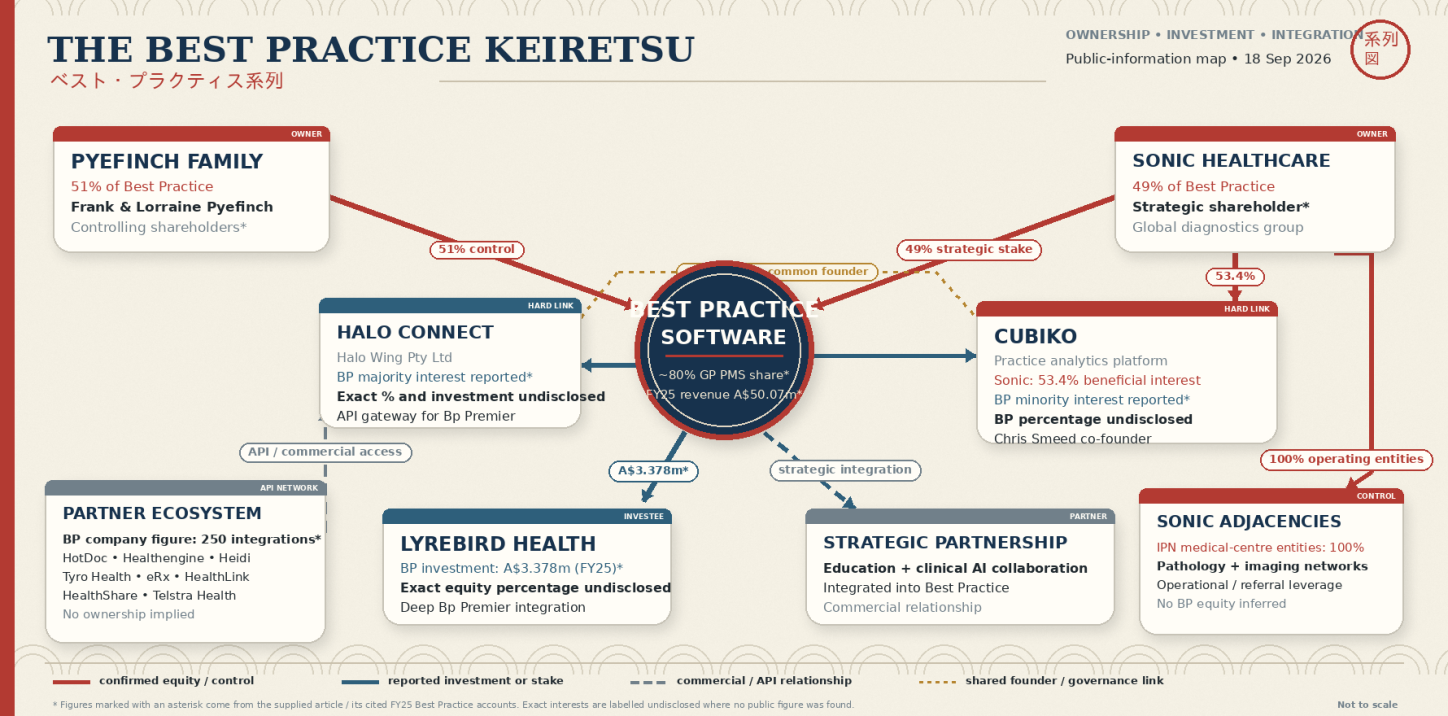
The Pyefinch family retains 51% of Best Practice. Sonic Healthcare holds the other 49%.
Unlike the Medical Director experience – sold to Primary Health Care, then to private equity firm Affinity, then to Telstra for $340 million in a trajectory that ended with a product most consider to be declining and even somewhat abandoned, Best Practice has stayed close to its founding purpose.
(Note: Telstra Health is hard at work at a new iteration of Medical Director based on a fully cloud and AI architected platform, so watch this space still).
“Our owners embedded that ethos in all of us,” Ms White says.
“We are not sitting back going, we are the market leader, we don’t need to improve.”
When asked what critics would have the company do differently, White’s answer is honest: “It’s always people in industry, never a customer. And when I kind of talk to them about our ethos and values and what we deliver – and ask what would you prefer? They always get very stumped.”
The case against
The trouble with a good company becoming a near-monopoly is that the effects on the broader ecosystem are structural, even if they aren’t intentional.
Dr Max Mollenkopf, a Newcastle GP who posts prolifically on practice economics and digital health, put it plainly in a LinkedIn piece that sparked significant sector discussion. He reproduced a post from a colleague:
“Looking for a new practice to work from next month. IF YOU RUN ANYTHING OTHER THAN BP DON’T BOTHER SPEAKING TO ME.”
Dr Mollenkopf’s analysis of why this is a problem was characteristically sharp. The first issue is what he calls Stockholm syndrome: GPs are cognitively overwhelmed, and they’ve learned to tolerate a “good enough” product rather than face the disruption of change.
“Better the flimsy esky lid I know,” he writes.
The second issue is the change proposition.
The person who bears the cost and risk of switching – the practice owner – is different from the person who would benefit most, the GP.
“You need to convince such that I’m prepared to migrate decades of patient data, retrain my reception team, rebuild workflows and deal with all the inevitable shit that breaks when we change over. Then I need to convince my GPs that they should learn how to use it and take a risk with me while they are drowning.”
Dr Mollenkopf’s conclusion: “Heidi could build something tomorrow that makes BP look like Windows 95 and I’m still not convinced practice owners would move.”
His advice to startups is “build on top, otherwise you’ll be the ones with cold dead hands”.
Related



The choke point
The real concern with Best Practice is not so much price gouging or bad faith. There is very little evidence of either.
It is structural.
At 80% of GP practices, Best Practice is the choke point through which almost any innovation must pass to reach Australian general practice.
With its Halo Connect integration model you can connect if you demonstrate you’re good for GPs and are prepared to pay for access and share a percentage of revenue.
That is a standard SaaS platform model. It’s the Apple model in fact. But it means that Best Practice effectively decides what innovation gets through and when.
The Heidi Health example is instructive.
Heidi, Australia’s fastest-growing medical AI company, connects to Best Practice. But the connection is deliberately limited: Heidi is allowed to access the patient record for superficial documentation purposes, not for deep longitudinal clinical data.
Simultaneously, Best Practice has invested $3.378 million in Lyrebird Health (wonder how much that bought you the company when they did that?) a competing AI scribe and documentation product and is building that integration deeply into its platform.
This is a deliberate strategy to contain a competitor.
Boohoo. It’s business. Who wouldn’t do that? It’s smart, right? It’s not like if Heidi couldn’t roll over Best Practice with all its smarts and cash it wouldn’t. It would. So what is Best Practice to do?
From any business or shareholder perspective it’s done the right thing. It’s just that it’s such a stark example of how much of a chokehold the platform has on the GP market.
In this example the effect is clear: Heidi’s ability to move deeply into Australian general practice is almost entirely denied by Best Practice’s early chess move with Lyrebird, a fact that seems to be borne out by a noticeable shift by Heidi in Australia to chase the hospital market with a lot more vigour.
Matthew Galletto, CEO of MediRecords, raised a related point about the pricing question.
A LinkedIn commenter had suggested Best Practice hasn’t behaved like a monopoly because its pricing has remained low.
Mr Galletto’s response:
“I’m not sure price is the right measure of market power in this case. Best Practice is 49% owned by Sonic Healthcare. When a pathology and diagnostic services company has a significant interest in the software sitting at the centre of Australian general practice, the strategic value of that position potentially extends well beyond the price of the software licence,” he said.
“In fact, there may be very little incentive to maximise PMS pricing. Keeping the product affordable, widely adopted and deeply embedded in general practice may be considerably more valuable to a strategic shareholder than extracting another few dollars per GP each month.”
Indeed, Best Practice makes a big chunk of its money on being a toll collector for all those integrations paying them for access to their doctors.
The BP financial accounts tend to support Mr Galletto’s diagnosis.
Best Practice has investments in Lyrebird Health, the majority of Halo Wing Pty Ltd (the Halo Connect middleware entity), and a commercial relationship with Sonic Healthcare Services who owns 49% of them, now a stake in rapidly emerging frontrunner for best Australian AI medical knowledge database, Med Luma and tactical minor shareholdings in related data and access products like Cubico.
The network of interconnected holdings around the dominant GP platform – which also sits at the centre of IPN, Sonic’s GP network, the nation’s largest private pathology business, and Cubico (the GP booking platform of which Sonic owns 51%) – resembles nothing so much as a keiretsu: an ancient Japanese term for a web of cross-shareholdings that collectively reinforces the central platform’s position without any individual element being obviously anticompetitive.
The tech debt problem
The other structural issue is timing.
Best Practice’s software was built on a desktop server architecture that dates to the early 2000s and its based on Medical Director, which was built in the 90s.
It is not cloud native. Layers of functionality have been added around the original codebase – the Halo Connect middleware layer is itself a workaround for the fact that the core product does not natively speak web protocols.
The result is a system that works, that GPs trust, and that is genuinely hard to break away from, but that carries significant technical debt at precisely the moment when the government is pushing hardest for data interoperability, FHIR compliance, and sharing by default.
The Assignment of Benefit episode illustrates illustrate the gap. When the government required all practices to implement a new payment assignment protocol, Best Practice – despite warning the government three times in consultation papers that the policy was poorly designed – built it anyway at a cost of approximately $1 million and many months of engineering resources.
Then the government shelved it. Undoing the implementation required Best Practice to push a patch to thousands of practices.
MediRecords, with its cloud-native architecture, implemented the same requirement in a week for $50,000, then turned it off remotely overnight with one stroke of a keyboard when the government backed down.
That disparity is not an accident; it is the consequence of 30 years of technical accumulation.
Ms White acknowledges it to some extent: “We have on-premise product that will change soon. Yes, we’re not perfect.”
It matters because the government’s interoperability agenda – the Sparked FHIR standards work, the sharing-by-default framework, the National Health Data System – will require the nation’s GP platform to move faster than its technical architecture has historically permitted.
Notwithstanding, Ms White is emphatic that she wants to move faster on FHIR: “I am sick of co-designing. Can we please move beyond standards to implementation?”
But the gap between wanting to move faster and being structurally capable of moving fast is potentially the problem.
Senior government officials have expressed concern that Best Practice will struggle to deliver the data sharing the government wants, at the pace it wants, given the technical constraints of its existing architecture.
But they have also acknowledged the obvious corollary: if Best Practice starts to fail, 80% of Australian GP workflow fails with it.
It is in no position to let that happen.
Too big to fail
Medical Director is a cautionary tale of too big to fail.
At its peak, Medical Director had 95% of the GP desktop market – even higher dominance than Best Practice today.
A decade of sale-and-resale, including a stint with PE (that often doesn’t help a lot) culminating in the $340 million Telstra Health acquisition, left it with an ageing codebase, eroding market share now estimated at 15-20%, and a development roadmap that has repeatedly promised a cloud-native replacement without delivering it at scale.
Telstra Health is working on that rebuild, and is promising some sort of phoenixing in the not-too-distant future.
Sidenote: one of Best Practice’s best product persons, Danielle Bancroft, jumped ship from Best Practice just over a year ago, and is now with Telstra Health. That might help.
The lesson is not that dominance inevitably leads to decline. It is that dominance acquired through genuine product quality and customer focus can be lost through ownership changes that prioritise extraction over reinvestment.
Best Practice’s Pyefinch-family ownership and the GP-centric culture White describes are genuine cultural protections against that outcome.
But they are surely not permanent, and the current pace of AI-driven innovation in clinical software is compressing the timelines within which any dominant platform can afford to stand still.
Ms White is clear-eyed about this problem and about related the “shadow IT risk” now emerging in the sector for groups like hers.
She describes with concern the reality of GP practices where different doctors use two or three different AI scribes – Heidi, Lyrebird, MBSPro – none of which talk to each other or write back to the patient record in a clinically coded form (although technically if you’re using Best Practice, Lyrebird does talk to the patient record).
“Clinical decisions are being made based on transcribed clinical data stored in Heidi now – not data in the EMR,” she says.
“A doctor sees one of your patients. You use MBSPro. He uses Heidi. Half the data is not there.”
This is not a problem Best Practice created. But it is a problem that only gets solved if the central platform can move fast enough to provide what the AI scribes are currently offering and move it into the clinical record properly.
So is it a good thing or a bad thing?
It is a bit of a cop-out to say say, “is what it is, and it is both”.
Best Practice’s dominance reflects the genuine merit of a product that grew without an outbound sales force because GPs chose it.
It is operated by people of good intent, led by a CTO who is clearly alert to the risks of complacency, and owned in a structure that has so far prevented the extraction dynamic that destroyed Medical Director.
Its investment in Lyrebird, its Halo Connect partner network, its SPARKED engagement, and its strategic partnership with MedLuma, enabling an integration that will bring AI-governed clinical decision support directly into the BP toolbar from October, all suggest a company that understands it must evolve.
But at 80% share, the systemic risks are structural and independent of intent.
The GP sector cannot easily innovate around a choke point like this.
Technical debt constrains the pace of change at exactly the moment the government is demanding faster interoperability.
The keiretsu structure — Sonic, IPN, Halo Connect, Lyrebird, Cubico, Med Luma — provides a powerful defensive moat that rational startups will think twice before challenging.
And the shadow IT problem – AI scribes running parallel to the PMS, fragmenting patient data across ungoverned systems – will only get worse if the central platform cannot absorb their functionality fast enough.
The government’s dilemma is the sharpest version of the problem.
If it mandates FHIR implementation timelines that Best Practice cannot meet at its current pace, it risks destabilising the infrastructure of Australian general practice.
If it accommodates Best Practice’s pace, it slows down the interoperability agenda it has declared to be a national health priority.
That is not a dilemma that Best Practice created through bad behaviour. It is the dilemma that any platform creates when it becomes too important to the functioning of an essential service to be treated like a normal market participant.
In the end, the dominance of Best Practice is not a problem with a villain. It is a structural challenge that requires the government, the sector, and Best Practice itself to be honest about what is actually true: that a good company, doing its best, has become too central to GP workflow to allow innovation to proceed at the pace the clinical environment now demands.
Solving this issue is hard than it sounds.
If you found this article interesting, Jessica White will be interviewed at Burning GP at Noosa on 26 September, along with many other leader and thinkers on the future of general practice. Program and tickets are HERE. As an HSD or TMR reader you can apply a 30% discount with promo code: BGP_30
Disclosure: The author is a non-executive director of MediRecords, which competes in the GP patient management system market. He has attempted to present all perspectives fairly, including the case for Best Practice’s position, but readers should weigh that conflict accordingly.