

The Active Script List exists. The technology exists. So why are patients still struggling to manage their own prescriptions and access their own data?
“Who here has received an eScript?” About 95% of the room put their hands up.
Then I asked: “Of those people, who knows what the Active Script List is?”
Three hands stayed up. One of them worked in a health department. Another was Ryan, our chief technology officer. So I’m not counting them.
One person. Sigh.
For anyone in the same position as that room: the Active Script List (ASL) is one list holding all of a person’s active prescriptions in a single place, rather than scattered across individual text messages.
How are we still here?
I asked those questions during my presentation – You’re not designing the experience. You’re inheriting it.
A handful of people came up to me afterwards. Once the disbelief wore off, they started telling me what they were actually dealing with.
The person who had accidentally deleted an SMS containing a repeat they later needed.
The person who had been diagnosed with breast cancer and described the confusion and stress of juggling eScripts. That one caught me off guard in the heat of my ASL rant (I’m sorry I wasn’t more comforting in the moment).
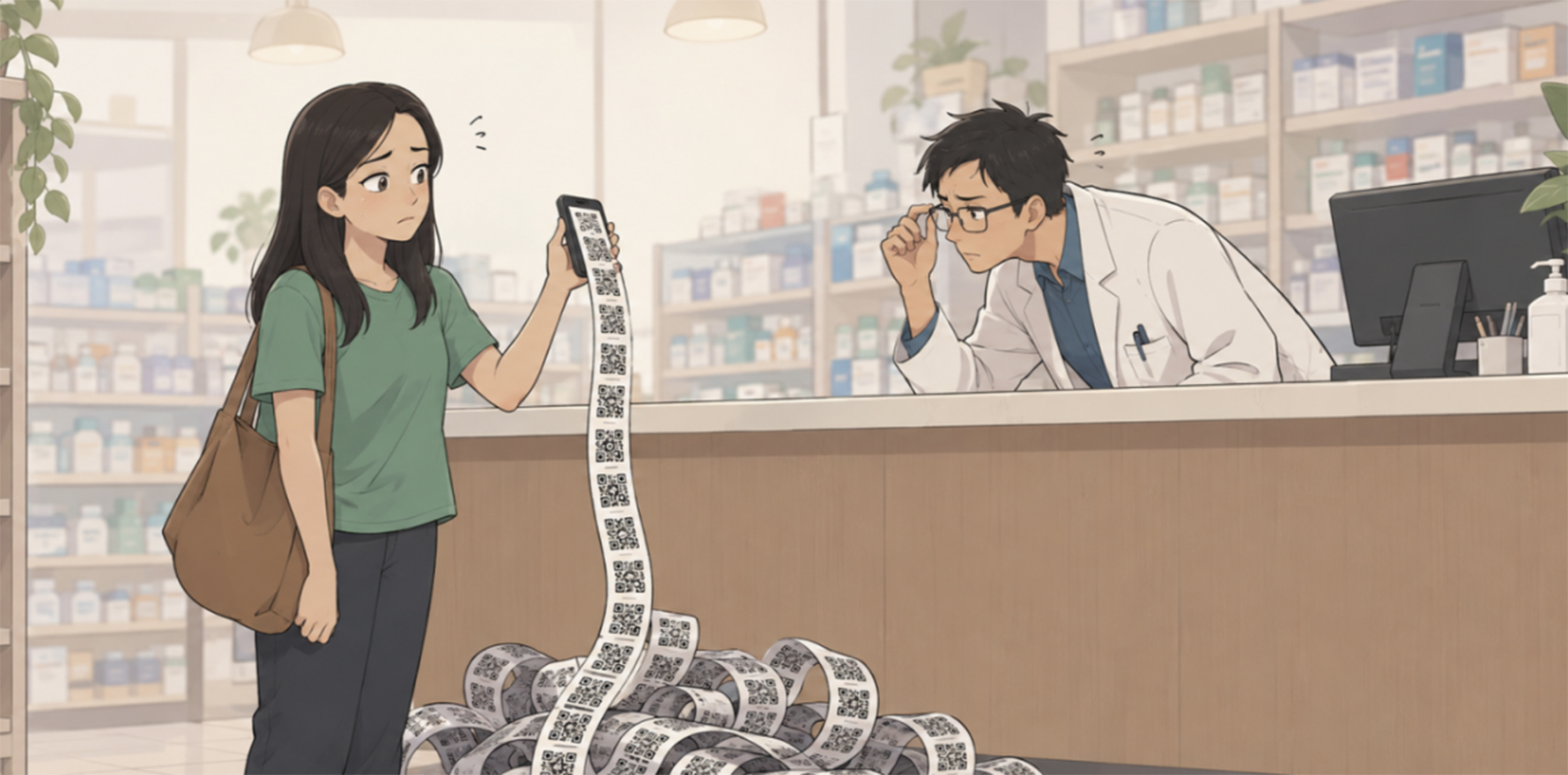
The person standing at the pharmacy counter scrolling back through months of text messages, opening each link one by one to see whether there was still a QR code behind it, or whether that script was already gone.
Just the other week at the HL7 Australia Connectathon in Brisbane – a room full of people working towards health interoperability – a GP told me he had never heard of the Active Script List until that day.
He then described exactly the same problems in his patients: losing their eScripts, needing prescriptions reissued, and eventually some of them going back to paper.
In the same room, a registered nurse working in tech, and already using our app to manage prescriptions, told me they still hadn’t got around to registering an ASL.
They had hesitations of their own, including whether they would have to register their ASL with every single pharmacy they go to.
Yikes.
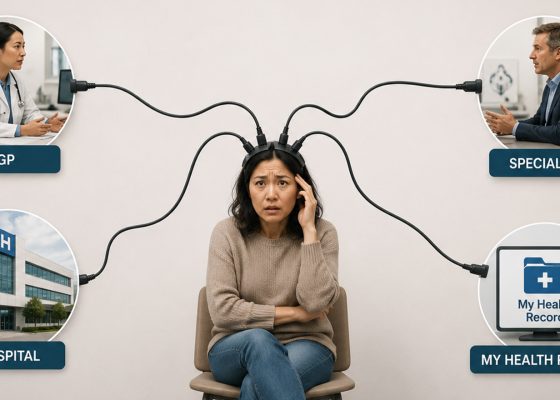
Every one of these people can access their prescriptions. They can tap a link in an SMS and see an eScript. What they can’t do is stop managing their own health information as a scattered pile of text messages.
People also struggle to reason why a new message arrives after every dispense, rather than one eScript carrying them through their repeats. It doesn’t feel digital to them. It’s work we have handed to the patient: work out which message is current, which one is spent, which one to open at the counter, and hope you don’t delete the wrong one.
The Active Script List addresses the underlying problem behind much of that frustration. Delete the message and the script is still there. Open the list and what’s current is in front of you.
Everyone in that room knew their prescriptions were digital. Almost nobody knew they could have one consolidated list.
How are we still here in 2026?
The Active Script List wasn’t invented yesterday. We first launched ASL linking in our consumer app in 2024.
There are currently two registration pathways for an ASL: assisted registration, or self-registration through a conformant mobile application.
Assisted registration means a pharmacist sets it up on your behalf and hands over a linking code. Self-registration means you register yourself through a conformant mobile application, without needing a pharmacist or prescriber to do it for you.
I remember when the Electronic Prescribing Conformance Profile version 3.0 went live, because MA-8 became almost ingrained in my head. I was so excited for Australians. This was game changing.
MA-8 required a mobile application supporting self-registration to validate the person’s identity through an Agency-approved Identity Management Service.
That requirement was written into the conformance profile. In 2026, consumers still can’t self-register.
The regulatory change has been made. The identity-verification arrangements needed to enable self-registration are still being finalised.
Every time I raise it, people have the same reaction:
“What about myGov?”
Fair response. We already use myGov to access government services.
But patients don’t experience this as a government infrastructure problem. They experience it through our products. They don’t contact the National Prescription Delivery Service because they can’t self-register, and they don’t contact the department because they don’t understand the identity requirements.
They contact us. They tell us they can’t get their ASL, they ask which pharmacy will give them the code, they ask why they can’t just register themselves.
The software vendors closest to the consumer experience are the least able to fix it.
Related

Protective friction makes sense
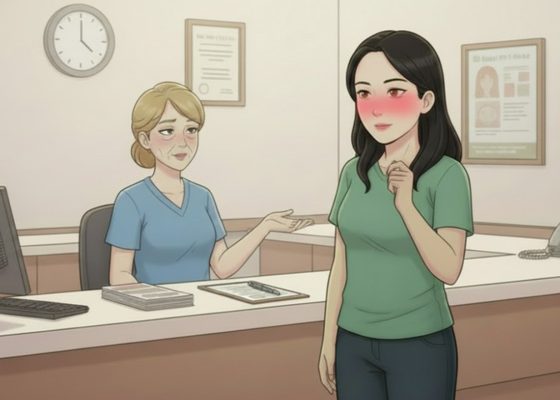
An Active Script List holds sensitive health information, so protective friction makes sense. Friction that makes someone feel they are jumping through hoops to reach information about themselves is a different thing entirely.
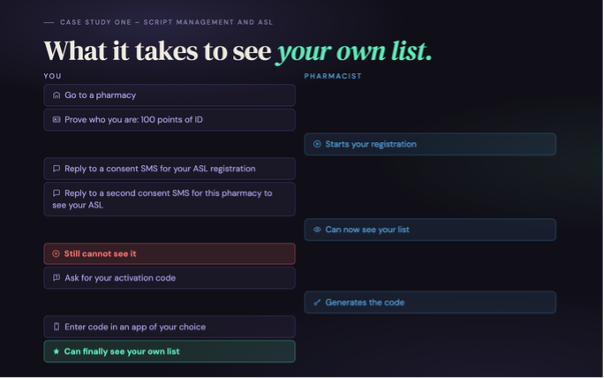
I’ve heard from health consumers who have requested their ASL linking code from a pharmacist, only to be told:
“No ASL code – we don’t support that app.”
The app was ours. But the point isn’t about which app the patient chose.
There are two different codes a pharmacy can hand over, and they do very different jobs.
One activates that pharmacy’s app. The other unlocks your Active Script List, in whichever conformant app you choose.
Both come from the same counter. Both get called a code.
I’ve spoken with health consumers who haven’t registered at all, hesitating because they assume they would need a separate code from every pharmacy they use.
Of course they assume that. You get the code from a pharmacist, and if the pharmacy hands over the key, it is reasonable to think the list belongs to the pharmacy.
There is one list. It belongs to the patient, it follows them wherever they go, and one code opens it.
Sometimes the patient walks out with the pharmacy’s app activated instead. Their prescriptions may well be visible in there, and most people have no way of knowing it wasn’t what they asked for.
Then the support requests arrive. Patients are asking a software company to help them find a counter that understands their own right of access.
We built this to give people a better way to manage their prescriptions, and a choice about how they do it. A patient can still walk away from that counter with neither.
Available. Accessible. Informed
Available? Yes. The Active Script List exists. The pathway exists.
Accessible? Barely. Some apps have the functionality, including the government’s own 1800Medicare app. But today you still need a pharmacist to unlock it through assisted registration.
Informed? No. One hand in a room where 95% of people had received an eScript is difficult to explain away.
The GP who had never heard of it until that day makes this much bigger than a consumer awareness problem.
So, on a report card, I’d say C-minus. The technology earned better than that.
The frustrating thing about a C-minus is how much of the hard work has already been done – the requirements written, the pathway designed, the software built – and a patient is still standing at a counter scrolling back through months of text messages.
We should be further along
The measure of this can’t be whether the information exists on a government website. It has to be whether the people trying to use it can find their way through.
Every person I’ve described received an eScript. The token arrives by SMS, gets opened and gets scanned at a counter. Yet it tells them nothing about the list they could be holding instead.
Information only counts when it arrives at the moment someone would act on it. The eScript journey is full of those moments – when a script is issued, after it’s dispensed, when the last repeat is used and a patient starts wondering what happens next. Any one of them would reach a person better than a page on a government website ever will (I have plenty of ideas on this. Do not get me started).
The legislation has changed. The pathway is being worked through.
The bar is whether the person knows it exists, can reach it, and finds their life easier for it.
One more thing, for those designing this at a national level.
The consumer experience deserves the same attention the conformance requirements get.
This is the consumer’s information. Yet a patient can still walk into a pharmacy asking for access to it and be told which app they can use.
How a person reaches their own health information is part of the design, not something to be worked out downstream.
None of this is only about the Active Script List. The next capability will arrive the same way – conformant, complete, and unknown to the people it was built for – unless design, planning and implementation account for how it reaches them.
Now we need to finish the job.
The ePrescription is digital. The experience isn’t.
Mina Giang is a co-founder of Oexa and designed Scripty, a free script wallet app with Active Script List, built to support choice of pharmacy. Originally posted on connectedeventually.com.au where she writes about my own journey through the Australian health system. A working notebook, from inside it.