


Ambulance ramping may look like a shortage of beds. But the deeper problem is that too much of Australia’s existing health capacity cannot move.
It’s an extraordinary number. But the most useful response for Australian health leaders is probably not to ask what South Australia is doing wrong. It’s to ask what this tells us about how Australia has been trying to solve hospital congestion.
Because South Australia is hardly alone.
Access block, delayed discharge, ambulance ramping and overcrowded emergency departments are recurring features of health systems across the country. Western Australia, Victoria, Queensland, New South Wales and other jurisdictions continue to wrestle with variations of the same problem.
The Australasian College for Emergency Medicine describes access block explicitly as a whole-of-health-system problem: when hospitals and community services become overloaded or inaccessible, the pressure ultimately accumulates in emergency departments and ambulances.
And there is now another striking national statistic – more than 3700 patients awaiting aged-care placements are occupying public hospital beds across Australia.
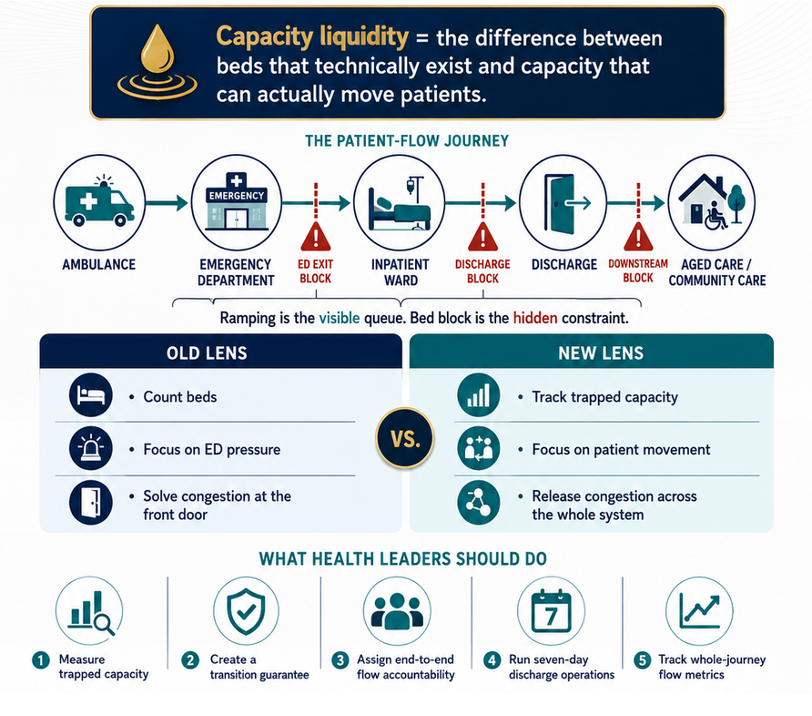
So perhaps it is now time to rethink the problem, because Australia may not simply have a hospital capacity shortage – it may have a capacity liquidity problem.
A bed is not capacity
Health systems tend to talk about capacity as inventory. How many beds? How many nurses? How many ambulances? How many operating theatres? How many residential aged-care places?
All are important.
But an economy can possess enormous assets and still experience a liquidity crisis if those assets cannot be converted into something usable when they are needed.
Healthcare is surprisingly similar.
A hospital may technically have 600 beds. But if 70 of them are occupied by patients who no longer require acute hospital care, another group is waiting for diagnostics or specialist decisions, and discharge processes effectively slow outside traditional business hours, the hospital does not really have 600 beds available to meet acute demand.
It just has 600 pieces of infrastructure.
Operational capacity is something different.It’s the ability to put the right patient in the right place at the right time.
This is the distinction between capacity stock and capacity flow.
Australia has historically invested heavily in the former. The next generation of hospital reform needs to become much better at the latter.
The empty bed fallacy
There is an understandable instinct whenever hospitals become congested: build more beds.
Sometimes that is exactly what is required. Population growth, ageing, increasing complexity and rising demand mean Australia will unquestionably need additional healthcare infrastructure.
But there is a danger in assuming that every capacity problem is solved by adding capacity, because a poorly flowing 700-bed hospital can eventually reproduce exactly the same congestion as a poorly flowing 600-bed hospital. It simply does so at a larger scale.
A new bed creates capacity once. Better flow creates capacity repeatedly.
This may be one of the most underappreciated economic principles of healthcare.
If a health service safely removes one unnecessary day from the hospital stay of 30 patients every day, it effectively creates the equivalent of 30 available beds without constructing another ward.
That doesn’t make infrastructure investment unnecessary. It means infrastructure and flow should no longer be treated as substitutes for each other. We need both.
Stop trying to solve ramping at the ramp
Ramping is particularly difficult politically because the failure becomes spectacularly visible. An ambulance parked outside a hospital is something everyone can see. But operationally, the ambulance is often simply the last queue in a long chain of queues.
A patient cannot move from the ambulance because the emergency department is full. The emergency department cannot move an admitted patient because an inpatient bed is unavailable. The ward cannot create that bed because another patient cannot leave. That patient may be waiting for pharmacy, allied health, transport, rehabilitation, disability support, residential aged care, a community service or a decision somewhere else in the system.
The queue we photograph is therefore not necessarily the queue we need to fix.
That leads to a different question for health executives.
Instead of “how do we reduce ramping” we should ask, “where in the patient journey is capacity becoming trapped, how long does it remain trapped, and who has the authority to release it?”
That is a much more useful management question.
Australia needs to manage patient flow like critical infrastructure
There is a bigger conceptual shift available here. We currently tend to organise healthcare around institutions – hospitals, ambulance services, primary care, aged care, disability services, community health, mental health.
Each has its own funding arrangements, governance structures, performance measures and organisational boundaries.
Patients, rather inconveniently, do not organise themselves that way. They tend to move across all of them.
And many of Australia’s most persistent healthcare failures occur precisely at the interfaces between organisations. The patient who is medically ready to leave hospital but cannot access aged care is the obvious example.
From the hospital’s perspective, that person is a delayed discharge. From the aged-care system’s perspective, they may be someone awaiting placement. From the emergency department’s perspective, they are the reason an inpatient bed has not become available. From the ambulance service’s perspective, they may ultimately be part of the reason a crew cannot transfer its next patient.
Everyone sees a different problem, but the patient experiences one system failure.
This is why Australia’s next approach to bed block should be built around the patient journey rather than organisational ownership.
A new model: manage capacity liquidity
This would require five significant shifts.
1. Measure trapped capacity, not simply occupied beds
Hospital occupancy is a blunt metric.
A bed occupied by a critically ill patient and a bed occupied for three extra days because an external service cannot accept the patient are both recorded as “occupied”. Operationally though, they mean very different things.
Boards and health departments should be able to see, almost in real time:
- how many patients are medically ready to leave acute care;
- why they cannot leave;
- how many bed-days are being lost to each barrier;
- how long each barrier has persisted; and
- which organisation or decision is required to resolve it.
Imagine if every health service had a trapped-capacity dashboard alongside its traditional occupancy dashboard.
The conversation would change very quickly.
2. Create a transition guarantee
Once somebody no longer requires an acute hospital bed, their transfer to the next appropriate level of care should become a system priority. Not because hospital beds are more important than other services, but because an acute bed is one of the most expensive and scarce pieces of infrastructure in the health system.
Australia should explore something resembling a Transition Guarantee.
Once a patient is clinically ready to leave acute care, the system actively creates, commissions or purchases the safest appropriate next setting rather than simply allowing the patient to wait indefinitely for normal capacity to become available.
That might include rehabilitation, transition care, hospital in the home, residential care, supported accommodation, community nursing, short-term private-sector capacity, or other clinically appropriate alternatives.
The exact solution will vary by patient. The principle should not: patients who no longer require acute care should not routinely become permanent occupants of scarce acute capacity because two parts of government cannot align their systems quickly enough.
The funding reconciliations can happen afterwards. The patient should move first.
3. Give someone responsibility for the whole journey
This may be the hardest reform.
Most executives are accountable for organisations. Far fewer are genuinely accountable for flow across organisations.
When congestion develops, responsibility can therefore become fragmented. The ambulance service owns ambulance performance. The emergency department owns ED performance. The hospital owns hospital performance. The aged care provider owns aged care performance. The Commonwealth and states own different parts of funding and policy.
Each participant can be acting rationally within their mandate while the overall system produces an irrational result. Australia needs much stronger end-to-end flow accountability.
That doesn’t necessarily require another bureaucracy. It just requires existing system leaders to have sufficient information, authority and resources to intervene when capacity becomes trapped across institutional boundaries.
Someone needs to own the question: What does this patient need to move today?
Related



4. Make hospitals seven-day flow organisations
Healthcare demand operates 24 hours a day, seven days a week.
Many of the processes required to move patients through hospitals still do not operate with the same intensity – diagnostic access, senior clinical decisions, pharmacy, allied health, transport, external assessments, discharge coordination.
These seemingly mundane operational details can collectively determine whether beds become available at 10am, 5pm, tomorrow or three days from now.
If Australian hospitals want genuinely resilient flow, we need to stop thinking about discharge as something that happens at the end of admission.
Discharge planning should begin almost as soon as admission does. The expected pathway out, likely barriers and required external services should become visible early.
Flow is not an administrative function. It is a clinical and operational capability.
5. Stop judging the system by a single queue
There is also a governance danger in making ramping the dominant measure of success. Any system aggressively managed against one visible metric can learn to move the problem somewhere else.
Reduce ambulance transfer time and the queue migrates into emergency corridors. Improve emergency department targets and pressure may shift to inpatient wards. Accelerate discharge without adequate safeguards and readmissions may increase.
The objective should therefore not be to make the ramp look better – it should be to create safe end-to-end flow.
Boards and health departments need a balanced view incorporating ambulance transfer, ED length of stay, decision-to-admit delays, delayed discharge, hospital length of stay, readmissions, patient outcomes and safety.
The unit of measurement should increasingly become the patient journey, rather than the performance of an individual department.
This also changes the Commonwealth–state conversation
The thousands of Australians occupying hospital beds while waiting for aged care illustrate one of the fundamental weaknesses of a federated healthcare system.
The clinical journey is integrated. The funding system is not.
There will always be legitimate arguments about who should fund what. But those debates should not create a perverse situation where leaving a patient in an acute hospital bed becomes easier administratively than purchasing a safer and substantially less intensive alternative.
This is where governments may need a different form of agreement. Not simply funding agreements. Flow agreements.
Agreements that define what happens when failure in one sector starts consuming critical capacity in another. Because jurisdictional boundaries may matter enormously to governments. But they mean considerably less to the patient waiting on a stretcher.
The real ambition should be resilience
South Australia’s recent experience offers an important national signal rather than simply a state-level story. Its latest ramping record occurred despite significant work to expand health-system capacity and improve flow. The argument itself states that expecting ramping to disappear entirely is unrealistic and that the goal should instead be safe, sustainable performance.
That is an important insight.
Perhaps the objective should never have been a perfectly empty ambulance ramp. Complex health systems will experience surges. Winter happens. Demand fluctuates. Workforces experience illness. Hospitals encounter unexpected events.
A resilient system is not one that never comes under pressure – it’s one that can absorb pressure, redistribute capacity and recover quickly.
And that requires spare capability somewhere in the system.
Efficiency and resilience are not always the same thing. A hospital operating permanently at the edge of its capacity may look efficient on a spreadsheet right up until something unexpected happens.
Then it becomes fragile.
The next hospital bed Australia builds should come with a flow strategy
There is obviously no single solution to ambulance ramping.
Australia will need more beds in some places. More workforce. More aged-care capacity. Better primary and community care. More virtual and hospital-at-home models. Better mental-health pathways. And more effective demand management.
But perhaps there is a larger lesson emerging.
We have spent years asking how much healthcare capacity Australia has.
The more critical question now may be: How much of that capacity can actually move?
That is the next frontier for health-system leadership. Not simply adding more beds to a congested system. But understanding where capacity becomes trapped, making those constraints visible, giving leaders authority to remove them, and designing funding arrangements that allow patients to move across organisational boundaries.
Because a hospital does not have capacity simply because a bed exists. It has capacity when the right patient can enter that bed – and the patient who no longer needs it can safely move on.
That is the difference between building a bigger health system and building one that actually flows.
Dr Sidney Chandrasiri is the CEO of the Australian Institute of Health Executives.
This article was first published on the AIHE website. Read the original article here.