

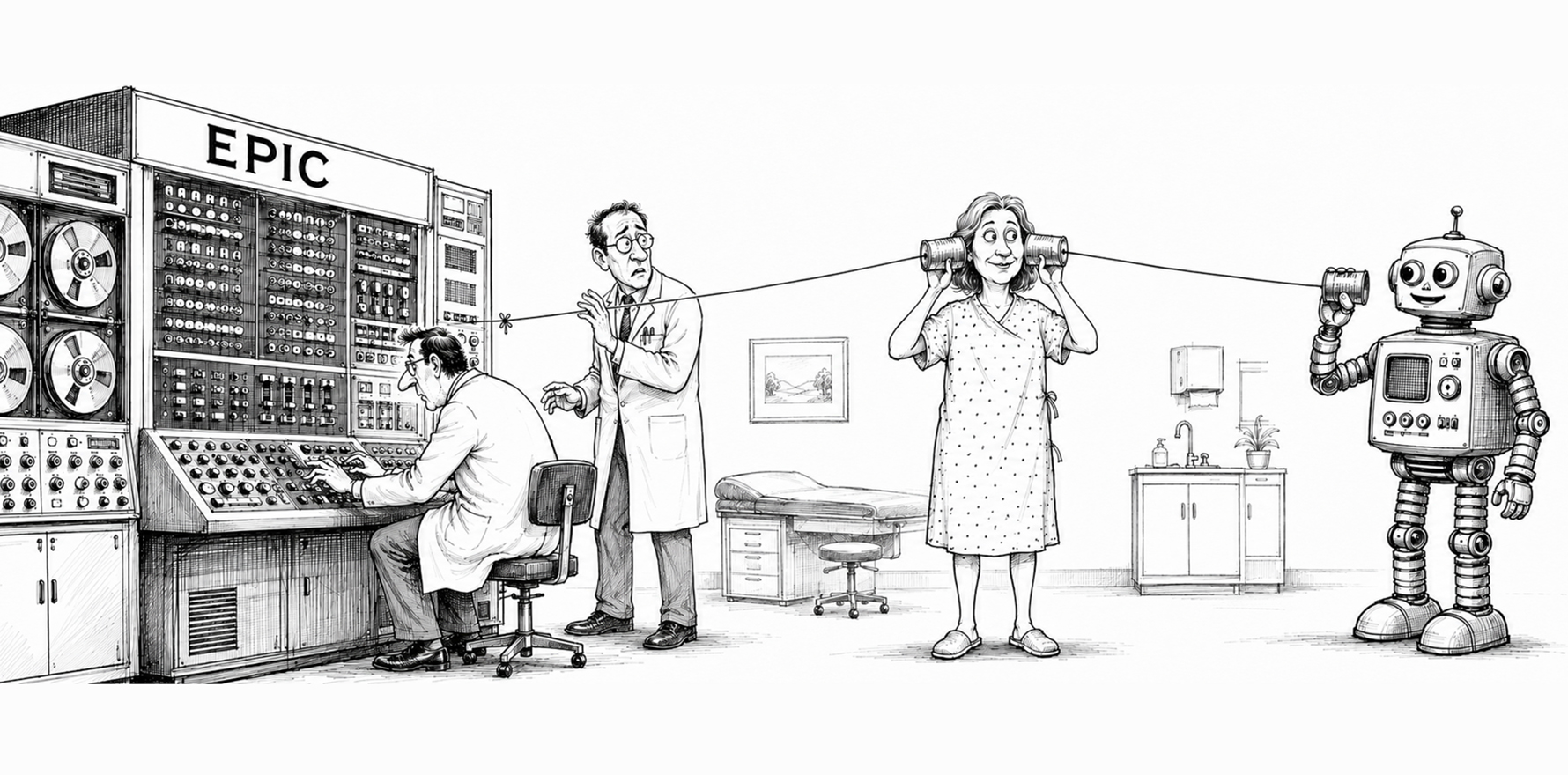
The battle for the hospital AI layer has begun in earnest, it’s moving fast, and administrators are being asked to make consequential decisions with incomplete information and no safe option to stand still.
OpenAI announced this week that ChatGPT for Healthcare now connects to Epic’s electronic health record system, allowing authorised clinicians to pull patient data – notes, labs, medications, specialist letters – into a secure enterprise workspace.
UCSF Health in San Francisco is the pilot partner for the integration.
Two weeks ago Epic previewed a no-code platform for building custom AI agents inside the EMR called Agent Factory, launching with roughly 120 built-in features and three pre-built clinical personas.
OpenAI’s integration aims to go around Epic’s new internal offerings via government-mandated FHIR APIs, and Epic is not entirely happy, probably because they can see where this is all heading in the US.
Notably, ChatGPT’s Epic integration is “authorised clinician only” (a hospital has to sign a HIPAA-compliant Business Associate Agreement with Open AI) and is “read-only” meaning it can read a chart and draft a summary, but the clinician must then switch back to Epic, find the patient, and paste in any new information manually.
AI in US is going much faster than Australia because of 21st Century Cures Act
That the new integration is only for clinicians at this stage is a distinction that is important because the real power of ChatGPT over a moat-protected enterprise platform like Epic is its nearly 77 million US users of its consumer product, which presumably it wants to use to help lever its way into the hospital enterprise market somehow.
ChatGPT Health isn’t at this stage trying to force a direct patient-to-consumer link into Epic, but it can’t be far off.
US legislation on data sharing forces Epic to make a patient’s record fully available to any patient who wants it, and Epic has MyChart Portal, which allows a patient to access and retrieve their record, via a fairly rigorous identity and privacy HIPAA compliant pathway.
Apparently the race is on for multiple patient apps to be forcing this pathway to all the major EMR provider platforms, both hospital and non hospital.
And it seems likely that both Anthropic and ChatGPT will be at the forefront of such a push given both are the logical consumer friendly end of a patient trying to decode their records.
None of this is happening much yet in Australia because the Department of Health, Disability and Ageing has never pulled the trigger on across-the-board mandating of both providers and software platform vendors having to share patient data as seamlessly as possible.
We instead have chosen to make sharing legislation sector by sector and edge our way to what the US did in one legislative change called the 21st Century Cures Act.
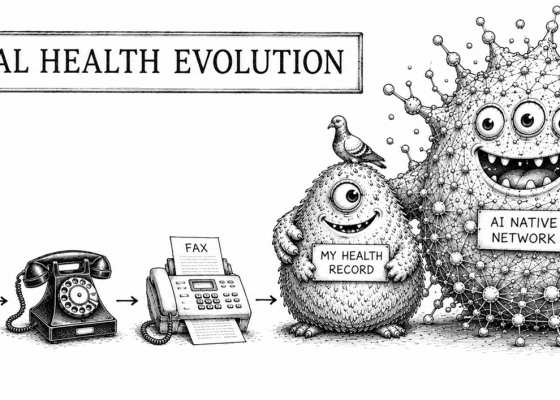
In Australia today patients can extract their My Health Record, and any results records they can randomly now get from certain providers, such as the path labs, and have ChatGPT or Claude ingest the whole lot and then start the process.
You do hear about it happening more and more, but it’s not easy. The My Health Record isn’t easy to deal with. The data isn’t comprehensive still and anything outside the My Health Record that is provider accessible so far is random.
In other words, as far as empowering patients goes with the new AI revolution, Australia is way behind the eight ball and not likely to catch up fast.
Theoretically now in the US, you can go to your GP, a hospital and a path lab and have everything downloaded directly into your patient app, and then have some or all of that data ingested by one of the LLMs and start a much more interesting journey as a patient through the system.
What’s going on in the US now, and the ChatGPT Epic clinician integration is just the first shots fired in a change in informational power dynamics that is going extremely fast: that very soon the patient apps, including the iPhones and Android phones, are going to automatically ingest a patient’s results and data on demand, and automatically talk to the relevant health-related consumer AI in real time.
As much as we in Australia love to think we have an advanced digital health program aimed at empowering our population with their own data, we are miles behind achieving this sort of dynamic, and we aren’t even on a very rapid path to catch up. Not yet anyway.
Epic and Oracle will consolidate but the power dynamic is shifting to the patient
Epic’s native agents write directly to the chart because they are built into the source of truth.
It’s a huge structural advantage that cannot be closed while OpenAI remains outside the EMR for write back and not dissimilar to the problem a lot of challenger health AI groups, including scribes like Heidi, have outside the US.
Although Epic is mandated to share data the reality is that it is making it very hard for external software platforms to force that sharing and as a result they have a new business model and major new revenue stream getting outside platforms to pay them for extra help to get it the integration done more efficiently. It’s effectively still a form of information blocking. It’s just that they are saying , “OK the government says let you in, but they didn’t say make it easy…if you want it easy, pay up”.
And you’d assume at the pace that Epic wants the market to move.
In this environment Epic is madly building out its internal AI capability to stave off all its AI challengers. Its Curiosity predictive model – drawing on Cosmos, a database of 320 million de-identified patients – forecasts stroke risk, readmission probability, and deterioration in real time. And its new Ergo interface is effectively an advanced integrated scribe, invisible inside daily clinical tasks.
Related


Shadow IT players strategy
OpenAI’s strategy to counter this problem is the same play Heidi Health has been running: get clinicians using the product outside of the enterprise system contracts, and use the specification power of your clinician converts to force a hospital eventually to direct the big enterprise EMR platforms to integrate in a more effective manner.
In OpenAI’s case they are attempting to use enterprise licences under HIPAA-compliant Business Associate Agreements with certain hospitals to embed deeply enough in daily behaviour that institutional displacement becomes politically difficult.
At Beth Israel Lahey Health in the US, 6000 physicians adopted Heidi before the hospital had formally endorsed it, spread by peer recommendation alone. By the time the CIO evaluated the options, half the medical staff was already using it daily. The procurement decision had been made by Heidi’s “shadow” recruits.
ChatGPT is working on the same dynamic.
Clinicians are already using it at home, at times with patient data they should not be putting into a consumer product.
The enterprise version, under a BAA, is a big step: it gets that behaviour inside a governance framework of a hospital.
If or when clinicians come to love the tool, it likely will become very hard to remove, in spite of what hospital management might think is better.
Australia is fragmented and lacks uniform sharing legislation
The US battle assumes a hospital landscape dominated by large enterprise EMRs. Epic holds 43.7% of U.S. acute care hospitals and 56.9% of hospital beds, while Oracle Health (Cerner) holds 21.9% of hospitals and 20.4% of beds, according to recent KLAS data.
In the US Epic and Cerner are frontrunners to hold their ground in the battle for AI workflow in hospitals, at the least.
We aren’t quite so concentrated in Australia, especially when you throw in private hospital groups, none of whom run either of the big enterprise EMR platforms.
In Australia you could say we have three emerging markets for hospital AI:
- the big urban centres, where Oracle and Epic do tend to dominate, at least in Queensland, NSW, Victoria and presumably at some point Tasmania, and “the rest”.
- The midsize non-enterprise hospital market, which is, if you add it up, pretty big, and which likely won’t ever have the likes of Oracle or Epic dynamics directing it.
- The legacy small and potentially remote hospital market, where even a quick AI scribe deployment might be a starting no brainer.
Australia compared to the US hospital market is far more fragmented and eclectic. It’s federated, where each state or territory goes its own way, and then, even within some states, each hospital can go its own way.
It’s been a herding cats exercise in the past. But agentic AI could change that problem quite a lot.
A bunch of innovative, well funded, new clinical workflow AI players such as Heidi and Lyrebird, are eyeing the market, as are some existing cloud PMS players such as MediRecords, and there are some larger established usual suspects such as AWS, Salesforce, ChatGPT Health and Telstra Health with a set of new AI-led hospital workflow products which can overlay existing layers and create a lot of new efficiency.
Damned if you do and damned if you don’t
Who’d be a hospital CEO or a state e-Health manager in this day and age?
You’re almost certainly damned if you go too slow at this point of time – the traditional speed for hospital technology procurement at scale – but you’re almost certainly going to risk ending up in the hospital elephant’s executive graveyard if you go too fast, and miscalculate in any way (and there are lots of ways thanks to AI).
The herding cats mid to small and remote hospital market has the odd interesting incumbent – more or less legacy – vendor, who might, despite the AI invaders, benefit significantly from this new AI enhanced world, if they play their cards right.
A lot of agentic AI is going to be able to overlay some of the more established and organised incumbent medical record players, such as Infomedix and even Orion.
Orion is moving rapidly on its own AI transformation, while Infomedix is a smaller local player which essentially digitises paper in those many hospitals we still have which operate on paper and fax.
That simple process of digitising the paper record, although it sounds a little like the My Health Record PDF problem – it’s a paper record that’s technical digital but needs a lot of work to be useful – is a very big step for hospitals given the context of what AI can do to these types of digital records.
As a result we have some completely new innovative players eyeing this market although don’t be surprised if a player like Heidi decides to pivot its way into it quickly if it’s not getting traction trying to break into the enterprise hospital market.
For a hospital running a legacy-state PAS with limited integration capability, a scribe that requires no EMR integration and delivers immediate clinical documentation value is not a compromise. It may be the only realistic near-term path to AI-assisted care. The same logic applies to the emerging agentic AI market.
The hospital that cannot afford Epic’s Agent Factory – and cannot staff the IT team to configure and govern it – is a large, underserved, and increasingly contested market.
Heidi’s institutional model, NexusMD’s care-to-coding pipeline, and Telstra Health’s Corus interoperability platform are all likely eyeing it from different angles.
What hospital CEOs and CTOs need to decide
For most Australian hospital leaders, there is no single right answer right now as to what to do.
The market is moving too fast, the evidence is too immature, and the infrastructure prerequisites for the most sophisticated tools are too far from where most hospitals actually sit.
What is clear is that the window for deferring a view on what to do is closing.
Clinicians are already making technology decisions regardless of what the C-suite decides and in some cases this is going to be a very messy dynamic for hospital management.
The administrators who will navigate this best are the ones who have mapped their institutional context clearly enough to know which category they are actually in: Epic-ready large system with the capital and IT staff to build natively (NSW Health?); mid-tier platform hospital that can evaluate integrated scribe options on their existing EMR; or legacy-environment hospital where a standalone AI scribe deployment is the practical and defensible starting point.
Those are three very different technology conversations requiring three very different procurement strategies.
The mistake, one that is a very natural one to make given the vast and complex array of options in the AI gallery, is treating the new AI hospital layer as one thing.
Note: if this article is interesting to you and you want to understand more, Wild Health, and Health Services Daily are holding a New Models of Care Changing Hospitals Summit in Melbourne on October 29, which will have expert panels and speakers and Q&A dealing directly with this fast emerging problem for hospital C suites. You can check out the program and speakers and get a 20% discount on that ticket using the promo code NEWMODELS20 HERE.