


Hospital CIO groups and CEOs need to come together and share their experiences before we end up repeating expensive mistakes across our siloed hospital procurement sector.
If you opened The Australian yesterday you would have read the headline, “Queensland health service adopts Heidi Health AI scribe for 10,000 doctors in major deal”.
Metro South Health doesn’t employ 10,000 doctors, it’s more like 2400.
A quick check of the Metro South and Heidi press releases and that 10,000 is a number most likely describing the total “clinician” count at Metro Health where they’re bundling doctors, nurses, midwives and allied health professionals across an entire network.
So, still a big deal, right?
It’s not that easy to tell, which isn’t all that surprising, as fluffing stuff up so no one is really sure what’s going on, but it sounds big, has become a hallmark of the marketing folk at Heidi these days.
In July we unpicked a major announcement in the NHS in which we were told the “NHS launches largest ever AI clinical document procurement covering 70,000 Midland clinicians” when the real deal at the time was only five of the 15 trusts, so a potential 23,000 clinicians only to start (an eerily similar degree of error to The Australian yesterday) and none of them were actually contractually bound to use the scribe.
Heidi had simply been approved for use by those five trusts and Heidi had to market then individually to each health group to actually win new business.
In this case there was a jurisdiction-wide exaggeration, which the press picked up and amplified without any checking and Heidi didn’t correct the misinformation the media started spreading.
Yesterday The Australian’s error was proudly posted by a Metro Health South doctor and then by Heidi on its company LinkedIn page without correction as well.
It reads just a little like a typical AI hallucination.
Is it deliberate to let the misinformation blossom (Heidi’s LinkedIn page has 67,000 followers), or just sloppy on the part of Heidi’s senior management? Accuracy is meant to be a core element of Heidi’s scribe product and an important tenet of practising good medicine.
It’s hard to tell at this stage which way to read what is going on, but there are some possible hints in other components of how Heidi is spreading its gospel.
Another Heidi post from the last few days reveals that the group has decided to buy some reasonably pricey electronic billboard advertising both inside and outside of Canberra Airport this month (see below).

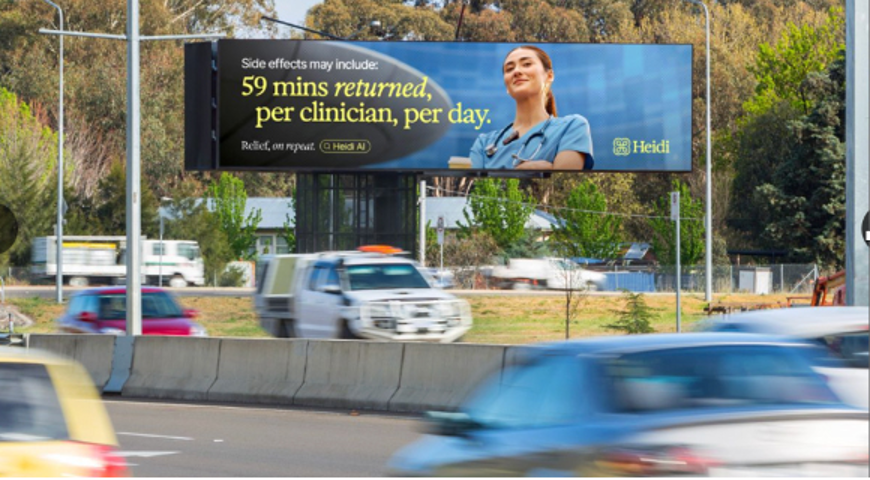
These ads aren’t trying to target the aspiring Canberra clinician scribe user demographic.
These are directed at positioning the brand to those in power: some who are medical regulators I guess, some high up in the Department of Health, Disability and Ageing, and of course, the politicians.
It has to be a first for a medical software company in Australia.
So what is going on?
What Metro South confirmed, and what it wouldn’t
First, a bit more information on the actual deal that has been struck by Heidi and Metro South.
Metro South confirmed, on background, that the deal is a signed contract, reached after a trial, formal procurement and a cyber security assessment. The deal will roll out slowly over time to five hospitals – plus Princess Alexandra, QEII Jubilee, Logan, Redland and Beaudesert – plus community and oral health, and addiction and mental health services.
Heidi use is optional for any clinician in the group, but most importantly, it does not interface with any of the hospital’s electronic medical record or PAS systems.
It will be used by clinicians via them separately logging into a web-based Heidi app.
What neither Heidi or Metro South has confirmed so far is:
- Whether money is changing hands, and if so on what basis – it is interesting to make such an announcement but include no commercial details at all.
- Whether the trial compared Heidi against any other scribe before it was endorsed as the only scribe for use so far. We think Heidi was the only scribe on trial per the NHS Midlands trial.
Full disclosure: Heidi’s Simon Kos told us by email:
“Heidi wasn’t the only scribe trialled. Metro South Health tested a panel of AI scribe providers as part of its procurement process, and Heidi was ultimately selected following that process.”
The fact that the contract is for a stand-alone scribe which clinicians have to separately log into via a web app was not included in either press release. That feels like a fairly serious omission given this fact is arguably the most operationally important and potentially controversial detail in the deal.
Related



The integration problem nobody’s asking about
Metro South runs on Oracle Cerner, which has its own integrated AI scribe.
Heidi, by Metro South’s own admission, does not talk to that record. Clinicians work in a separate web app – meaning notes and whatever coding-relevant detail sits inside them – have to be manually moved back into the record which matters for the patient’s file, for continuity and workflow, for coding, and for funding.
It’s not really a point of debate that clinicians love using Heidi. It’s a very good app for what it does: transcribes, summarises and make suggestions from a knowledge database around that summary. It allows clinicians to be computer clear when chatting to their patient. It’s cool and in the consult, almost certainly productive … in the consult.
But there’s a very real cost for a group like Metro South sitting on the other side of that “59 minutes a day saved” (I got that number from their Canberra billboard ad) if the scribe isn’t integrated in some way to both the EMR and the PAS.
And it’s not a cost that is captured in any of the survey work we can see reported as a part of the trial process in the press releases because that work is focusing just on the clinician consult and the patient experience.
Nobody seems to have looked at how much time the new “outside-the-consult” stuff costs and whether cutting and pasting clinical detail between a web app and a hospital system introduces its own error risk.
These seem like fairly basic and holistic productivity and governance questions.
But here’s a few more for a hospital group to be seriously considering when opting so heavily for a standalone scribe:
- How safe is it to do your consult without the frame of the patient’s longitudinal record in there to help you run your consult, compared to doing it with a scribe that does do that?
- How much disconnect, time and hassle occurs before and after a hospital consult when the EMR and PAS aren’t in the loop and all this new data has to be double-handled from the standalone scribe into the enterprise systems?
We don’t know any of the answers to these questions because the trial didn’t consider them. It just looked at the clinician, and their consult.
To be clear, we aren’t on the sidelines barracking for the big enterprise EMRs and their new knowledge prediction and scribe modules here. Both Epic and Oracle have an awful track record of blocking information and holding hospitals ransom to the use of their own ecosystem at significant cost and, at times, efficiency loss.
A patient number that doesn’t add up
Both press releases lead with the same claim: “more than 70% of patients … reported they felt their clinician spent more time with them, heard and cared for them”.
For that to mean anything a patient would need a genuine before-and-after comparison – the same doctor, without a scribe, then with one. That’s not how hospital care works and we doubt how the survey methodology panned out either. Patients flow through EDs and outpatient clinics seeing different clinicians, often just one time.
The realistic version of this survey finding is patients reporting a generally good impression of a single consultation, not a controlled comparison against their own prior experience with an unscribed version of the same doctor.
Presented as evidence the scribe measurably improved the doctor-patient relationship, it’s a contrived reading of what the question could actually capture.
Heidi’s strategy is risky but it might work
Faced with the ultimate problem of “if the EMRs don’t let you in, you’re ultimately out”, Heidi’s strategy has been pretty blunt. It is to “flood the clinician zone” until enough doctors depend on the tool that they can pressure institutions to force EMR integration later.
Heidi doesn’t own an EMR and has no near-term path to one. Its position depends on getting embedded deeply enough in a hospital culture and eco system that switching becomes a political and cultural problem for hospital management as much as a technical one.
In this light, it’s easier to understand those Canberra billboards.
Let’s not just get the clinicians onside here en masse, let’s get the politicians and policy makers loving our vibe as well.
If Heidi gets even 30% of the 10,000 or so doctors, nurses and allied health professionals using their scribe at Metro South for any length of time, trying to get each group to change over at some point of time to suit the workflow much better, if that case is made, is going to be much harder and more expensive.
Best Practice by rights is pretty old and clunky patient management solution for general practitioners in Australia, but 80% of our GPs love it. They love it for lots of reasons but the major one is that it’s just so familiar in their day-to-day work. Its user interface hasn’t changed much in nearly a decade.
Standalone scribe now or integrated one later?
In the only hospital contract that Heidi has won so far in the US at Beth Israel Lahey Health (BILH), involving up to 6000 providers across 14 hospitals and 175 primary care practices, there also is no integration with the hospital EMR.
In that contract, and with the Metro South contract, the narrative on the decision to go early on a standalone scribe is “physician first”, “integration second”.
It’s an argument that BILH clinicians posted and Heidi started echoing in its PR pretty heavily soon after.
BILH leadership argued in their annual report to the Massachusetts Attorney General and subsequent industry papers that their AI roadmap prioritised “AI Democratization” and clinician experience over rigid workflows. They publicly defended using Heidi, even though it was standalone because it allowed 47 different medical specialties to adopt the technology immediately without waiting for custom Epic builds.
That’s Heidi’s position so far as we understand it in the case of Metro South: clinicians need this relief now, and it will create productivity.
It’s a pretty good argument but it’s not really a properly tested one by the looks of things.
There’s a big issue in play here for the efficiency and productivity of all Australian hospitals. There’s been no rigorous comparative trials or research trying to unpick the problem.
If you go with a standalone scribe in a hospital setting now, will that actually be the most productive path for the hospital and its patients and clinicians, in the end? Or might you be making a rod for your own back down the track if your clinicians get too used to the standalone workflow and have to re-adapt later? Are EMR scribe options safer, getting much better now, or are they clunky, expensive and restrictive?
The hospital AI scribe problem has a long way to run yet but you sense that the hospital CIO groups out there and the CEOs need to come together and share their experiences and thoughts a lot more before we end up repeating expensive mistakes across our very siloed hospital procurement sector.
If you want to do that in the near-term, Wild Health and Health Services Daily are holding a hospital summit in Melbourne looking specifically as this problem as one of many issues facing the hospital sector in the era of AI. You can view the speakers and program and get a 20% discounted ticket to that summit HERE .Your 20% discount code is NewModels20.