


‘Just when you think it could not possibly get worse, it does': Another Single Digital Patient Record Implementation Authority employee tells us just how deep the problems go.
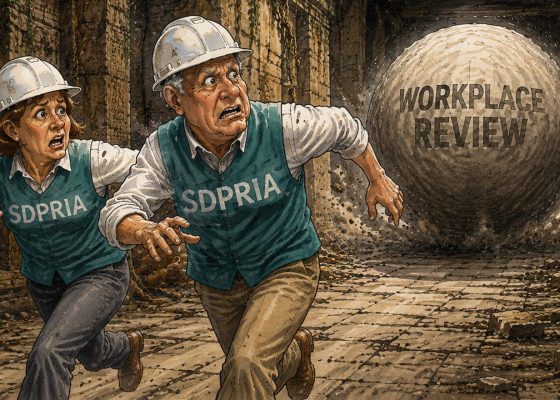
An “arm’s length” psychosocial review of the workplace culture at the Single Digital Patient Record Implementation Authority will report to the Health Services Union at the end of this week.
An email from the HSU to workers at the SDPRIA, leaked to Health Services Daily this afternoon, says the “high level of member participation” had delayed the report.
“This slight delay reflects the significant amount of information provided by members and the complexity of the issues raised, all of which require careful consideration,” said HSU of the review, which is being conducted by HealthShare NSW.
“Once the HSU has reviewed the draft report, a meeting will be arranged for all SDPRIA members to discuss the report’s recommendations and the proposed next steps,” said HSU’s memo to staff.
Meanwhile, internal SDPRIA documents obtained by Health Services Daily reveal there are currently over 3500 open incident tickets linked to the Hunter New England LHD Epic rollout – almost nine times the figure HSD was able to report on Saturday after obtaining additional documentation.
HSD reported on Saturday that open tickets from the second stage of Tranche A of the SDPR rollout – which brought Hunter New England LHD online – amounted to about 400.
We can now report that documentation shown to us indicates that between the 27 May go-live and today, 22 July, just over 16,300 incident tickets have been logged.
As of today, just over 3500 remain open.
Almost half of those open tickets, HSD understands, are within the patient administration services (PAS) team. PAS uses Epic modules that provide waitlist and referral visibility, upcoming bookings, triage status, schedules, performance metrics, admissions, transfers, discharges, bed management, and patient registration.
The six weeks following the 27 May go-live is known as the “hypercare period” – during which all SDPR systems are turned on, the new electronic medical record is live, and the provider – in this case, Epic – provides extra resources to SDPRIA staff for dealing with any issues.
On a practical level, the hypercare period includes SDPRIA staff on a 24/7 roster addressing incident tickets, providing “at-the-elbow” support, and dealing with forwarded calls from the statewide eHealth NSW service desk.
The hypercare period for the first stage of Tranche A – done for the Justice Health Forensic Mental Health Network and the NSW Health Pathology John Hunter hospital lab back in March – was four weeks long.
For Hunter New England LHD that hypercare period was six weeks.
“The six-week hypercare period was as poorly managed as the Justice hypercare period,” said a SDPRIA employee, speaking with HSD on the condition of anonymity.
“Excessive, repetitive meetings, multiple staff manning bridge lines, night shifts that were kept going unnecessarily, staff having to start Tranche B work while still dealing with hypercare duties.
“Everyone is extremely exhausted, very stressed, and completely overwhelmed. We cannot catch our breath.”
Tranche B – the Epic rollout in five more LHDs, namely Northern NSW LHD, Mid North Coast LHD, Northern Sydney LHD, Central Coast LHD and LIMS North – is scheduled to go live in November.
Also in today’s edition:
- Australia risks becoming ‘hostage to geopolitics’ over healthcare AI
- Physical assault rates among healthcare workers double in 10 years
- The withholding problem: how good doctoring can lead to institutional mistrust
- Northern Territory to come full circle on voluntary assisted dying
- Coatsworth slams public health and clinicians for ‘failed’ smoking policies
- With AI in the consultation room, governance matters more than ever
- Researchers map ‘pharmacy deserts’, call for more equitable distribution
“To make matters worse, the executive management team are now limiting the ability of staff to get on with Tranche B work,” said the SDPRIA worker.
“[Management is] insisting on extra approval steps just to interact with our stakeholders, which is urgently necessary to obtain the data required to build the Tranche B needs.
“What’s infuriating is that the scope of Tranche B is still not fully defined, and there are endless back-to-back meetings internally, which does not allow for any progress.
“The tranche planning, reporting processes and governance that should have been decided and completed way before Tranche A is only being discussed now – and then whatever is decided gets changed at the 11th hour.”
According to the employee the Authority is still struggling with HR components such as overtime payment, on-call processes, and rostering. But staff are still expected to complete the extra configuration, building, testing, and integration required for Tranche B.
Earlier this week, HSD reported that the SDPRIA had said it was working “collaboratively” with the Health Services Union and employees to address workplace concerns.
“The wellbeing of our staff members remains our priority and we take all concerns raised by our staff very seriously,” said the SDPRIA’s CEO Dr Teresa Anderson.
“We are committed to ensuring they are supported, engaged, and experience a psychologically safe workplace.”
Despite that response, the reality on the ground is vastly different, said HSD’s anonymous source.
“Staff are spoken to by executive management in a condescending, patronising, dismissive manner on a daily basis,” they said.
“We are never consulted, we are just told what to do with an unrealistic deadline.
“There are endless internal information requests and directives – it’s a constant drain of our mental energy and productivity.
“How is this consideration of our wellbeing?
“If anyone makes a mistake or has an error in judgment, rather than being spoken to in a respectful manner and provided information to do better or correct a mistake, the staff are dragged over hot coals and formally punished.
“Many people have been, and continue to be, scapegoated by the executive team. How is this psychologically safe?”
Related

The SDPRIA worker said what started as an exciting, challenging program has devolved into a nightmare.
“Yes, a program this size and scale is challenging, but it is made unnecessarily more challenging by the executive leadership team,” they said.
“Their lack of operational planning and skilled strategic leadership – choosing ‘reactive authoritarian management’ instead – is making us sick, tired and frustrated to the point of wanting to leave as soon as possible.
“There will be a great loss of talent but the leadership doesn’t care if people quit.
“People were originally excited to join the program because it was sold as a once-in-a-career opportunity, to work on the country’s largest digital health transformation.
“While the staff are still connected to the meaning and purpose of this program, and the necessity of a statewide eMR, the physical, mental, and emotional toll outweighs anything positive,” they said.
“Just when you think it could not possibly get worse, it does.”