


I was rationing my own care due to cost. I didn't know I had five Medicare-subsidised allied health visits. Let's sit with that thought.
I was in pain. My GP created a care plan (aka a GP Chronic Condition Management Plan) and referred me to an allied health professional.
Their books were full. Auto-reply.
I panicked – convinced the referral had to be to that exact person. I asked the practice if there was an alternative. The GP responded with: “It’s an open referral with a list of other options.” Then the original specialist saw my care plan, got in touch, and opened up a spot.
So while I waited, I saw my regular physio to see if it would help. My GP also referred me to someone else as another approach. My care team was quietly getting bigger – which felt reassuring, and also slightly overwhelming.
Then I started seeing the specialist my GP had referred me to. She’s great. She also costs nearly $200 a visit, which I was claiming through my private health fund and getting $20 back on. She wanted to see me weekly to get on top of the pain.
I started spacing out the appointments instead – trying to be financially responsible.
A few visits in, she asks: do I have a care plan?
I say yes.
She’s taken aback. If I had one, why wasn’t I claiming on it?
“You mentioned your regular physio – that’s allied health. You’ve probably already used some visits.”
I told her I definitely used my private health fund for the physio. Got my $20 off.
We both “lol”.
She explained I was entitled to five Medicare-subsidised allied health visits under my care plan.
Three months into this pain journey and it was the first I’d heard of it.
At the end of the appointment, trying to sort the payment, we went looking.
I opened the 1800 Medicare app – the obvious choice. It’s called Medicare. I went to Medicare Services. Claims summary. How to enrol. How to claim. Nothing that said: you have a care plan, here are your visits, here’s what’s left.
(As I’m writing this, I’m still second-guessing myself – maybe I missed it? Maybe it’s there and I didn’t find it? That self-doubt, for someone who works in this space, is its own kind of finding.)
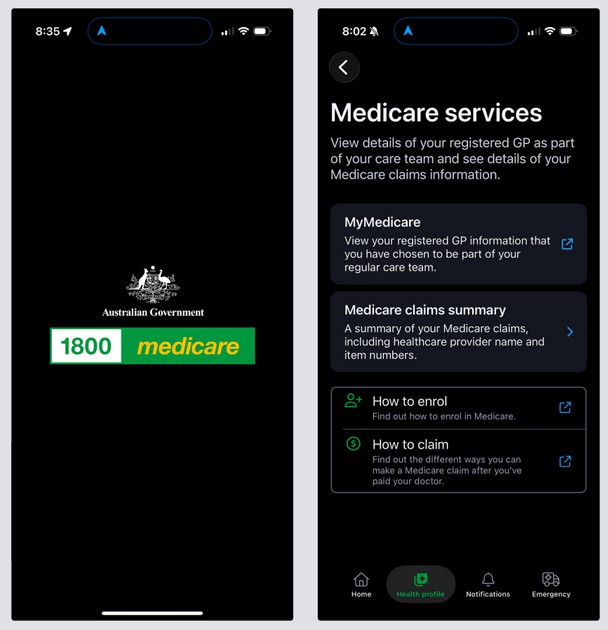
What about the myGov app? I open it, go to Services > Medicare. It hangs. I close the app, try again. Still hanging.
The receptionist said she can’t see it on her end.
We gave up. She said let’s just try claiming and see what comes back.
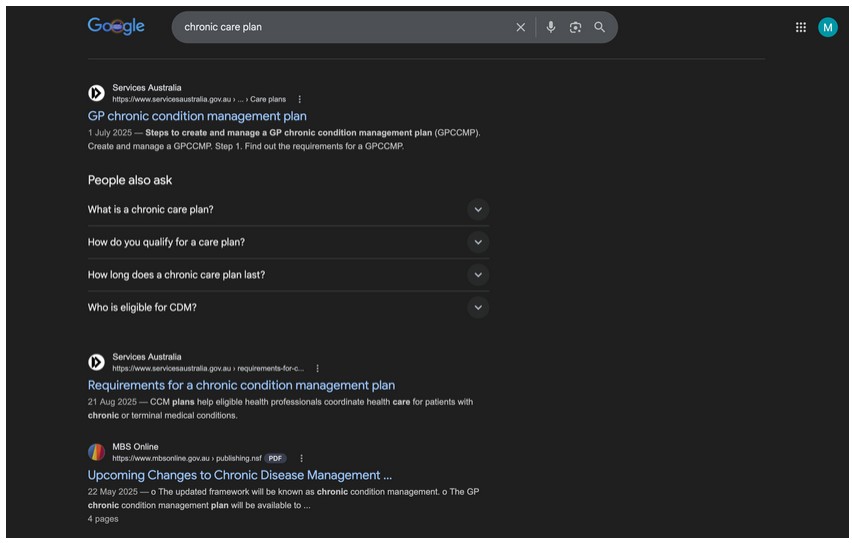
It’s 11pm. I’m reflecting on the day and I Google “chronic care plan” – trying to understand why I didn’t know about the five sessions, wondering if my GP had mentioned it and I was just too focused on the care itself to take it in.
The first results are written for health professionals. Not a patient-facing explainer in sight. Maybe that’s who’s searching. Patients know about it and maybe I’m the only one who doesn’t know?
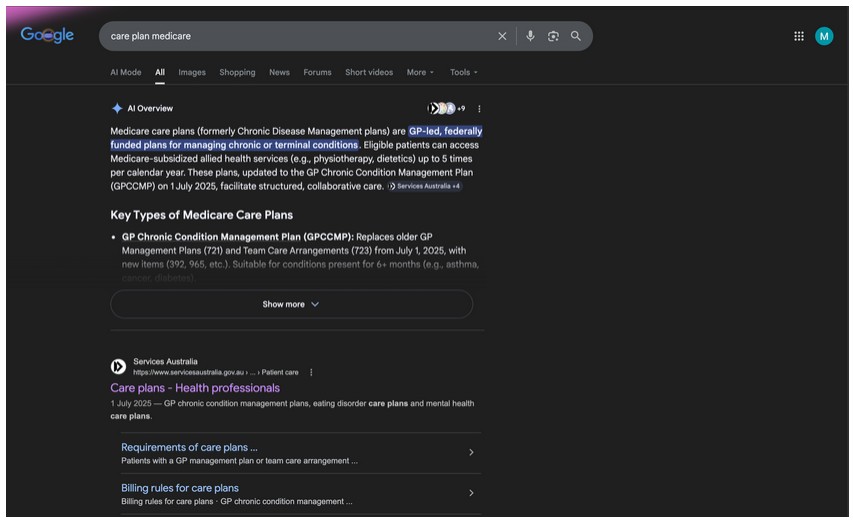
Adding “Medicare” to the search pulls up an AI Overview – but should a patient be navigating their entitlements through an AI summary they’re told not to fully trust?
Still the first Google results are again for health professionals.
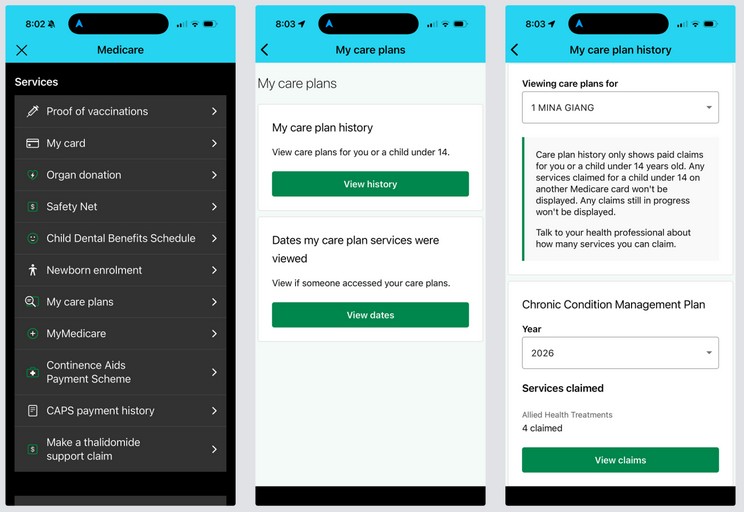
I give the myGov app another go, update it, get in. Care plan history is there, sitting under Medicare Services. A section called My care plans. Four allied health treatments claimed. For the calendar year.
Four. When did that happen?
Three of the five had gone to another allied health provider whose service fees were lower. I hadn’t known to direct them to this specialist – the one my GP specifically recommended, known to be the best in her field, at nearly $200 a visit. The one I actually needed them for.
One visit left for the year.
My care plan history screen in myGov shows four claimed. Not four out of five. Not one remaining. Just four claimed. There’s a note that says: “Talk to your health professional about how many services you can claim.”
Which contradicts the fact that my specialist couldn’t see how many I’d claimed on her end either.
So the journey, as best I can piece it together, looks like this:
- Your health professional should tell you you’re entitled to five visits – if they think to mention it.
- If you keep seeing the same provider, they’d know their own history with you – “you’ve seen me twice, so you should have three left, provided you haven’t seen anyone else”.
- But if that provider was booked out, or didn’t work out, or was on leave – which was my case – you need to go to myGov, not the 1800 Medicare app, to find out how many claims have been made.
- Then tell your next health professional yourself: I have one left. Let’s make this count.
The claiming system redirecting me to ask my health professional about the entitlement it already knows – B I Z A R R E.
What am I missing?
So here’s what I keep thinking about those gaps – what could help a health consumer navigating their own pain, providers and cost?
The care plan document should explain what it entitles you to – in plain language, for patients.
Mine was thorough. Clinically detailed. It said nothing about five Medicare-subsidised visits. Nothing about open referrals. No link to where any of this is explained. One paragraph. A link to a consumer-facing government page. That could be a template fix.
The 1800 Medicare app (previously the myHealth app) – the one literally called Medicare – doesn’t show your care plan entitlements.
That lives in myGov app. Why? I do not know.
W I L D.
And if you look at the app reviews, people are asking where their Medicare card is – because the name leads health consumers straight to that assumption. It feels predictable. The data exists.
The GP created the plan through Medicare. Surfacing it in the app a patient instinctively opens isn’t a technical leap.
Related


Whose job is it to tell the patient?
My GP was focused on my care – as they should be. The specialist was surprised I didn’t know. Nobody’s job in either appointment was to walk me through the billing mechanics.
But if we want it to be the patient’s responsibility to know – we have to actually empower them. That means updates that reach patients, not just health professionals.
Practice management systems are focused on clinicians – and they’re already stretched keeping up with mandatory government updates (I wrote about it here).
Asking them to take on patient education on top of that, without a clear commercial reason to do so, is a big ask. But the opportunity is there.
The same way an eRequest could tell a patient what they’re entitled to at the point of referral – a care plan notification could do the same. Someone just has to decide it matters enough to build.
I didn’t know to go looking. I didn’t know there was anything to find.
I spent three months spacing out nearly $200 appointments, rationing my own care, carrying the out-of-pocket cost – while Medicare-subsidised visits sat in a system I couldn’t read, in an app I didn’t know to update.
The data existed. The entitlement existed. The pathway existed. I couldn’t access it, in an app I didn’t know it was in.
And I work in health tech. Which is either deeply embarrassing, ironic, or exactly the point.
Mina Giang is co-founder and head of product and experiences at Oexa, a Brisbane-based digital health technology company which created the Scripty app, a consumer-focused, free digital wallet that integrates with the national Active Script List.
This article was first published on Ms Giang’s LinkedIn feed. Read the original article here.