

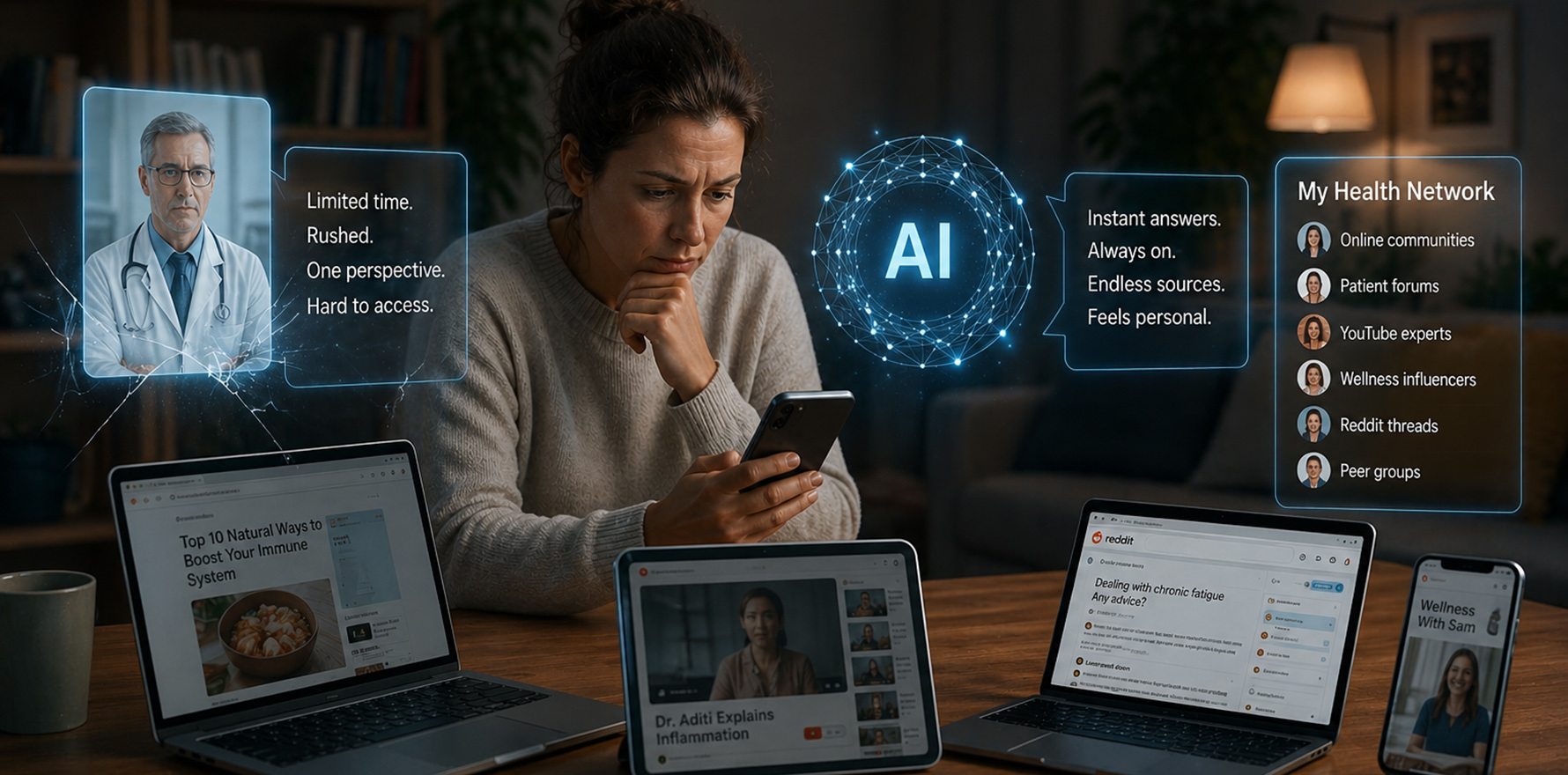
Seventy percent of consumers believe contested health info, 35% turn to machines. Doctors still lead but lose their monopoly as consumers build their own truth networks.
Health content once travelled in neat, straight lines. Doctors spoke, institutions endorsed, and the public listened.
That tidy hierarchy is dissolving and in its place something noisier and far less predictable is emerging: a marketplace of competing truths where algorithms, acquaintances and experts all jostle for attention, and the final judgement sits with the individual.
That’s according to our analysis of this year’s Edelman Trust Barometer, as it relates to the health sector.
The consequences are significant for marketers in the heavily regulated industry, and provide lessons for those in adjacent industries like insurance or pharma.
Authority has been diluted, sliced into fragments and redistributed across networks that move at digital speed.
Artificial intelligence has accelerated the shift, offering instant, personalised answers that feel as authoritative as they are accessible, even if they are wrong – and in the worst cases, deliberately wrong.
The result is not merely confusion, but a new kind of agency. People are no longer passive recipients of health information. They are editors, curators and, increasingly, arbiters of what counts as truth.
What you need to know
- Trust in health is shifting from institutions to individuals, with people building their own mix of sources including doctors, AI, influencers and peers.
- Edelman’s latest Trust Barometer data shows deep fragmentation: about two-thirds say their country is divided on health issues, and 70% believe at least one contested claim. This is not disengagement. Those with divisive beliefs are often more active, consuming multiple and sometimes conflicting information streams.
- AI is now embedded in health decisions, with 35% citing usage, valued for speed, clarity and non-judgmental responses, reshaping expectations of care.
- More information is driving lower confidence in decision-making as consumers struggle to navigate competing claims.
- Trust is being redistributed across a network of voices, forcing brands and public health players to earn belief continuously rather than assume it.
“Divisive health beliefs are pervasive. The reality is that there are many divides in how people think about health, both in developed and developing countries and across levels of education,” said the 2026 Edelman Global Trust Index
Vale herd immunity
Measles should be a relic, not a burgeoning public health crisis in Europe, the US and, as the figures increasingly suggest, Australia. Yet the disease, which for decades was suppressed by the extraordinary efforts of public health officials, and the public’s willingness to accept facts instead of feelings as evidence, is back.
And this time, it’s carried not only by microbes but by memes. False claims about vaccine safety – and the lie that vaccines are linked to autism – have persuaded a significant minority of parents to delay or skip routine immunisations.
Those lies have been amplified by politicians, populists and even state actors across the jurisdictions.
The consequences of that misinformation are visible in the data: outbreaks cluster among the unvaccinated.
In Europe, cases doubled in 2024 to 127,350, according to the World Health Organization, and 38 people died. The US outbreak lags Europe, yet the evidence is that the country is on the verge of a breakout. According to the Centers for Disease Control, cases in the US grew from 58 in 2023 to 285 in 2025. Last year, the country recorded its first measles deaths in over a decade. Three months into 2026, cases are already at 1714.
Australians are as susceptible as anyone. Cases tripled between 2024 and 2025 from 57 cases to 168, and the latest figures, as of last week, suggest 70 cases so far this year.
That the wealthiest societies in the world, with the most advanced health systems, are so afflicted is the result of misinformation made manifest.
A Washington Post poll found that roughly a quarter of parents who believe false claims have altered their children’s vaccination schedules.
Individual doubt has morphed into collective vulnerability, puncturing the protection of herd immunity. Public health experts now warn that if coverage continues to slip, measles could regain a permanent foothold. What was once a triumph of modern medicine risks becoming a case study in how quickly it can be undone.
Also in today’s edition:
Dr Google
Trust in health information is no longer anchored in doctors or institutions alone. As misinformation spreads and AI tools deliver instant answers, consumers are assembling their own mix of sources, blurring the line between expert advice and algorithmic guidance, and reshaping who and what they choose to believe.
The shift is laid bare when you zoom in on the data about consumer attitudes to health information in this year’s Edelman Trust Barometer. Released in January, it suggests a problem even more fundamental than misinformation: there is a structural change in how people form, distribute and act on trust.
“Rather than pushing for uniformity of belief, it’s more effective to invest in health outcomes and impact,” the report states.
Australia broadly tracks the global direction of travel on trust in health, but with some notable divergences in both levels of trust and attitudes to authority.
On the fundamentals, the same fragmentation is evident, with consumers drawing on a wider mix of sources. Trust remains highest in proximate, human relationships such as doctors, consistent with the global pattern. However, Australia presents a more mixed institutional picture, with higher trust in employers and local health authorities.
Where Australia diverges more sharply is in its comparatively lower trust in certain commercial and media actors, reinforcing a more cautious stance toward intermediaries.
Trust in media and business sits below global averages, suggesting Australians may be more sceptical of corporate and information ecosystems that sit between expert advice and the public. This scepticism coexists with relatively high trust in frontline health services such as hospitals and pharmacies, indicating a clearer distinction between service delivery and system-level actors than in some other markets.
Another point of difference is the more restrained belief in AI’s capabilities relative to global peers.
While Australians are participating in the broader shift toward AI-supported health decision-making, fewer believe AI-enabled individuals can perform at least one task as well as a doctor compared with the global average.
This suggests that, in Australia, the erosion of institutional authority may be tempered by a more cautious perception of AI’s role, leaving a somewhat stronger reliance on traditional healthcare relationships – at least for now.
Global discord
The global picture presents as a more fragmented landscape.
Roughly two-thirds of respondents across the world say their country is divided on key health issues, and 70% believe at least one contested health claim to be true. These beliefs range from vaccine scepticism to doubts about common medical guidance. They are not confined to any one demographic.
Crucially, those holding such beliefs are not disengaged or uninformed. They are often more active consumers of health information than others, drawing from multiple, sometimes conflicting sources.
That pattern reflects a bigger change, according to the Edelman report. In the past, trust flowed largely from institutions such as governments, health authorities and the media to individuals. Now, individuals are assembling their own trust networks.
Doctors remain the most trusted source, with about 80% of respondents saying they trust their own physician to tell the truth about health issues.
But that trust exists alongside a growing reliance on other voices. Friends and family, online creators and AI systems all play a role, even when their advice diverges from professional guidance.
Unpeeling the onion
The trends revealed by Edelman do not represent an outright rejection of expertise, but rather a layering of influences.
Among respondents, 35% say they already use AI to manage their health. They use it to answer general health questions, interpret test results and explore possible diagnoses. For many, these tools provide something traditional systems struggle to match: immediacy, clarity and a sense of personalisation.
Those advantages are reflected in how users describe AI compared with human providers.
Among users, AI is seen as more non-judgmental, easier to understand and more sensitive to personal constraints. That combination is quietly resetting expectations for how health information should be delivered.
At the same time, confidence in people’s ability to navigate health information is falling. The share of respondents who say they feel confident finding answers and making informed decisions dropped sharply over the past year, with significant declines across most countries surveyed.
That paradox – greater access to information but lower confidence in using it – sits at the heart of the shift.
The report links this erosion of confidence to the volume and diversity of information sources now available as people are exposed to a constant stream of competing claims, advice and interpretations.
In practice, that means individuals are increasingly acting as their own arbiters of truth, weighing inputs from professionals, peers and algorithms. In many cases, they do so even when those inputs conflict.
Up to 60% of respondents who rely on non-medical sources say they have received advice that contradicts their doctor’s guidance. A significant share say they have followed that alternative advice instead. Among those with the most divisive beliefs, trust extends to both traditional experts and non-institutional sources such as influencers or community figures.
That expansion reflects a broader shift in how legitimacy is defined. Formal credentials still matter, but so do lived experience, peer endorsement and perceived relevance. A recommendation is more persuasive if it is repeated across multiple sources and aligns with an individual’s personal context – that’s also the perfect juju for social media.
The implications extend beyond healthcare into how organisations communicate more broadly.
“The majority of people are hesitant to trust across health beliefs in every country measured. To adapt to this, communicators and practitioners need to elevate goals shared across groups,” the authors of the report argue.
Related

A post-fact world
The findings suggest simply presenting accurate information is no longer enough.
Messages that challenge existing beliefs directly are often resisted. Instead, people respond more positively to approaches that acknowledge uncertainty, reflect their lived experience and build trust over time.
This dynamic also changes the role of businesses. When asked how companies could build trust on divisive health issues, respondents were most likely to favour those that encourage cooperation and dialogue rather than taking a strong public stance.
For companies operating in healthcare, pharmaceuticals or consumer wellness, that creates a delicate balance. They are expected to provide clear guidance while also navigating a fragmented and often polarised audience.
It also raises questions about the role of technology platforms that increasingly mediate health information. AI tools, search engines and social media networks are not just channels for communication. They are active participants in shaping how information is filtered, interpreted and trusted.
“People are open to new recommendations on health issues when they hear from trusted voices. Amp up frequency and match the many points of contact that consumers and patients are getting their information from,” according to the Global Trust Barometer.
In that context, the traditional idea of a single authoritative message reaching a passive audience appears increasingly outdated.
Instead, trust is negotiated through ongoing interactions across a network of sources, each contributing to how individuals form their views. Technology accelerates this process, making it faster and more dynamic but also more complex.
For public health officials, the report makes it clear they need to adjust to a fragmented system where trust must be actively brokered across competing sources, rather than assumed from institutional authority. For businesses, the data suggests the challenge will be to recognise that communication is no longer just about reach or clarity, but is instead about belief.
Organisations now compete with algorithms, peers and a growing array of alternative voices in a landscape where trust is no longer given – it is earned, repeatedly, in real time.
Andrew Birmingham is the editor of Mi3, which was the first publisher of this article. Read the original here.