

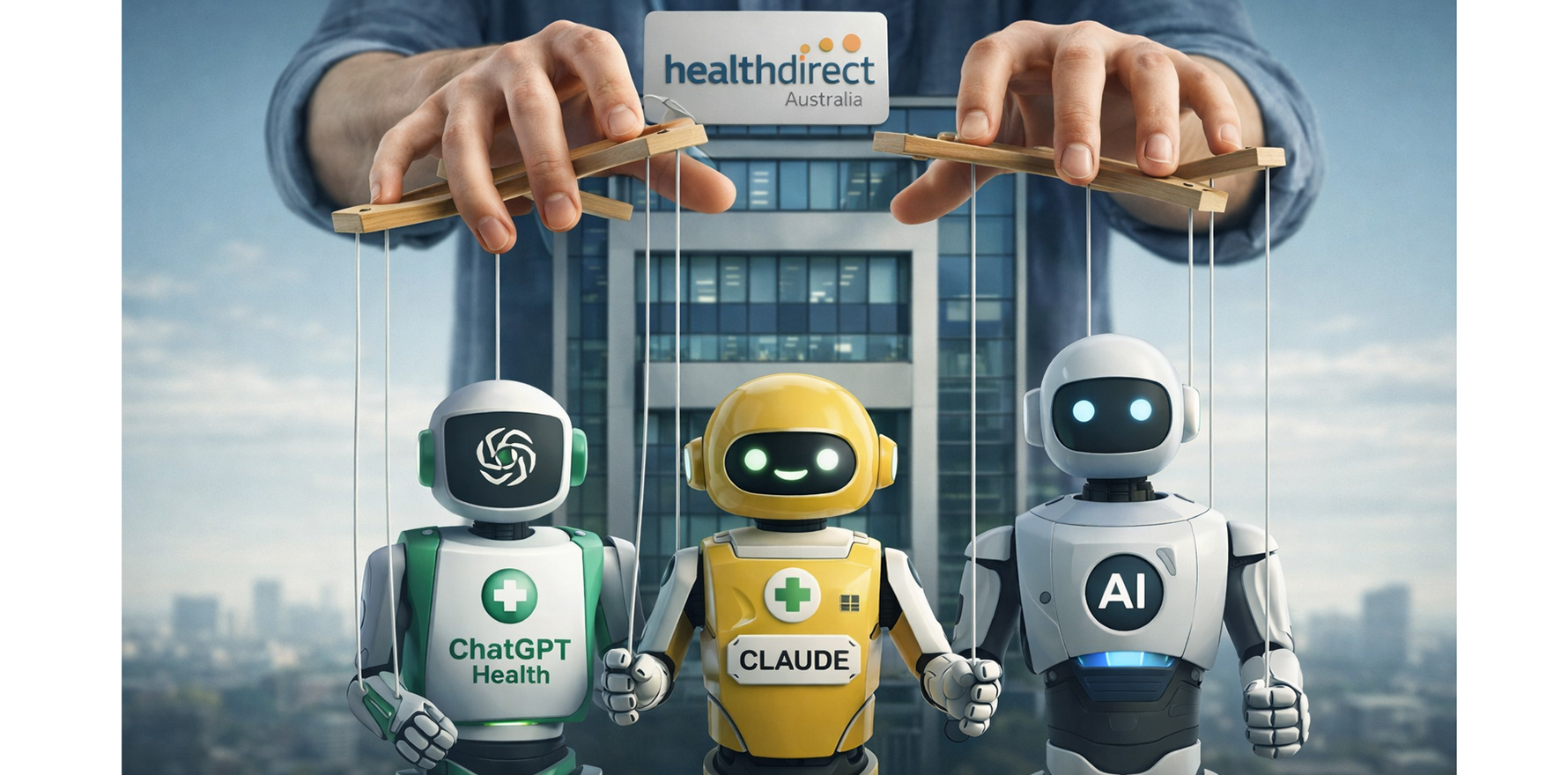
From doorway to source: in the patient-side AI era, the information and triage service is stepping up to the challenge of making sure chatbots give the best advice to patients.
National digital health information and triage service Healthdirect has used its latest quarterly report to signal a major shift in how it will reach and serve its customers in the patient-side AI era.
“More people are now getting health information directly from AI tools such as ChatGPT, Claude and Google’s AI-generated search summaries, which answer questions immediately without the person ever visiting a website,” said Healthdirect’s October to December 2025 report, released on LinkedIn late last week.
“Globally, conversational AI use grew 81% in the year to March 2025, while traditional search traffic declined. Google’s AI summary now appears in around four in every 10 health searches.”
The government-funded service makes clear that consumer behaviour is moving away from the familiar “Google → website” journey towards AI-driven interactions, where users receive answers directly without ever visiting a source site.
For Healthdirect, this shift was not framed as a threat — but as a fundamental change in distribution.
In the report, Healthdirect explicitly reframed its purpose: it is “not funded to generate website visits” but to ensure Australians receive trusted health information that influences their care decisions.
“If a consumer is getting health information from an AI assistant they already trust, and that information is sourced from Healthdirect, our purpose is being served,” said the report.
“The front end has changed; the mission has not. This is Healthdirect’s content reaching further than a website link ever could.
“If that information is delivered via AI tools rather than its own website, the mission is still being achieved.”
Claiming the space
Healthdirect is now actively repositioning itself to “claim the space” as a foundational content provider within the broader AI ecosystem, the report said — effectively aiming to become “the source behind the answer”.
To support this, the organisation is restructuring its content so it can be more easily interpreted and trusted by AI systems. This includes the use of schema markup to signal clinical authority and improve attribution, as well as investment in analytics to track how Healthdirect information is being used across AI and search environments.
It is also actively pursuing syndication and content-sharing partnerships with AI developers and large language model platforms, positioning itself as a collaborator rather than a bystander.
The goal is to ensure that as Australians increasingly turn to AI tools, those tools deliver advice that reflects Australian clinical standards, includes appropriate safety guardrails and enables escalation to human care when needed.
“We are engaging with AI developers and LLM platforms on how Australians can continue to use the AI tools they love but in a way that improves safety, provides escalation to a human, and delivers accountability,” said the report.
“Healthdirect has the clinical credibility, the national standing and the public interest mandate to be a shaping voice in those conversations and improving the experience so Australians can make health choices from personalised AI that reflects Australian safety, quality and security standards.”
Related



The new approach aligns with other initiatives outlined in the report, including enhancements to the Symptom Checker that connects users directly to virtual emergency departments and other care pathways.
The report also shows that Healthdirect’s existing services continue to operate at significant scale.
During the October to December 2025 quarter, the Healthdirect helpline received 360,919 calls, with 80% answered within 20 seconds — a marked improvement from the previous quarter. Consumer satisfaction reached 91%, up from 88%.
Digital services also remain heavily used, although the report hints at emerging pressure from AI-driven behaviour.
The Healthdirect website recorded more than 9.1 million visits during the quarter, down from 10.3 million in the previous period. The Symptom Checker was accessed more than 648,000 times, with over 419,000 users starting a triage and around 72.5% completing it.
Other services continue to expand, including more than 450,000 video consultations facilitated during the quarter and over 600,000 calls to the My Aged Care contact centre. The National Health Services Directory handled more than six million API calls.
Healthdirect is also exploring how AI can be embedded within its own services, not just as an external distribution channel. Trials of AI-enhanced symptom checking have shown that personalised, AI-generated self-care advice can improve users’ understanding of their condition and increase confidence in managing symptoms. There is also early evidence that this could reduce unnecessary use of primary care services for low-acuity issues.
Internally, the organisation is piloting AI tools to support its workforce, including AI scribes to reduce administrative burden in virtual GP services and AI-driven quality monitoring of calls.
Read the full report here.