


The TGA is, in a manner, managing to keep hold of the tail of the bucking bronco that is healthcare AI, but given what is at stake, is that going to be good enough?
Who’d be Tracey Duffy, DoHDA’s first assistant secretary for medical devices and product quality – effectively the first person to blame at the Therapeutic Goods Administration should AI governance of medical devices go off the rails in a bad way?
Betting on the chances of that happening would be like betting on the Melbourne Cup. Everyone cares but no one knows.
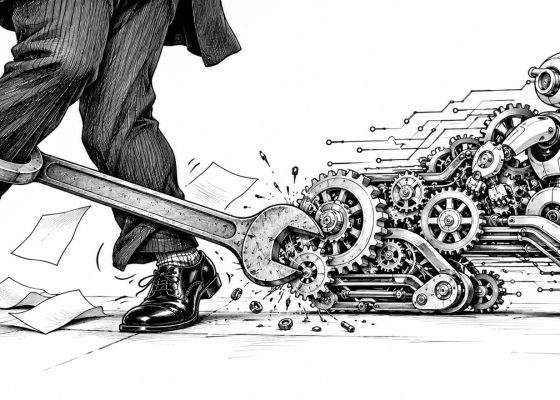
Some people now think that any which way you look at the job Ms Duffy has, AI has disrupted the TGA’s working model to the point where it’s not workable anymore.
A couple of quick examples of what’s in play might help illustrate the sort of dilemma the TGA and our increasingly AI-riddled health system suddenly find themselves in.
The Heidi paradigm – catch me if you can
Heidi is definitively a medical device under the TGA guidelines, has been identified as such (not formally publicly yet, but everyone knows) and given the only whisper of regulatory oversight so far has been a perfunctory review of just 12 out of about 150 local AI scribes, one could say it’s operating in the wild, doing essentially whatever it wants.
More worrying perhaps is that keeping way out in front of the TGA’s capability for keeping up with its deployment to market of radically novel, but so far dearly loved, technology has likely been a key part of the group’s core strategy from the start.
After all, if you aren’t able to measure and frame a new piece of medical software from a governance perspective, each time an iteration of that software is deployed and it’s out of the range of expertise of the regulating body, it can hardly be regulated in any effective manner.
Certainly not in time to catch its deployment to market, which Heidi only tells you as they are doing it – ie, there is no requirement for them to pre-submit to the TGA what they are going to launch.
Adding to this dynamic, Heidi can’t afford in any way to slow down. In fact, given the highly competitive race it is in for a decent slice of the global AI clinical workflow layer, it probably needs to speed up a little more.
It’s “The Fast and the Furious” – Heidi being the Vin Diesel crowd and the TGA being hapless law enforcement.
Luckily for everyone, the good folk at Heidi are, mostly, reasonably responsible. Heidi know that just one big risk incident and they could sink themselves in one go. So they are being pretty thorough on the risk management side of things.
Notwithstanding, it’s a little like the fox in charge of the hen house, except in this metaphor the fox knows that if it kills one chicken, it itself will be killed.
The irony here is that in having to be so cognisant of the risk of fast-developing AI and live deployment, Heidi likely has the most understanding of how to effectively regulate themselves.
Apart from them ignoring everyone and everything from time to time in the name of speed, brand and regulatory fence jumping – eg, allowing autonomous bots to descend on Best Practice to break into the system on behalf of its users and extract patient data against the explicit Ts and Cs of Best Practice – they sort of need to be model good governance citizens.
There is paradox on top of irony here: we break the rules, but don’t worry, we’re also making the new ones for you too; you just have to trust us because you’ll never catch up.
At least you won’t the way you currently operate.
The work Heidi is doing to ensure it doesn’t screw up is work the TGA theoretically should be doing. But given that work is all at the bleeding edge of AI governance and risk management of novel new AI models, and given the TGA has a very full work card already, and an inappropriately small budget, all the TGA can really hope to do is hold onto the tail of this thing long enough for something in the dynamic to change.
It’s all the sort of work that the TGA will need to understand one day in order to develop a new agile framework for managing AI governance across the country.
In one sense, Heidi is probably writing a lot of its own future regulatory framework.
You suspect this is all a dynamic the TGA is well aware of, and to its enormous credit, it has made the very difficult (but probably sensible) decision to trust what is going on for the time being and let the innovation run free for a while.
You could argue it doesn’t have any other choice, but it does. It could send a firm signal to the market and come down heavily on a player like Heidi. But that would stop a lot of obviously productive innovation and a lot of clinician-level efficiency at the coalface.
If you want to keep following the Fast and The Furious metaphor the above would be the Paul Walker character – the policeman who is sympathetic to Vin Diesel’s cause. Maybe that’s Tracey Duffy (see below)?
The TGA is at least keeping a very keen eye on things and sending the odd warning shot over the bow of Dom’s AI crew to remind them they’re still here and could do something if things get too wild.
On Tuesday at the Australian Institute of Digital Health’s (AIDH) AI+Care conference in Melbourne, Ms Duffy said all the scribe vendors needed to be very clear that the TGA was hot on the follow-up to its 12-scribe review, and would be coming for any vendors in the near term who were obviously medical devices but weren’t able to show appropriate compliance.
Just how capable the TGA is of really doing that in the “near term” isn’t clear. But at least it is making the right noises.
The frontier model consumer dilemma
Ms Duffy also told the conference that one of her biggest areas of worry and focus is consumer-facing devices that offer medical decision support.
When you think about this, of course this should be a problem for the TGA. After all, if consumers can use AI freely to make medical decisions on accessible products, but you start heavily regulating the doctors using, say, Heidi Evidence, you are going to end up with a big problem.
First, doctors simply wouldn’t put up with having their access to their decision support rate-limited by regulation while their patients had free rein on such information. If it happened they would just access what was still available to them outside the regulation zone.
If the shadow IT problem with Heidi in hospitals – which supposedly strictly forbid the use of AI scribes (many bosses are deliberately turning a blind eye) – is as big as people say, you aren’t going to be able to rein in clinicians by regulating clinician-facing products heavily suddenly. Unless there is an incident of course.
You don’t have to think about the problem for long to realise that it’s actually not your local consumer app developer that’s going to create the most issues here. It’s the big frontier models of Anthropic and ChatGPT.
And they’re already embedded deeply with consumers.
As well as servicing consumers at an extremely professional level already with their base products, both already have doctor-grade versions of the product overseas and both plan to be able to make connections between these products and the ones they offer consumers.
The TGA talks about the frontier models like they offer a lesser quality of medical decision support and that what is given to doctors is necessarily better. But the reality is that all the information is equalising between the two sides.
That the frontier models are driving most of this puts the TGA’s biggest actual problem in terms of consumer-facing AI decision support as medical devices almost immediately out of range of any possibility of meaningful regulation under its current working model.
And if you believe the information asymmetry between the doctor and the patient is equalising fast – democratising as it were – then the problem of trying to regulate the frontier models becomes the same problem of regulating decision support in the new clinical AI vendors.
You can’t do it doing what you used to do. You need to figure this problem out another way.
After pausing for a bit when this rather curly question was put to her on Tuesday Ms Duffy told the AIDH AI delegates something fairly revealing:
“Well, that’s the million-dollar question worldwide. It’s not just our problem.”
Related


She meant, of course, that it’s not just a TGA problem; it’s a problem for regulators all over the world.
But Ms Duffy seemed to have shown the TGA’s weak hand.
If it can’t really control anything on the patient side so far, it’s going to be very difficult to rein in the clinicians and the software vendors servicing them with decision support attached to their AI tools.
Ms Duffy continued:
“It also comes back to consumer behaviour as well. What we found coming out of covid is so many consumers right around the world are much more savvy at using IT and tech to access information … the consumer [is] really driving how they want to see their healthcare delivered and who they get their healthcare information from.”
Apply that thinking to the clinicians now.
This, I’d argue, is the hard logic for saying the working model of the TGA as we’ve all known it is broken so it has to somehow step back, review how it is tackling this problem and come up with a new way to do it. Probably a very left-field way, which isn’t the usual style of big government departments but hey …
Ms Duffy, who is a very sharp operator and doing a very good job given the degree of difficulty she faces, had plainly said in her address that a big focus and worry was consumer devices offering medical decision support, and then when someone pointed out the major groups doing this are the big frontier models Claude and ChatGPT, she (metaphorically) threw her hands in the air.
Anyone would though. It’s not the TGA’s fault and not Ms Duffy’s fault. But the DoHDA had better get its thinking hats on and start nutting this problem out a little more eloquently, because we do need an effective regulator of healthcare AI and soon.
If anyone thinks this piece is a criticism of the TGA, it’s not. It’s a plea for the DoHDA to realise the position this vital body is in, and throw some resources and thinking at it to move faster at understanding the problem and coming up with a better solution fast.
Getting Heidi to play ball is near impossible in this game.
But getting Anthropic and ChatGPT to work with you tightly on regulation around consumers?
Not going to happen.
Heidi will help a bit notwithstanding and that’s maybe the way in for the TGA.
Surprisingly, ChatGPT is engaging with Healthdirect so that a lot of people asking questions in the wilderness of AI, search or dark forests of social media influencers, are actually being directed to Healthdirect by ChatGPT now, from where they can be connected to proper medical services.
According to Healthdirect, of the 19% of people who are using AI to search for medical information and diagnoses, 54% are now directed by ChatGPT to Healthdirect. That’s a pretty good starting ratio.
This is a start the TGA might want to think about and work on.
Bettina McMahon, the Healthdirect architect of this left-field engagement, might be useful to them in that respect. Not only did Ms McMahon convince her conservative minders that this was something her group needed to do given the trends in consumer behaviour, but she somehow got inside the tent with ChatGPT and got the whole thing moving. Not easy.
Notwithstanding, in the end, the politics of trying to firmly regulate these global, digital, imperialist 800-pound consumer platform gorillas is next to impossible.
Witness our failure in trying to get Meta and Google to send us some spare change to help journalists via our news bargaining code. Both groups are now pulling out of this deal.
The dilemma writ large for the TGA and its working model is this: if Claude and ChatGPT are medical decision support models that can be used and are used en masse now by both patients (consumers) and clinicians alike, regulating groups like Heidi, MBSPro, Lyrebird, Best Practice, Oracle Cerner and Epic on the same sort of decision support access (or better) doesn’t make a lot of sense.
If you say to a Heidi, no decision support sorry, and make some argument that Heidi and lots of other specialist medical AI vendors’ decision support is “special medical grade” (ie, better than the frontier models), that requires more scrutiny, it’s just not (or won’t be soon). Both Claude and ChatGPT already have “special medical grade” products they are embedding in EMRs in the US.
What in the end will the difference be?
It won’t be the information. It will be the doctor helping the patient interpret that information … being a “trusted” information concierge.
Doctors are still trusted way above any information patients are getting digitally.
The EY Global Consumer Health Survey 2026 found that patients trust (rely on) their doctor at 89% compared to AI 68% (pretty high), internet search 61% and social media 49%.
It’s a huge change to the patient-doctor dynamic but probably a very good one.
Soon a patient can arrive having interrogated much the same information data set that a doctor has access to.
Of course, a doctor can ask better questions, is working from a focused and professional framework with longitudinal data and has knowledge on the periphery which makes their interpretation of this data very important to a patient who trusts them.
The new consult becomes a conversation about what the patient has asked their AI, what AI said, what they want from that, and what the doctor thinks having checked their AI and knowing the history and other things about their patient.
There’s an argument here that the medical decision support ecosystem eventually talks directly to the information generated by the patient from the consumer ecosystem and that is all available for the patient and doctor to discuss in a consult. No cut and paste or sheets of paper.
That would look like a Best Practice talking directly to a patient’s conversations with an LLM via a portal and integrating it with the doctor’s conversation with say a MedLuma (an Australian-focussed and high-grade medical decision support engine) or a Heidi Evidence.
The AI may even give the doctor some suggestions based on what it thinks the patient’s prompts must have been and how he or she should be approaching them.
There’s a lot more going on in a consult like this than what was happening just a couple of years ago – even today – and it’s mostly all good.
If the TGA does step back to assess the bigger picture here, stuff like this is what it should be looking at, not simply regulating “a device” based on an old paradigm.
It should make it obvious that working the old way – new device, apply rules, regulate or not etc – simply isn’t applicable any more.
It’s a new world that needs fresh eyes, a better understanding of what is actually changing, and from that a much more agile and appropriate governance framework.
In the past, it was okay to regulate just specialist medical software vendors, and you could.
You did it in a very considered, well planned and controlled way: usually devices got tested and approved before launch.
It was a long and expensive process but worth it to most software vendors.
Everyone should realise that this paradigm is now well and truly gone.
Kansas is a fond but distant memory. It’s literally a different solar system.
The question for the TGA now
The question for the TGA then becomes this, and it’s a pretty hard question.
Given all of the above, how much use is it to sit on the sidelines, taking the odd shot across the bow of a Heidi or Best Practice or Lyrebird, in the hope that they’ll play ball until you can catch up (in fairness all these vendors all still do pay some homage to the TGA still)?
If you believe any of the above logic, you aren’t going to catch up at all if you keep doing what you used to do. Not even close.
The TGA should surreptitiously take a time out – well earned, it is working its rear end off trying to get a hold of this beast currently – and rethink this whole problem out in a comprehensive way mapping all of these new AI dynamics, including the patient engagement part.
There is no question we still need a TGA to do what it’s always done: oversee opportunity and risk and run framework that is agile and effective at overseeing and managing the risk to patients while allowing appropriate innovation.
That’s not the one we currently have.
No fault of the TGA or its very capable employees.
But we need an authority practising a working model that is designed for this new paradigm of clinician and consumer information exchange.
It’s probably one that needs to be given a lot more bandwidth and scope by its department, which necessarily would include more funding given the importance of the problem to the future of the system and the safety of patients.
And we need that … yesterday.
This topic will be just one of many featured at our HSD Health Leaders Canberra Summit on June 9 on the topic of Australia’s Healthcare System in the AI Upside down. You can see the initial draft program and speakers HERE now, and if you’re game, book your tickets and save nearly 50% on the eventual ticket price in our pre Xmas specials. Any input please send to greta@healthservicesdaily.com.au.