


A letter to acute hospital leaders.
Dear colleague, I’m writing to you not as a critic of acute care, but as someone who deeply understands its pressure, its brilliance, and its breaking point.
Your hospital is carrying the weight of a system that was never designed for what is coming. And what is coming is not subtle.
Over the next 10 to 15 years, the ageing curve alone will generate a structural surge in demand that no bed expansion program can absorb. Frailty, multimorbidity, dementia, polypharmacy, social isolation – these are not episodic events.
They are compounding risk factors.
If we continue with hospital-by-default as our operating model, we will drown in activity while telling ourselves we are being productive.
This is the burning platform.
Doing nothing is not neutral. It is a decision to lock in structural insolvency of the acute model.
The 7/46 reality we don’t say out loud
Across systems, a familiar pattern emerges – roughly 7% of the population consumes close to half of hospital resources.
Not because they are failing. Not because clinicians are failing. But because we have designed no alternative.
We have built extraordinary rescue infrastructure. We have underbuilt prevention infrastructure.
And hospitals have become the default safety net for collapsing community scaffolding.
You and I both know that you cannot “treat” your way out of this curve. More beds simply create more throughput.
The only sustainable lever is this: manage risk before it becomes acute.
The tsunami you can already see
Look at your non-elective admissions. Look at your length of stay for over 75s. Look at delayed discharges. Look at ED presentations for frailty crises that could have been intercepted earlier.
Now project that forward 15 years. The demographic shift is not speculative. It is actuarial fact.
If we wait until the wave hits, we will be arguing over bed numbers while the shoreline disappears.
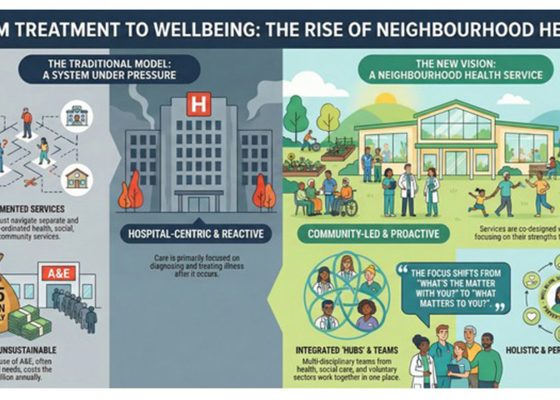
Neighbourhood health hubs are not a “nice-to-have” community initiative. They are demand-management infrastructure.
Why this is good for acute hospitals
Let me be clear.
Investing in neighbourhood health hubs is not about weakening acute hospitals. It is about protecting them.
When neighbourhood health hubs are designed properly, they:
- Intercept frailty before crisis;
- Manage multimorbidity proactively;
- Embed social prescribing and welfare support to reduce avoidable presentations;
- Integrate mental health early;
- Identify the rising-risk 2% to 4% before they become the high-cost 7%.
The impact is measurable:
- Fewer avoidable ED attendances;
- Reduced non-elective admissions;
- Shorter lengths of stay;
- Lower readmission rates;
- Improved flow across the whole system.
That is direct cost pressure relief. But there’s a deeper dividend.
Healthy life expectancy Is the only metric that matters
If we succeed only in increasing life expectancy while extending years lived in frailty, we have not succeeded.
Neighbourhood health hub models shift the focus upstream – from “What’s the matter?”, to “What matters to you?”
They embed multidisciplinary teams, not just clinicians, but debt advisers, housing navigators, community connectors, because individual health reflects social context.
And when we address context:
- Falls reduce;
- Medication crises reduce;
- Isolation reduces;
- Dependency slows.
That translates into gains in healthy life expectancy, not just survival. And healthier years mean fewer high-cost hospital years.
The false comfort of fortress thinking
I understand the instinct – protect the bed base. Protect the balance sheet. Protect the institution.
But if 46% of your resources are being consumed by 7% of the population, the real strategic risk is not partnership.
The real risk is inertia.
If your hospital meets its financial targets while the community ecosystem collapses under underinvestment, the wave will still hit you.
The platform behind us is already smouldering:
- Ageing demographics;
- Workforce shortages;
- Estate backlogs;
- Rising complexity;
- Constrained public funding.
The question is not whether demand will rise. The question is whether we build the shock absorbers now.
Related


Ceding control to gain sustainability
The hardest shift for any acute hospital health leader is this – ceding sovereignty is the prerequisite for sustainability.
Neighbourhood health hubs require:
- Shared data;
- Shared risk stratification;
- Shared governance;
- Shared accountability.
They require us to move from institutional performance to system stewardship.
But the dividend is profound:
- Reduced volatility in demand;
- Greater allocative efficiency;
- Stronger community resilience
- A workforce that feels part of a solution, not trapped in crisis response.
This is not about dismantling acute care. It is about designing the architecture that allows acute care to remain exceptional.
The opportunity in front of us
You, as acute hospital leaders, are uniquely positioned. Acute CEOs carry credibility, influence, and the ability to redirect capital conversations.
If you lead the investment in neighbourhood infrastructure now, you:
- Flatten the future demand curve;
- Protect acute capability for when it is truly needed;
- Improve healthy life expectancy across your catchment;
- Turn a looming tsunami into a managed swell.
If we wait, we will spend the next decade expanding beds, burning out staff, and wondering why the curve never bends.
The question I leave with you
In 10 years, when demand surges and the ageing wave crests, will we say we didn’t see it coming? Or will we say we used this moment to redesign the system?
The choice is not hospital versus community. The choice is reactive expansion versus preventative architecture.
Neighbourhood health hubs are not a threat to acute hospitals. They are the strategy that ensures acute hospitals survive the next 15 years.
The burning platform is doing nothing. The opportunity is building the neighbourhood.
I look forward to your reply.
Eugene
Eugene McGarrell is general manager of commissioning and planning with the Sydney North Health Network, and former CEO of Health Australia.
This article was originally published on Mr McGarrell’s LinkedIn feed. Read the original article here.