

What if the most transformative health innovation of our time wasn’t a new drug or a piece of gadgetry, but the simple, scalable technology of a connected and empowered community?
We all know the familiar picture: an overstretched health service, crowded emergency departments, long waits for treatment and a constant struggle to keep up with demand.
But while emergency departments grapple with reactive care, something remarkable is happening quietly at a neighbourhood level.
This isn’t about a new wing at the local hospital or the latest pharmaceutical breakthrough. It’s a shift in how we think about health, a move away from treating sickness and towards creating wellbeing from the ground up.
Far from being a fringe idea, this approach is gaining traction as health systems, local government, community managed organisations, and neighbourhoods work together in new ways.
Here are the five truths at the heart of this quiet but profound revolution.
Truth 1: The most potent health interventions aren’t clinical
For far too long, we’ve assumed that medicine is all about clinics, prescriptions and surgical theatres.
But the evidence tells us something different: where we live, the quality of our housing, access to work and connections to others shape our health more than most clinical interventions.
These factors, the so-called wider determinants of health, consistently prove to be powerful drivers of both health and health inequalities.
This is why community hubs, social prescribing, employment support and safe local spaces matter. They aren’t “adjuncts” to health services; they are health creation in action.
In places where local people have invested in community assets and services, the benefits extend far beyond attendance at a surgery or clinic.
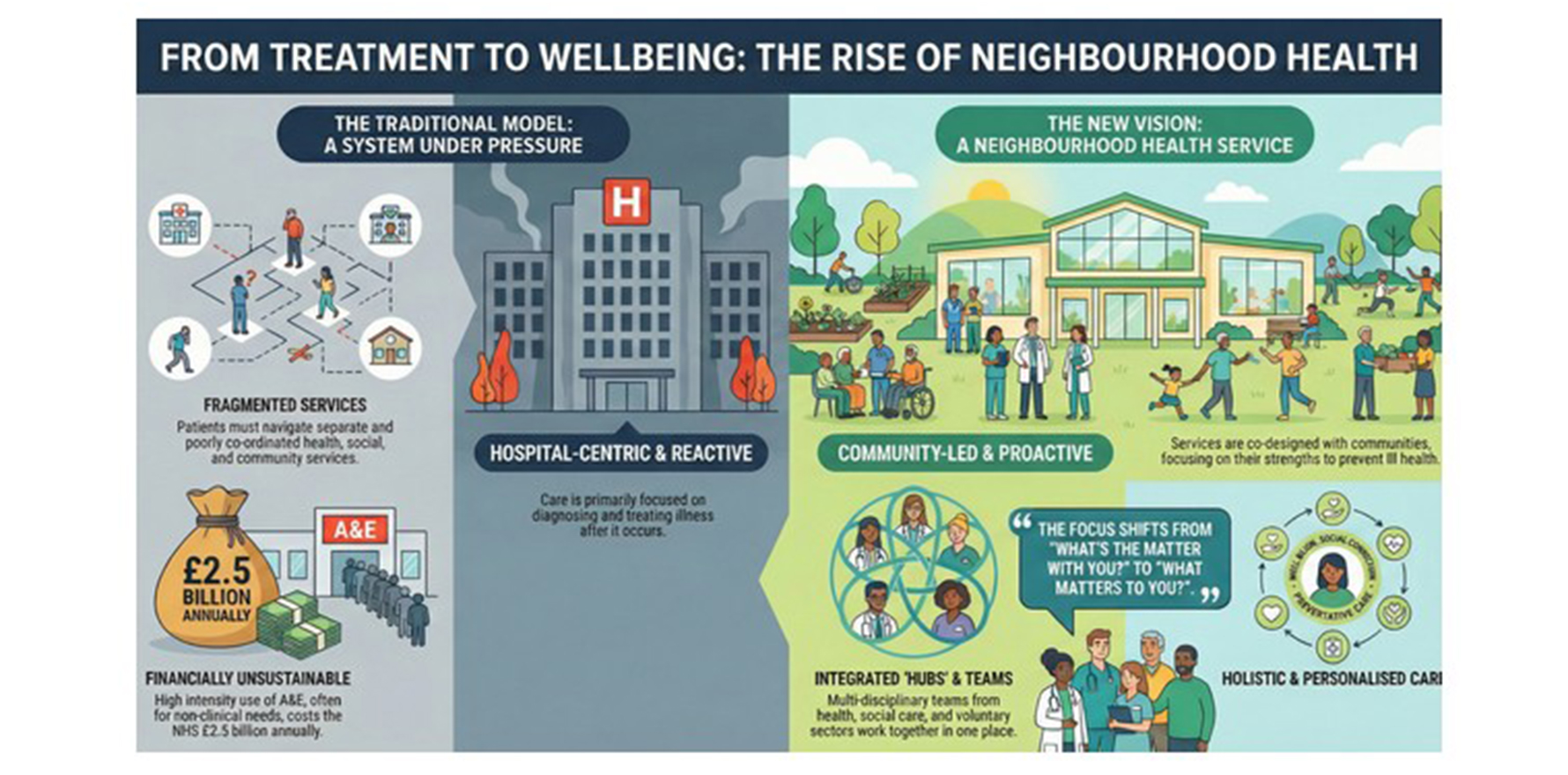
Truth 2: The question has changed from ‘what’s the matter with you?’ to ‘what matters to you?’
This might sound like semantics, but it’s foundational. Traditional healthcare starts with diagnosis. The emerging approach starts with meaning: what matters most to the person sitting across from us.
By asking this simple question and listening deeply, professionals uncover the real drivers of ill-health, loneliness, financial stress, insecure housing, and start to craft solutions with people, not to them. This is the essence of personalised, asset-based care that recognises strengths and fosters agency.
It reframes the practitioner-person relationship from passive recipient and expert to active partner and co-creator.
Truth 3: The fortress mentality is being replaced by place-based teamwork
Healthcare and public services have long operated in organisational silos, each clinging to its own mandate, budget and performance metrics. This creates a zero-sum game where success for one can create strain for another.
The new paradigm is collaboration at place level. Across the UK, neighbourhood health initiatives align health services with housing, social care, local government and community partners to tackle shared challenges together rather than in isolation.
This isn’t just co-location of services; it’s joint responsibility for population outcomes. It shifts the focus from activity and throughput to collective impact and wellbeing, and it means pooling resources, insight and agency in the interests of communities.
Truth 4: We now prioritise proactive support over reactive crisis management
The traditional model waits for crises and then responds. The new approach aims to anticipate and prevent them.
Neighbourhood-oriented roles like community health and wellbeing workers are being deployed in areas with the greatest need. These workers, often recruited from local communities, visit households regularly to help address the root causes of poor health, housing issues, social isolation, financial insecurity, before they escalate into emergency care.
The logic is simple: it costs far less to keep someone healthy than to treat them once they deteriorate.
But crucially, it’s also more humane. It’s care that starts early, stays close and takes the whole person, not just the symptom, seriously.
Related

Truth 5: Community-led change isn’t just better: it’s more sustainable
There’s a big difference between services being in a community and being led by it. Community-led health means local people set priorities, co-design solutions and shape what success looks like.
This shift in power, from top-down to bottom-up, is perhaps the most radical of all.
It requires public services to trust communities with resources, decision-making and accountability. But done well, it unlocks local insight, energy and resilience that no external expert can replicate.
It’s no surprise that neighbourhood health frameworks now explicitly reference community partnership, shared leadership and co-production as core components of sustainable health and care.
Conclusion: A more hopeful future for health
These five truths aren’t isolated ideas. Together they form a new paradigm for health that is integrated, relational, proactive and community-centred. It challenges the very assumption that healing happens only in hospitals or surgeries.
What if the most transformative health innovation of our time wasn’t a new drug or a piece of gadgetry, but the simple, scalable technology of a connected and empowered community?
The quiet revolution in healthcare isn’t just about systems reform. It’s about restoring health where it really lives, in the everyday lives of people and their neighbourhoods.
Eugene McGarrell is general manager of commissioning and planning with the Sydney North Health Network, and former CEO of Health Australia.
This article was originally published on Mr McGarrell’s LinkedIn feed. Read the original article here.